Algeria vs Morocco: comparing the navies by frigates and submarines
Editor’s assessment: This file compares the size and composition of the Algerian and Moroccan navies, ship by ship; it does not compare the two armed forces as a whole. We count only ships whose delivery has been officially announced or confirmed by the manufacturer, and we clearly separate what is in service from what is under negotiation, such as the Moroccan submarine file. We relied on manufacturer data (Naval Group, Damen, Navantia, TKMS and Fincantieri), an official report of the French National Assembly and SIPRI data. Source confidence: high for modern ships, low for older units, because neither country publishes complete official lists of its fleet. Note: size does not equal strength; the comparison declares no winner and does not predict the outcome of any confrontation between the two neighbours.
Algeria has a larger navy than Morocco when measured by tonnage and submarines: six Kilo-family submarines, a modern landing ship and five frigates and large corvettes delivered since 2010. Morocco has the largest warship of the two countries, the FREMM frigate “Mohammed VI”, and in September 2026 received a new patrol vessel from Spain, but it does not yet have a single submarine. The French Scorpène submarine deal is still under negotiation, not a signed contract.
We have previously compared Algeria and Morocco at the level of the whole military in Algeria and Morocco: a comprehensive comparison of military power 2026, and compared their air power in Morocco or Algeria: which is stronger in the air? (both in Arabic). This file is limited to the sea and goes down to ship level: how many major units are there in each category? When were they delivered? Who built them? And what has not yet been confirmed?
The comparison is particularly relevant this week, after Moroccan and European media on 16 and 17 November 2026 recirculated a passage from a French parliamentary report saying that Morocco is in the “final stage” of an agreement to buy Scorpène submarines. Below we explain what the report says verbatim, and what it does not say.
The short answer
- Submarines: only Algeria has submarines, six in total: four modern Project 636 boats and two older 877EKM boats. Morocco has no submarine in service.
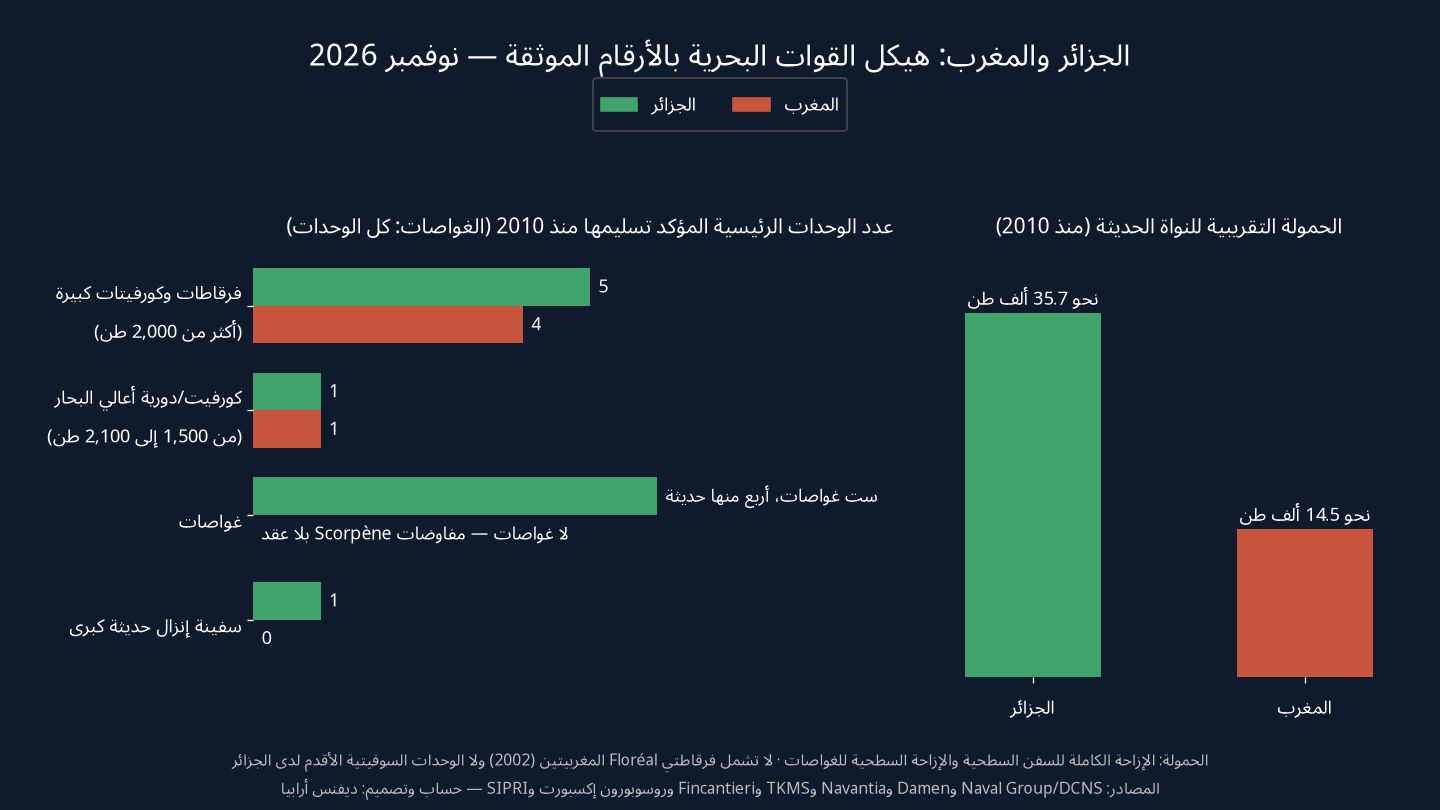
- Frigates and large corvettes delivered since 2010: five for Algeria (2 MEKO A-200AN and 3 C28A) against four for Morocco (one FREMM and 3 SIGMA). Morocco also has two older Floréal-class surveillance frigates delivered in 2002.
- Amphibious capability: Algeria has the landing and support ship “Kalaat Beni Abbes” (about 8,800 tonnes), while Morocco relies on small landing ships from the 1970s.
- Approximate tonnage of the modern core: about 35,700 tonnes for Algeria against about 14,500 tonnes for Morocco, by an editorial calculation explained below.
Scope of the comparison
Data reference date: 17 November 2026. What we count as “modern”: every major combat or amphibious ship, or offshore patrol vessel displacing more than 1,500 tonnes, delivered in 2010 or later. Submarines are all counted, with modern and older boats shown separately.
Out of scope: naval aviation, coastal missile defence, the coast guard, small patrol boats, munitions stocks, and training and readiness levels. We do not count any ship whose delivery has not been announced, or any deal whose signing has not been officially announced.
Methodology: five criteria with declared weights
We distributed 100 points across five criteria that measure the “size” and composition of a navy, not its ultimate combat capability. Each weight is justified by the criterion’s role in a navy’s ability to operate far from its coasts:
| Criterion | Weight | Why this weight? |
|---|---|---|
| Modern surface combat fleet (number and tonnage) | 35% | Frigates and large corvettes are the backbone of naval air defence, anti-ship and anti-submarine warfare |
| Submarine force | 25% | A deterrence and intelligence-gathering capability that is hard to detect and weighs on the calculations of any other party at sea |
| Fleet modernity and share of older units | 15% | A large fleet of ageing units is worth less than a smaller, modern fleet |
| Confirmed modernisation track (deliveries since 2023) | 15% | Measures what has actually arrived in recent years, not what circulates in reports |
| Amphibious and support capability | 10% | Troop transport, relief and logistic support at sea |
How to read it: we do not turn the criteria into a single number. For each criterion we determine which of the two navies is larger based on confirmed data, or describe it as “close”, and then add up the criteria weights for each side. The result is an editorial reading with declared weights, not an official ranking, and changing the weights may change the weighted reading.
Tonnage calculation: we used the declared full-load displacement for surface ships and the surfaced displacement for submarines. Only units delivered since 2010 are counted in the modern core, so the Moroccan figure excludes the two Floréal frigates, and the Algerian figure excludes the two 877EKM submarines and the older Soviet frigates.
Context: spending and imports are not read the same way
SIPRI estimated Algeria’s military expenditure in 2025 at about $25.4 billion (8.8% of GDP), against about $6.3 billion for Morocco (3.5%); details are in Military expenditure of Algeria and Morocco 2025 (in Arabic). But these are total military expenditure figures in current dollars under SIPRI’s definition; they may differ from the announced national budgets and do not show the navy’s share.
SIPRI measures arms imports with its “trend-indicator value” (TIV), a unit for the volume of actual deliveries, not a financial value. According to the March 2026 report, Morocco’s imports exceeded Algeria’s in 2021–2025 (28th in the world against 33rd), after Algeria’s imports fell 78% from their 2016–2020 peak. Morocco’s top three suppliers are the United States (60%), Israel (24%) and France (10%), while Algeria’s are Russia (39%), China (27%) and Germany (18%). SIPRI itself cautions that Algeria is often secretive about its imports and that its estimates for Algeria may be lower than the reality. Fleet size therefore cannot be inferred from spending or import figures alone.
The Algerian Navy: Russian submarines and surface ships from three continents
Algeria began modernising its navy early with Russian submarines, then expanded to Germany, Italy and China. It faces the Mediterranean alone, so its fleet is concentrated in a single theatre. Its modern core includes:
- Four improved Kilo submarines of the Project 636 type: “Messali El Hadj” and “Akram Pacha” (entered service around 2010), and “El Ouarsenis” and “El Hoggar” (officially commissioned on 9 January 2019). Each boat has a surfaced displacement of 2,350 tonnes according to Rosoboronexport. Alongside them are two older 877EKM submarines from the late 1980s. Details in How many Kilo submarines does Algeria have? (in Arabic).
- The two German MEKO A-200AN frigates “El Radii” (910) and “El Moudamir” (911), ordered in 2012 and arriving in April 2016 and May 2017, displacing about 3,700 tonnes and carrying RBS15 Mk3 anti-ship missiles and Umkhonto-IR air defence missiles.
- Three Chinese C28A corvettes (“Adhafer”, “El Fatih” and “Ezzadjer”), delivered between November 2015 and July 2016, 120 metres long and displacing about 2,880 tonnes, carrying C-802 anti-ship missiles and HQ-7 air defence missiles.
- A Chinese Type 056-family corvette, “El Moutassadi” (940), which entered service in April 2023 with a displacement of about 1,500 tonnes.
- The landing and support ship “Kalaat Beni Abbes” from Italy’s Fincantieri, delivered on 4 September 2014, 143 metres long, displacing about 8,800 tonnes and carrying more than 430 troops.
Older units: specialist sources mention three Soviet Koni-class frigates upgraded in Russia, Nanuchka-class missile corvettes and locally built “Djebel Chenoua” corvettes. Algeria does not publish detailed official lists, so sufficient reliable data is not available on how many of them are actually operational. For a naval comparison between Algeria and Egypt, see Egypt and Algeria: who has the larger navy? (in Arabic).
The Royal Moroccan Navy: a European surface fleet on two seaboards
Morocco built its modern fleet from France and the Netherlands, then Spain, and it is spread across two seaboards, the Atlantic Ocean and the Mediterranean Sea, which makes offshore patrol a large part of its missions. Its core includes:
- The FREMM frigate “Mohammed VI” (701), the largest warship of the two countries. It was delivered by DCNS (now Naval Group) in Brest on 30 January 2014; it is 142 metres long and displaces about 6,000 tonnes. It is an improved anti-submarine version and, according to the company, is fitted to carry 16 Aster air defence missiles, 8 Exocet MM40 missiles and 19 torpedoes. Details in How many FREMM frigates does Morocco have? (in Arabic).
- Three SIGMA frigates from Dutch company Damen, which some sources classify as corvettes because of their size: “Tarik Ben Ziyad” (613, 105 metres long and about 2,335 tonnes), delivered on 10 September 2011, “Sultan Moulay Ismail” (614) on 10 March 2012 and “Allal Ben Abdellah” (615) on 8 September 2012, the last two 98 metres long and about 2,075 tonnes. See SIGMA frigates in Morocco (in Arabic).
- The offshore patrol vessel “Moulay Hassan I”, based on the Avante 1800 design from Spain’s Navantia. It was launched on 27 May 2025 and its delivery certificate was signed on 17 September 2026 without an official ceremony; it is 87 metres long, displaces about 2,020 tonnes and has a crew of about 60. Its armament has not been officially disclosed.
Older units: the two French Floréal-class surveillance frigates “Mohammed V” and “Hassan II” (about 2,950 tonnes), which entered service in 2002 after a contract announced by Alstom in July 1999. Specialist sources also mention a Spanish Descubierta corvette from 1983, four Lazaga-class missile boats and three small BATRAL-class landing ships from the late 1970s, alongside French-built OPV-64 and OPV-70 patrol vessels. Morocco, too, does not publish a complete official list.
The Moroccan submarine file: what is confirmed and what is not?
The original source is French National Assembly report No. 1968, issued by the Foreign Affairs Committee on 15 October 2025 after a parliamentary delegation visited Morocco from 11 to 14 June 2025. The report says Morocco is “in the final stage of an agreement” to buy Scorpène submarines from Naval Group, to fill a “strategic gap” in underwater capability, with an industrial component including skills transfer, the participation of local players and the possibility of developing maintenance capabilities in Casablanca.
- Confirmed: advanced negotiations exist, according to an official French parliamentary document.
- Not confirmed: the number of submarines, the value of the deal and the delivery date. The report mentions none of them, and the circulating figure of “two submarines” comes from earlier press reports, not from the report itself.
- Not in existence as of 17 November 2026: any official announcement from Rabat or Paris of a signed contract. We therefore count Morocco’s submarines as zero in this comparison.
Even if the contract is signed soon, building a submarine, trialling it and training its crews takes years before it enters service. To find out who has submarines in the Arab world, see Who owns submarines in the Arab world?, and on the manufacturer see Naval Group (both in Arabic).
Technical table: major ships with confirmed delivery
| Category | Algeria | Morocco |
|---|---|---|
| Frigates and large corvettes (since 2010) | 5: two MEKO A-200AN frigates (about 3,700 tonnes) and 3 C28A corvettes (about 2,880 tonnes) | 4: one FREMM frigate (about 6,000 tonnes) and 3 SIGMA frigates (2,075–2,335 tonnes) |
| Corvette or offshore patrol vessel (1,500–2,100 tonnes, since 2010) | 1: “El Moutassadi” Type 056 (about 1,500 tonnes, 2023) | 1: “Moulay Hassan I” Avante 1800 (about 2,020 tonnes, 2026) |
| Modern submarines | 4 Kilo Project 636 (2,350 tonnes surfaced) | None — Scorpène negotiations without an announced contract |
| Older submarines | 2 Kilo Project 877EKM | None |
| Amphibious ships | 1 “Kalaat Beni Abbes” (about 8,800 tonnes, 2014) and older ships | 3 small BATRAL ships (late 1970s) — operational number not confirmed |
| Older frigates | 3 upgraded Soviet Koni — not precisely confirmed | 2 Floréal (about 2,950 tonnes, 2002) |
| Approximate tonnage of the modern core | About 35,700 tonnes | About 14,500 tonnes (about 20,400 tonnes with the Floréal frigates) |
| Origins of modern ships | Russia, Germany, China, Italy | France, the Netherlands, Spain |
Strengths and weaknesses
The Algerian Navy
Strengths: the only submarine force of the two countries; a larger number of modern surface units and greater tonnage; a modern multi-role landing and support ship; a fleet concentrated in a single sea.
Weaknesses: the variety of suppliers (Russia, Germany, China and Italy) raises maintenance and crew-training costs; reliance on a single supplier for submarines; scarce official data; a sharp decline in recorded imports since 2021 according to SIPRI, with the institute’s reservations about the accuracy of its estimates.
The Royal Moroccan Navy
Strengths: the largest warship of the two countries (FREMM) with advanced anti-submarine capability; a relatively homogeneous surface fleet from European suppliers; the most recent delivery of the two countries (September 2026); an increase in recorded imports in 2021–2025 according to SIPRI.
Weaknesses: no submarines at all so far; limited amphibious capability with small old ships; two long seaboards that spread a smaller fleet; the armament of the new patrol vessel has not been disclosed.
Assessment criterion by criterion
| Criterion | Weight | Which is larger? | Rationale |
|---|---|---|---|
| Modern surface combat fleet | 35% | Algeria (by a limited margin) | 5 large units of about 16,000 tonnes against 4 of about 12,500 tonnes, but the largest single ship is Moroccan |
| Submarine force | 25% | Algeria | 6 submarines against none; the Moroccan deal has not yet been signed |
| Fleet modernity | 15% | Close | Both countries have a modern core since 2010 and older units of unconfirmed readiness |
| Confirmed modernisation track since 2023 | 15% | Close | One unit for each country: “El Moutassadi” (2023) and “Moulay Hassan I” (2026) |
| Amphibious and support capability | 10% | Algeria | A modern ship of about 8,800 tonnes against small landing ships from the 1970s |
Weighted reading: the “size” balance tips towards Algeria in three criteria with a combined weight of 70%, while the two countries are close in two criteria weighing 30%. In other words, the Algerian Navy is larger by the measures of numbers, tonnage and submarines, not “the strongest” in all circumstances. The margin in the most heavily weighted criterion is limited, and it could change fundamentally if the Moroccan submarine contract is signed and the submarines enter service.
Conclusion and limits
If the question is “which of the two countries has the larger navy?”, the answer based on confirmed ships is Algeria, thanks to its submarines, its landing ship and a slightly larger number of modern surface units. The gap reflects two different choices: Algeria invested early in submarines and in diversifying suppliers, while Morocco built a European surface fleet for patrol on two seaboards and is still negotiating its first underwater capability.
To compare the two countries with the other Arab navies, see The largest Arab navies; on the future of Moroccan frigates, see FREMM or MILGEM: what future for the Royal Moroccan Navy’s frigates?; and on Morocco’s arms suppliers, see Where does Morocco buy its weapons? (all in Arabic).
Limits of this comparison:
- Size does not equal strength: readiness, training, munitions, naval aviation and coastal defence are not included.
- The numbers of older units are not confirmed in either country and could change the picture if counted.
- We did not count any ship or submarine under negotiation or construction without an announced delivery.
Frequently asked questions
Which is larger: the Algerian or the Moroccan navy?
The Algerian Navy is larger in terms of submarines, tonnage and amphibious capability, and by a limited margin in the number of modern frigates and corvettes. The largest single warship, however, is Moroccan: the FREMM frigate “Mohammed VI”.
Does Morocco have submarines?
No. The Royal Moroccan Navy has no submarine in service as of 17 November 2026.
Has Morocco bought French Scorpène submarines?
No contract has been announced. A French parliamentary report issued in October 2025 says Morocco is in the final stage of an agreement with Naval Group, but Rabat and Paris have not announced the signing of any contract, and the report does not mention the number of submarines or their value.
How many submarines does Algeria have?
Six submarines of the Russian Kilo family: four modern Project 636 boats and two older 877EKM boats.
What is the newest ship in the Moroccan navy?
The offshore patrol vessel “Moulay Hassan I” from Spain’s Navantia, whose delivery certificate was signed on 17 September 2026.
Does this comparison mean that one of the two countries would prevail in any confrontation?
No. Size is one indicator; actual capability depends on training, readiness, armament, intelligence and mission conditions, and the comparison does not predict the outcome of any confrontation.
Sources
- French National Assembly — Information report No. 1968 on the visit of a Foreign Affairs Committee delegation to Morocco, 15 October 2025 — assemblee-nationale.fr.
- SIPRI — Trends in International Arms Transfers, 2025, March 2026 — sipri.org; and the Military Expenditure Database 1949–2025, April 2026 — sipri.org.
- Navantia — Launch of the offshore patrol vessel for the Royal Moroccan Navy, 27 May 2025 — navantia.es; and Infodefensa — Delivery of “Moulay Hassan I”, 17 September 2026 — infodefensa.com.
- DCNS (Naval Group) — Delivery statement for the FREMM frigate “Mohammed VI”, 30 January 2014, via defenceWeb — defenceweb.co.za.
- Damen Schelde Naval Shipbuilding — Delivery of the third Moroccan SIGMA frigate, September 2012, via defenceWeb — defenceweb.co.za; and Mer et Marine — Dimensions and displacement of the frigates — meretmarine.com.
- Alstom — Contract to build two surveillance frigates for Morocco (Floréal), July 1999 — alstom.com.
- Fincantieri — Delivery of “Kalaat Beni Abbes” to the Algerian Navy, 4 September 2014 — fincantieri.com.
- Defense News — Algerian Navy commissions first MEKO A200 frigate, 26 April 2016 — defensenews.com.
- Janes (archive) — Algeria commissions two new Kilo submarines, 9 January 2019 — janes.com; and Rosoboronexport — Project 636 specifications — roe.ru.
- defenceWeb — Algeria receives third C28A corvette, 2016 — defenceweb.co.za; and defenceWeb — Delivery of a Chinese-built corvette, April 2023 — defenceweb.co.za.
Published: 19 November 2026. Data reference: manufacturer data, official documents and SIPRI up to 17 November 2026. We will update this file when the signing of the Moroccan submarine contract is officially announced or when either country takes delivery of any new major unit.