
BMP-3 or Bradley? Comparing the two infantry fighting vehicles in Arab armies
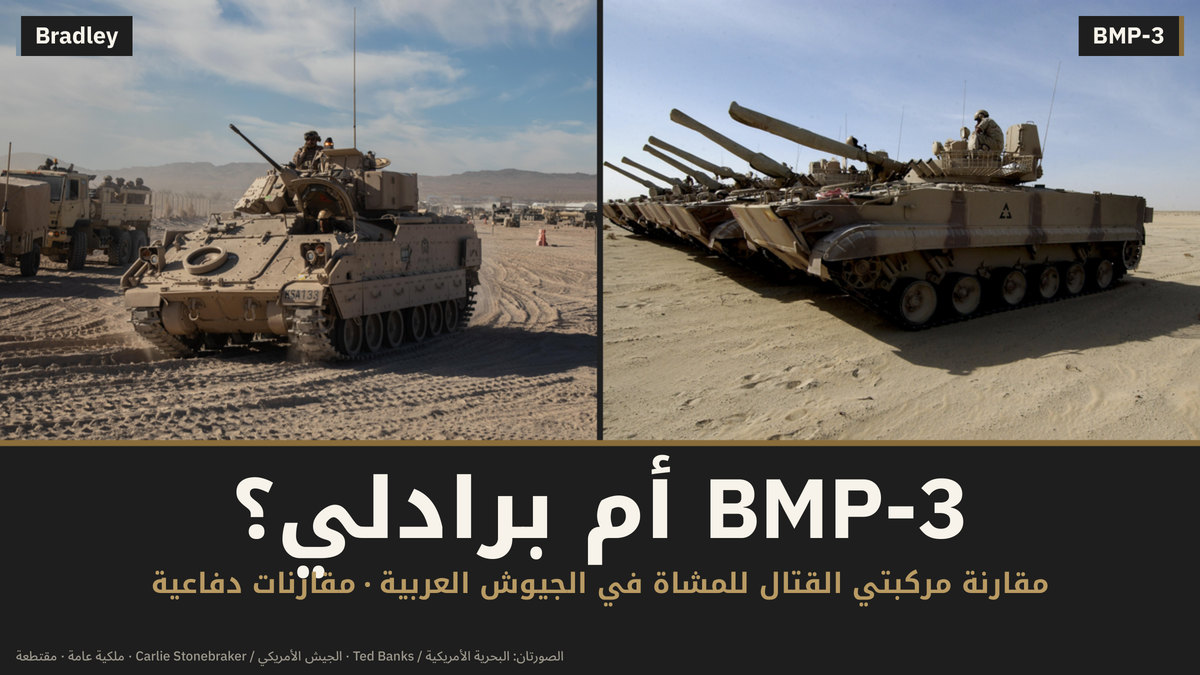
Defence comparisons | Data updated to 19 November 2026
The question “BMP-3 or Bradley?” is often framed as a contest between a Russian school and an American school. The Arab reality is more nuanced: the UAE, Kuwait and Iraq operate the BMP-3, Saudi Arabia and Lebanon operate the Bradley, and SIPRI records no Arab country operating both vehicles. This comparison draws on the SIPRI arms transfers register, the US Army’s FM 3-22.1 Bradley gunnery manual, specifications compiled by GlobalSecurity, notifications from the US Defense Security Cooperation Agency (DSCA), and statements by companies and Arab official bodies. In each section we distinguish between company specifications, independent assessment and estimate, and between order, contract and delivery. For the theoretical basis, see What is the difference between an IFV and an APC? (Arabic) and our detailed file on the Bradley M2: specifications and operators (Arabic).
Quick definition: what are the BMP-3 and the Bradley?
BMP-3: a “light tank” that carries troops
The BMP-3 was designed in the Soviet Union and is produced by Russia’s Kurganmashzavod; it entered Soviet Army service in 1990 according to GlobalSecurity. Defense Update reports that the turrets of the Emirati vehicles came from the KBP bureau in Tula. Its distinguishing feature is the turret: a low-velocity 2A70 100 mm gun that fires high-explosive shells and anti-tank guided missiles through the barrel, together with a 2A72 30 mm automatic cannon and a 7.62 mm PKT machine gun, plus two bow machine guns in the hull. GlobalSecurity describes it as “a light tank that can carry an infantry squad” and as fully amphibious, moving in water with two water jets.
Bradley M2: the US Army’s vehicle since 1983
The Bradley is a US family comprising the M2 infantry fighting vehicle and the M3 cavalry (reconnaissance) vehicle, both of which entered service in 1983 according to manual FM 3-22.1. It is produced today by BAE Systems. Its main armament is an M242 Bushmaster 25 mm automatic cannon, an M240C 7.62 mm machine gun and a twin launcher for TOW anti-tank missiles. The manual explains that the A2 variant added 100 horsepower to the power pack, additional protection and an internal spall liner. The ODS variant then added, after the lessons of the 1991 Gulf War, an eye-safe laser rangefinder and a tactical navigation system combining a GPS receiver and a digital compass. The latest variant is the M2A4, which a battalion of the US 3rd Infantry Division fielded in April 2022 according to Armada International.
Technical comparison table: what can really be compared
Methodological note: the BMP-3 figures are taken from the GlobalSecurity specifications table for the baseline variant, and the Bradley figures from the official table in the US Army manual for the M2A2 ODS. They are therefore specifications from two different sources, not test results under identical conditions. Arab armies do not publish the specifications of their current versions after upgrades and add-on armour.
| Item | BMP-3 | Bradley M2 | Nature of source |
|---|---|---|---|
| Manufacturer | Kurganmashzavod (Russia); turret from KBP in Tula according to Defense Update | BAE Systems (United States) | Official body/company and specialist coverage [4] [5] [16] |
| Entry into service | 1990 in the Soviet Army | 1983 (M2 and M3 in the US Army) | US Army manual and GlobalSecurity table [4] [2] |
| Reference variant for figures | Baseline BMP-3 | M2A2 ODS (US Army table) | Methodological choice [3] [2] |
| Crew and troops carried | 3 + 7 troops | 3 + 7 troops (M2A2 ODS) | US Army manual and GlobalSecurity table [3] [2] |
| Combat weight | 18.7 tonnes | M2A2: 63,982 lb (about 29.0 tonnes); M2A2 ODS: 66,401 lb (about 30.1 tonnes) | US Army manual and GlobalSecurity table [3] [2] |
| Engine | 500 hp diesel; UTD-32 engine of 660 hp in the BMP-3M | Cummins VTA-903T of 600 hp; 675 hp in the M2A4 | US Army manual and GlobalSecurity table [3] [5] [2] [15] |
| Maximum road speed | 70 km/h | 61 km/h (M2A2 ODS) | US Army manual and GlobalSecurity table [3] [2] |
| Range | 600 km | 400 km (M2A2 ODS) | US Army manual and GlobalSecurity table [3] [2] |
| Water crossing | Amphibious with two water jets; 10 km/h in water | The manual gives 8 km/h in water for the ODS without detailing crossing conditions, and no value for the M2A3 | US Army manual and GlobalSecurity table [3] [4] [2] |
| Main armament | 2A70 100 mm gun, 2A72 30 mm automatic cannon and 7.62 mm PKT machine gun in one turret, plus two bow machine guns | M242 Bushmaster 25 mm automatic cannon and M240C 7.62 mm machine gun | US Army manual and GlobalSecurity table [3] [2] |
| Anti-tank missile | Fired through the 100 mm gun barrel with laser-beam guidance: 3 ready and 5 stowed | TOW from a twin launcher: 2 ready and 5 stowed | US Army manual and GlobalSecurity table [3] [2] |
| Sighting and fire control | 1K13-2 in the baseline variant; in the Emirati BMP-3M programme a BZS1 sight with a thermal camera and laser from Sagem according to Defense Update | In the ODS: eye-safe laser rangefinder and GPS navigation system with digital compass | Official body/company and specialist coverage [3] [5] [2] |
| Latest variant cited | BMP-3M | M2A4 (fielded by a US battalion in April 2022) | Official body/company and specialist coverage [4] [5] [15] |
| Upgrades in Arab armies | UAE: 2011 contract worth $74 million to upgrade 135 vehicles to BMP-3M, and a 2025 memorandum of understanding with FNSS covering about 615 vehicles | Saudi Arabia: two DSCA spare-parts notifications in 2018 ($300 million) and 2024 ($500 million) for a fleet that includes the Bradley and other vehicles | Official body/company and specialist coverage [5] [6] [7] [13] [14] |
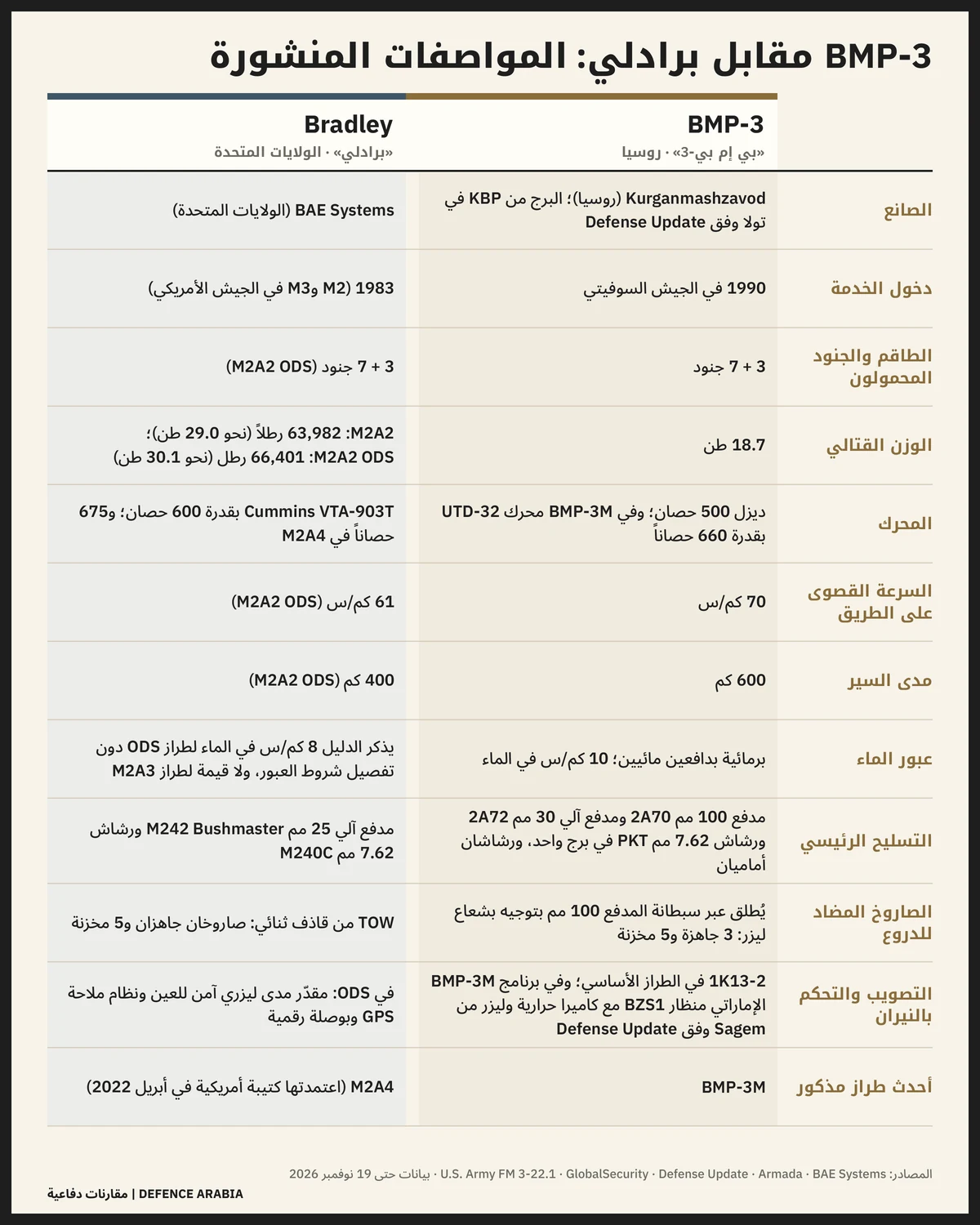
Note: the Bradley’s combat weight varies by variant and add-on armour. In the US manual’s table, the M2A2 weighs about 63,982 lb, or about 29.0 tonnes, and the M2A2 ODS about 66,401 lb, or about 30.1 tonnes. We chose the ODS for the numerical comparison because it is the variant for which the manual gives all specifications in a single column.
Armament and sensors: two different philosophies
The clearest difference between the two vehicles lies in the turret. The BMP-3 carries two main guns: a 100 mm gun for fortified targets and buildings, and a 30 mm automatic cannon for light vehicles. The 100 mm gun fires laser-beam-guided missiles, and the vehicle carries 3 ready and 5 stowed missiles according to the GlobalSecurity table. The Bradley relies on a single 25 mm automatic cannon and, against heavy armour, on TOW missiles from a twin launcher, with 2 ready and 5 stowed missiles in the M2A2 ODS according to the manual.
On sighting, GlobalSecurity states that the baseline BMP-3 uses the 1K13-2 fire-control system and mentions an optional thermal sight named Namut. In the UAE’s 2011 upgrade programme, Defense Update reported that the upgrade to the BMP-3M standard was expected to include a BZS1 gunner’s sight with a thermal camera and laser rangefinder from France’s Sagem and a new commander’s sight. This information comes from press coverage of an announced contract, and we found no official source specifying how many vehicles were actually upgraded. For the Bradley ODS, the US manual states that it has an eye-safe laser rangefinder within the integrated sight unit, and a GPS navigation system and digital compass that display the vehicle’s position and turret direction to the commander and driver.
We do not give detailed penetration figures or engagement ranges here, as these vary with ammunition and firing conditions. We found no independent source comparing the two vehicles in a single test.
Mobility and protection: weight versus amphibiousness
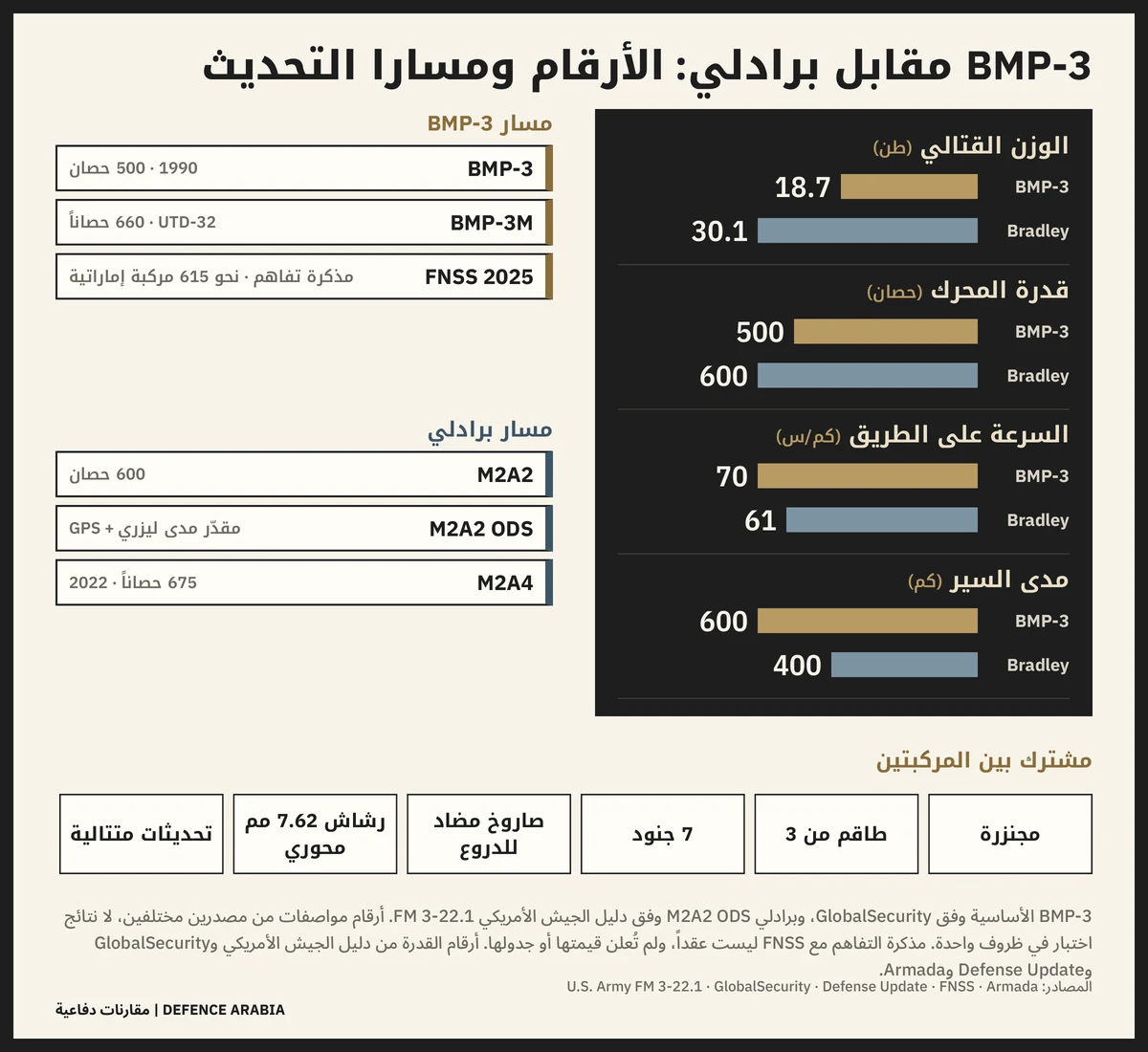
The baseline BMP-3 engine produces 500 hp for a combat weight of 18.7 tonnes; its road speed is 70 km/h, its range 600 km and its speed in water 10 km/h according to GlobalSecurity. The BMP-3M raises power to 660 hp with the UTD-32 engine according to Defense Update. The Bradley M2A2 ODS’s Cummins VTA-903T engine produces 600 hp for a weight of about 30.1 tonnes; its road speed is 61 km/h and its range 400 km according to the US manual. The M2A4 raised power to 675 hp with a new transmission to accommodate the extra weight and power demands, according to Armada International.
The lighter weight gives the BMP-3 amphibious capability and greater ease of transport. On the other hand, independent assessments criticise it for crew protection and the difficulty of exiting the vehicle. GlobalSecurity describes the crew compartment design as poor and making exit difficult, and notes that the upgraded version receives better assessments. Defense Update reports that 400 Emirati vehicles were fitted with reactive armour in 2000. For the Bradley, its manual states that the A2 variant added 30 mm of protection, the ability to fit armour tiles and a spall liner, but this came at the cost of weight. No official body publishes certified protection levels for the current Arab versions of either vehicle, so we do not compare protection with a number.
Missions: when does each vehicle have the edge?
In terms of class, the two vehicles perform the same mission: carrying a mechanised infantry squad and supporting it with fire in combat. The difference lies in the type of fire support. The BMP-3’s 100 mm gun gives the squad heavy firepower against fortifications without waiting for a tank or artillery, and its amphibious capability is useful where water obstacles abound. The Bradley suits a force structure integrated with Abrams tanks and other US systems, relies on the TOW missile against heavy armour, and benefits from a US upgrade path that is still producing new versions. This is a general editorial assessment based on published specifications, not an operational recommendation.
Arab users: what has actually been delivered?
| Country | BMP-3 | Bradley | Source and confirmation status |
|---|---|---|---|
| UAE | 652 vehicles delivered by Russia between 1992 and 2000 (250 for Abu Dhabi and 402 for Dubai) | Does not operate it | SIPRI; Defense Update and UPI cite about 600, and FNSS about 615 in 2025; the discrepancy is unexplained [1] [5] [6] [7] |
| Kuwait | 245 vehicles: 142 (1995–1997), 70 BMP-3M (2010–2011) and 33 (2015) | Does not operate it | SIPRI; TASS: last batch shipped on 30 September 2015, number not stated [1] [10] |
| Iraq | An estimated 31 vehicles, ordered in 2015 and delivered 2018–2019 | Does not operate it | SIPRI marks the number as uncertain; other circulating figures have not been verified by us [1] |
| Saudi Arabia | Does not operate it | 400 M2 vehicles delivered by the United States between 1990 and 1993 (two orders of 200 each) | SIPRI; DSCA notifications in 2018 and 2024 for Bradley spare parts; current sub-variant not published [1] [13] [14] [17] |
| Lebanon | Does not operate it | 32 used M2A2 vehicles delivered as US aid in 2017–2018 | SIPRI, the US Embassy (first 8 in August 2017) and the Lebanese Army (third batch on 17 June 2018) [1] [11] [12] |
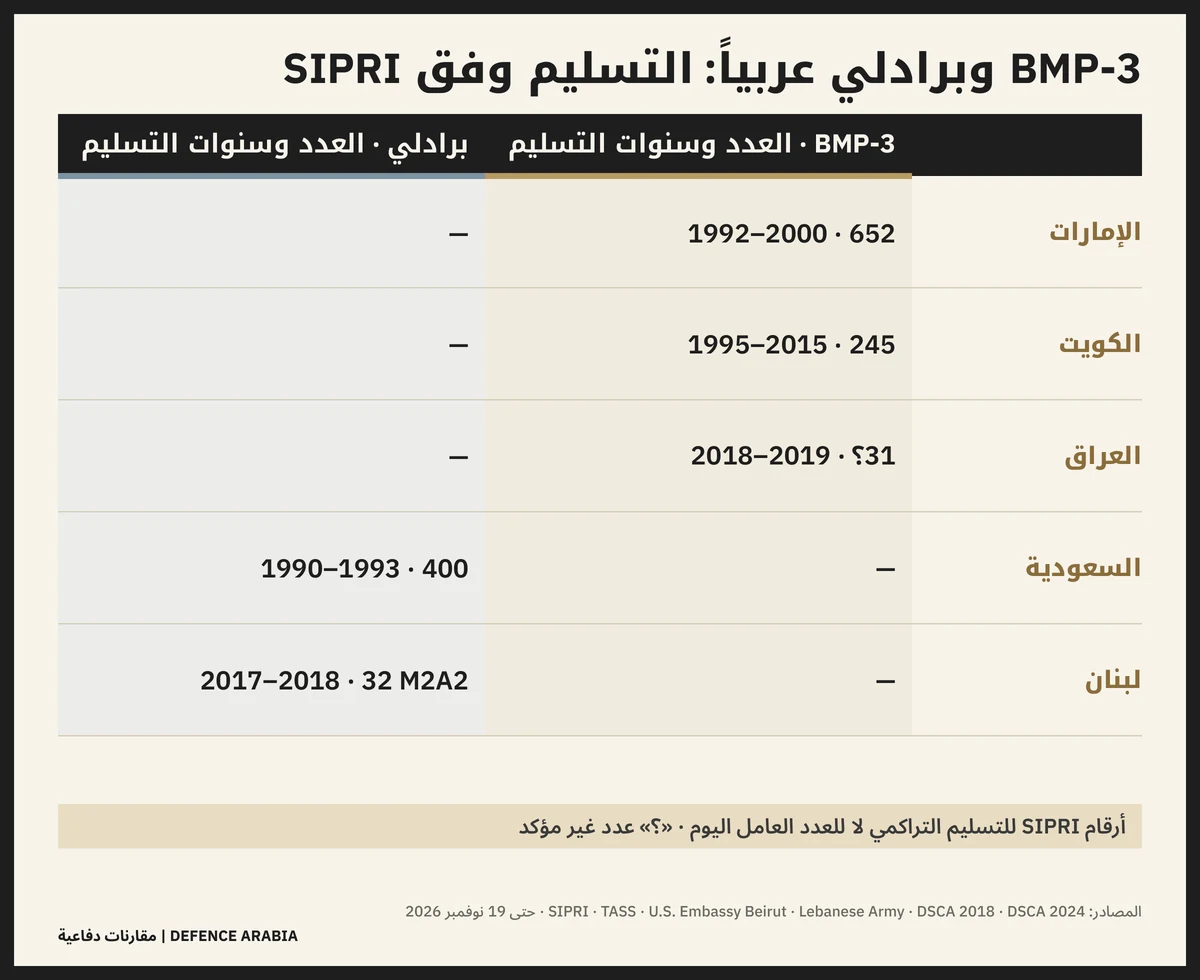
UAE: it is the largest foreign user of the BMP-3 according to Defense Update and UPI. SIPRI records two deals: 250 vehicles for Abu Dhabi ordered in 1992 and delivered between 1992 and 1994, and 402 vehicles for Dubai delivered between 1994 and 2000, for a total of 652 vehicles. SIPRI marks the year of the second order and the number of vehicles ordered as uncertain. Defense Update and UPI state that about 600 vehicles were delivered between 1992 and 2000, and FNSS in 2025 refers to “about 615” vehicles in the fleet. The sources do not explain this discrepancy; it most likely results from differences in what is counted, such as specialised vehicles or vehicles withdrawn from service — this is our assessment, not published information. GlobalSecurity states that in 1992 the BMP-3 won a UAE tender in which it competed against the Bradley and the British Warrior. For more on the UAE military, see How strong is the UAE military? (Arabic).
Kuwait: SIPRI records three deals with Russia: 142 vehicles ordered in 1994 and delivered between 1995 and 1997 (with the number marked as uncertain), then 70 BMP-3M vehicles ordered in 2009 and delivered in 2010 and 2011, then 33 vehicles ordered in 2014 and delivered in 2015. Albert Bakov of the manufacturer Tractor Plants group confirmed to TASS on 30 September 2015 that the last batch had been shipped to Kuwait, without stating the number, and that Kuwait’s first purchase was in 1994. SIPRI records no Bradley vehicles for Kuwait. Details of the Kuwaiti numbers are in How many BMP-3s does Kuwait have? (Arabic) and How strong is the Kuwaiti military? (Arabic).
Iraq: SIPRI records an order in 2015 and delivery between 2018 and 2019 of 31 vehicles, marking the number as uncertain. Other sources circulate much larger figures that we have not verified, so we consider Iraq a confirmed user of the type with an unsettled number.
Saudi Arabia: SIPRI records two US orders, each for 200 M-2 Bradley vehicles, in 1989 and 1990, delivered between 1990 and 1993, i.e. 400 vehicles. SIPRI does not specify the sub-variant, and Army Recognition’s 2018 coverage describes them as about 400 M2A2 vehicles. DSCA notifications confirm continued support: in March 2018 Congress was notified of a $300 million spare-parts case including M2 Bradley vehicles, and in November 2024 another notification worth $500 million was published for spare parts for the Royal Saudi Land Forces fleet, including the Bradley. These values cover other fleets, so they should not be counted as a cost for the Bradley alone. See our analysis Are Bradleys a long-term logistic burden on the Saudi army? (Arabic) and The Saudi army 2026 (Arabic).
Lebanon: in August 2017 the US Embassy in Beirut announced the delivery of the first 8 M2A2 Bradley vehicles at the port of Beirut, out of 32 vehicles, describing the contribution as an investment of more than $100 million. The Lebanese Army announced receipt of the third batch, of 8 vehicles, on 17 June 2018. SIPRI records 32 used M-2A2 vehicles provided as aid and delivered in 2017 and 2018.
The Turkish link: the FNSS memorandum to upgrade the UAE’s BMP-3s
On 20 February 2025, during IDEX in Abu Dhabi, AL TAIF, part of the EDGE Group, signed a memorandum of understanding with Turkey’s FNSS to upgrade infantry fighting vehicles of the UAE Armed Forces, according to statements by both companies and the Emirates News Agency (WAM). The FNSS statement puts the fleet at about 615 BMP-3 vehicles and says the upgrade targets mechanical, electrical and electronic systems, while the EDGE statement refers to “a specific fleet” without naming the type or number. Importantly, this is a memorandum of understanding, not a contract, and no value or timetable has been announced. Reports in some coverage, including Cyprus-based Defence ReDefined, of replacing the turret with FNSS’s Teber turret or changing the engine and transmission are possibilities under study according to that coverage, not announced decisions. For context, see FNSS company profile (Arabic) and The share of Turkish weapons in the UAE military (Arabic).
Strengths and limitations (editorial assessment based on the sources)
- Strengths: two guns, 100 mm and 30 mm, in one turret with missiles fired through the barrel. The vehicle is more than 11 tonnes lighter than the Bradley M2A2 ODS, amphibious according to its specifications, and has a published range of 600 km.
- Limitations: crew protection and difficult exit are criticised in independent assessments. Its future upgrade in the UAE is still a memorandum of understanding with FNSS rather than a contract, and the original supplier is Russian.
- Strengths: continuous US spare-parts support, as shown by the 2018 and 2024 notifications for Saudi Arabia, and an upgrade path that is still producing new versions. In September 2024 BAE Systems announced a contract to produce more than 200 A4 vehicles for the US Army.
- Limitations: greater weight of about 30.1 tonnes in the M2A2 ODS, a shorter range in the manual’s table (400 km) and a smaller-calibre main gun. The current sub-variant of the Saudi vehicles is also unpublished.
Which suits which mission? A balanced assessment
There is no outright “better” vehicle. If the criterion is direct squad firepower, amphibious capability and light weight, the BMP-3 leads on its specifications. If the criterion is integration with a US system, continued support and an upgrade path, the Bradley leads. Actual protection cannot be judged from open sources in the absence of certified figures for the Arab versions. The UAE, Kuwait and Iraq chose the BMP-3, while Saudi Arabia and Lebanon chose the Bradley — choices linked to supply, training and support relationships as much as to specifications. The decisive criterion is the mission, protection, logistic support and upgrade path, not the vehicle’s name.
What has not been published?
- Certified ballistic protection levels for each Arab version after add-on armour and upgrades
- The number actually in service today in each Arab army: SIPRI figures are cumulative deliveries, not current inventory
- The sub-variant and current equipment of Saudi Bradley vehicles
- The number of Emirati vehicles actually upgraded to BMP-3M under the 2011 contract
- A contract, value or timetable for the UAE BMP-3 upgrade programme with FNSS after the memorandum of understanding
- The confirmed number of Iraqi BMP-3 vehicles
- Unit price: contract and aid values include support, training, munitions and spare parts
Frequently asked questions
What is the difference between the BMP-3 and the Bradley in brief?
Both are tracked infantry fighting vehicles carrying a crew of 3 and 7 troops. Russia’s BMP-3 combines a 100 mm gun that fires shells and guided missiles and a 30 mm automatic cannon in a single turret; it weighs 18.7 tonnes and is amphibious according to its specifications. The US Bradley M2 relies on a 25 mm automatic cannon and TOW missiles, and the M2A2 ODS weighs about 30.1 tonnes according to the US Army manual.
Which is better: the BMP-3 or the Bradley?
This cannot be determined from open sources. The BMP-3 leads in direct firepower, light weight and amphibious capability according to its specifications, while the Bradley leads in integration with the US system, continued support and an upgrade path up to the M2A4. There are no certified protection figures or independent tests comparing them under identical conditions.
Which Arab armies use the BMP-3 and which use the Bradley?
SIPRI records deliveries of 652 BMP-3s to the UAE, 245 to Kuwait and about 31 to Iraq (an uncertain number), and 400 Bradleys to Saudi Arabia and 32 M2A2s to Lebanon. These are cumulative delivery figures, not numbers in service today, and SIPRI records no Arab country operating both vehicles.
Is the UAE upgrading its BMP-3s with Turkey?
AL TAIF, part of the EDGE Group, signed a memorandum of understanding with Turkey’s FNSS at IDEX on 20 February 2025, and the FNSS statement says it covers about 615 BMP-3 vehicles. It is a memorandum of understanding, not a contract, and no value or timetable has been announced. This was preceded by a 2011 contract with Russia worth $74 million to upgrade 135 vehicles to the BMP-3M standard, according to Defense Update and UPI.
How much does a BMP-3 or a Bradley cost?
No official unit price has been published for the Arab deals. The value of upgrading 135 Emirati vehicles ($74 million) relates to the upgrade, not purchase, and the US Embassy described its Bradley contribution to Lebanon as exceeding $100 million without detail. The two DSCA notifications for Saudi Arabia ($300 million in 2018 and $500 million in 2024) concern spare parts for several fleets, so a vehicle price cannot be derived from them.
Sources
1. SIPRI Arms Transfers Database — Trade Register: BMP-3 and M-2 Bradley transfers, 1950–2025 (generated 19 Nov 2026) (2026-11-19 (data generated)): Link
2. U.S. Army — FM 3-22.1 Bradley Gunnery (Table 1-1, BFV technical data) — copy hosted on GlobalSecurity (2003-11-28): Link
3. GlobalSecurity.org — BMP-3 – Specifications (accessed 2026-11-19): Link
4. GlobalSecurity.org — BMP-3 Fighting Vehicle (page modified 2023-03-27): Link
5. Defense Update — UAE To Upgrade 135 BMP-3 Armored Infantry Vehicles (2011-02-25): Link
6. UPI — Emirates, Russia sign modernization deal (2011-02-28): Link
7. FNSS — EDGE and FNSS Enter Partnership to Modernise UAE Armed Forces' BMP-3 Infantry Fighting Vehicles (2025-02-20): Link
8. EDGE Group — EDGE and FNSS Partner to Modernise UAE Armed Forces' Infantry Fighting Vehicles (2025-02-20): Link
9. WAM (Emirates News Agency) — EDGE, FNSS partner to modernise Armed Forces' infantry fighting vehicles (2025-02-20): Link
10. TASS — Russia completes BMP-3 infantry fighting vehicles delivery to Kuwait — manufacturer (2015-09-30): Link
11. U.S. Embassy Beirut (archive) — US Delivers Bradley Fighting Vehicles to the Lebanese Army (2017-08): Link
12. Lebanese Army (official Lebanese Army website) — The Handover Of The Third Batch Of Bradley Armored Vehicles (2018-06-17): Link
13. Federal Register / DSCA — Arms Sales Notification — Saudi Arabia, RSLF Ordnance Corps FMSO II (Transmittal 17-60) (2018-04-02 (notified 2018-03-22)): Link
14. Federal Register / DSCA — Arms Sales Notification — Saudi Arabia FMSO II (Transmittal 21-69) (2024-11-06): Link
15. Armada International — US Army Fields M2A4 Upgraded Bradley IFV (2022-04-28): Link
16. BAE Systems (PR Newswire) — BAE Systems awarded $440 million to produce additional Bradley Fighting Vehicles for the U.S. Army (2024-09-12): Link
17. Army Recognition — US will provide spare parts for Saudi Arabia M1A2 tanks and Bradley IFVs (2018-03): Link
18. Defence ReDefined (Cyprus) — UAE | Assignment to the Turkish FNSS of the Upgrade of 615 BMP-3 IFVs (2025-02): Link