Egyptian drones: Nut, 30 June, 6th October, Ahmose and Jabbar – specifications and status
Egypt’s indigenous drones are unmanned aircraft designed or assembled in Egypt by the Arab Organization for Industrialization (AOI), the Ministry of Military Production and local companies. The most prominent are the Nut, produced under Chinese licence and in service; the 30 June (EJune-30 SW) medium-altitude long-endurance drone; and the 6th October and Ahmose, both shown at EDEX 2023 with a stated endurance of up to 30 hours. At EDEX 2025 the company Tornex unveiled the Jabbar family of one-way attack drones. The armed forces do not publish the number of drones in service.
Quick table: Egypt’s main drones
| Drone | Developer | Class | First appearance | Stated status |
|---|---|---|---|---|
| Nut | Arab Organization for Industrialization and Military Technical College | Medium-altitude medium-endurance | EDEX 2021 (upgraded version) | Original version in service |
| 30 June (EJune-30 SW) | Industrial Complex for Engineering and Robotics (ICER) | Medium-altitude long-endurance (MALE) | EDEX 2021 | Displayed in 2021 and 2023 |
| 6th October | Egyptian development | Multi-role MALE | EDEX 2023 | Completed ground tests; first flight was planned for 2024 according to EDR |
| Ahmose | Egyptian development | Single-engine MALE | EDEX 2023 | Displayed |
| Thebes 30 | Egyptian development | — | EDEX 2021 (brochure only) | Under development according to Defense News |
| Jabbar 150/200/250 | Tornex | One-way attack | EDEX 2025 | First display |
| Hamza 1 | Arab Organization for Industrialization with HAVELSAN | Vertical take-off reconnaissance | EDEX 2025 | First display |
The Nut drone: the sky goddess of Egyptian mythology
The Nut takes its name from the sky goddess of ancient Egypt. It is a medium-altitude medium-endurance drone whose upgraded version was displayed on the Arab Organization for Industrialization stand at EDEX 2021. According to EDR magazine, the original version is in service with the Egyptian forces; it is produced locally under licence from China, which calls it the ASN-209, and the Military Technical College worked with the AOI on its development.
| Wingspan | 7.5 m |
|---|---|
| Take-off weight | 340 kg |
| Payload | 50 kg |
| Maximum speed | 180 km/h (cruise 120–140 km/h) |
| Endurance | 10 hours |
| Cruise altitude | 5,000 m |
| Data link range | 200 km line of sight |
A technical officer told EDR that the new version aims to raise the payload to 65 kg and endurance to 14 hours by reducing empty weight, while adding a satellite communications link. No official announcement has yet been made of this version entering service.
30 June (EJune-30 SW)
It first appeared at EDEX 2021 and is named after the events of 30 June 2013. It is a twin-engine drone produced by the Industrial Complex for Engineering and Robotics (ICER), and its design features a horizontal tail the size of a second wing fitted with raised tips. EDR says its aerodynamic design is largely based on the Emirati Yabhon Flash-20 drone.
| Length | 8.9 m |
|---|---|
| Wingspan | 12 m |
| Maximum take-off weight | 1,400 kg |
| Payload | 270 kg |
| Maximum speed | 260 km/h |
| Endurance | 24 hours according to 2021 data, and 14–16 hours according to 2023 data depending on configuration |
| Altitude | Up to 7,000 m (about 23,000 ft) |
Note that the endurance figure differs between the company’s data at the 2021 and 2023 editions, so we present both figures as published.
6th October and Ahmose: the second generation
At EDEX 2023 two new medium-altitude long-endurance drones were displayed together with their ground control station:
| Item | 6th October | Ahmose |
|---|---|---|
| Engines | Two engines (more powerful than the EJune-30) | One 145 hp piston engine |
| Wingspan | 18 m | 17.23 m |
| Stated endurance | Up to 30 hours | 30 hours |
| Hardpoints | 13 | 7 |
| Maximum speed | 260 km/h | 250 km/h |
| Service ceiling | 18,000 ft | 22,000 ft |
| Line-of-sight link range | 240 km | More than 100 km |
According to EDR, both drones can carry electro-optical sensors and a synthetic aperture radar, with no information on their armament, and the first flight of the 6th October was planned for 2024. We found no subsequent official announcement confirming the flight or entry into service.
EDEX 2025: one-way attack drones
At EDEX 2025 the Egyptian company Tornex unveiled the Jabbar family, according to DefenceWeb:
- Jabbar 150: 150 kg take-off weight, piston engine, 10-hour endurance and a camera for target selection.
- Jabbar 200: 200 kg weight, 14-hour endurance, 200 km/h speed and a 50 kg payload; it resembles the Iranian Shahed-136 in shape.
- Jabbar 250: small jet engine, 576 km/h speed, maximum range of 1,500 km and a 50 kg payload.
- Voltex-5 and Voltex-10: an electric loitering munition and a small fixed-wing drone with a 400 km range.
The Arab Organization for Industrialization also displayed the Hamza 1 reconnaissance drone developed with Turkey’s HAVELSAN, and Nayzak munitions for arming drones. To compare the Jabbar 200 with the Iranian drone: The Shahed-136 drone (Arabic).
Imported drones in service
Egypt also relies on imported drones, most notably China’s Wing Loong. For the stated numbers: How many Wing Loong II drones does Egypt have? (Arabic); on interest in Turkish drones: Why is Egypt turning to the Bayraktar Akinci and TB2? (Arabic); and on claims of a Chinese deal: The WJ-700 drone and claims of an Egyptian deal (Arabic).
Frequently asked questions
What was the first Egyptian-made drone?
One of the oldest is the Nut, produced under Chinese licence (ASN-209) by the Arab Organization for Industrialization, while the first Egyptian MALE drone to be displayed was the 30 June at EDEX 2021.
Is the 6th October drone in service?
There had been no official announcement to that effect at the time of writing; it completed ground tests in late 2023.
How long can the Ahmose drone fly?
30 hours, according to company data announced at EDEX 2023.
How many drones does Egypt have?
Egypt does not publish official numbers, and EDR notes how difficult it is to obtain these figures.
What is Egypt’s Jabbar drone?
A family of one-way attack drones from the Egyptian company Tornex, first displayed at EDEX 2025 in three models (150, 200 and 250 kg), the largest of which has a jet engine and a stated maximum range of 1,500 km; no orders for them have been announced so far.
Who makes drones in Egypt?
The main declared players are the Arab Organization for Industrialization, the Industrial Complex for Engineering and Robotics (ICER) and private companies such as Tornex, in cooperation with the Military Technical College and foreign partners such as Turkey’s HAVELSAN.
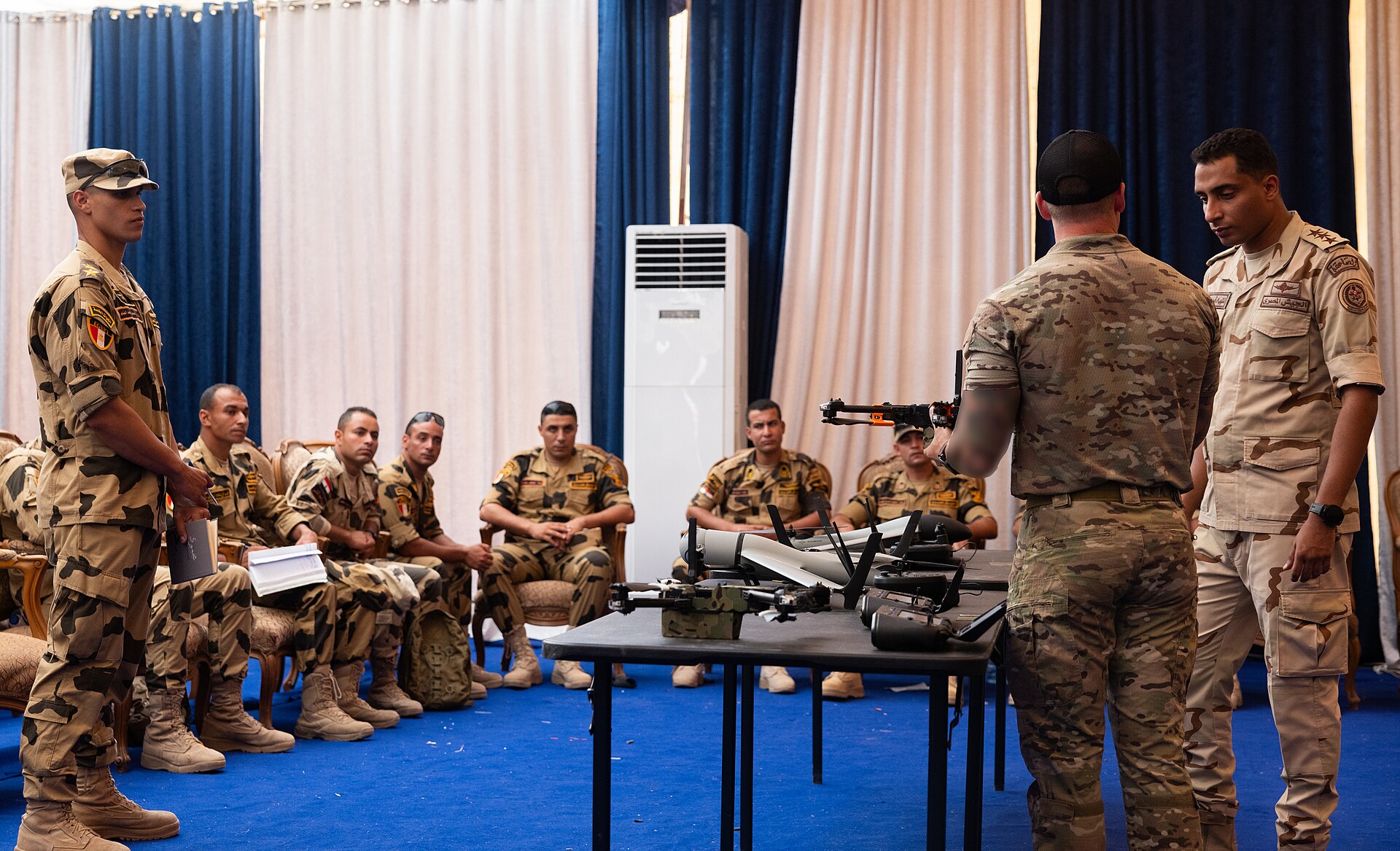
Main image: a US Air Force airman explains the capabilities of a small drone to Egyptian special forces personnel during Bright Star 2025 (illustrative photo). Source: Staff Sgt. Christopher Stolze / US Air Force via Wikimedia Commons – public domain.
Sources
- EDR Magazine – Egyptian-made drones at EDEX 2021
- EDR Magazine – The 6th October and Ahmose drones at EDEX 2023
- Defense News – Egypt unveils locally made drones at EDEX 2021
- DefenceWeb – New drones and rocket launchers at EDEX 2025
- State Information Service – Armed forces unveil the locally made Nut drone