
What are improvised explosive devices (IEDs)? And how do armies counter them
The short answer: an improvised explosive device (IED) is an unconventional explosive weapon made outside regular military production lines. NATO defines it as a type of unconventional explosive weapon that can take any form and be activated in a variety of ways, targeting soldiers and civilians alike. The glossary of Turkey’s Presidency of Defence Industries (SSB) defines it as a handmade bomb used mostly by non-state actors. (This article covers only the definition, the risks and counter-measures, and contains no technical details on manufacture.)
Why are IEDs such a difficult threat?
NATO explains that these devices can be adapted to almost any environment, on the battlefield or in the middle of a crowded city, which makes them hard to detect and stop. The Alliance considers that they play an increasingly important role in contemporary conflicts and that it must be prepared to counter them in any land or maritime operation involving asymmetric threats. See Asymmetric warfare (Arabic).
How do armies counter IEDs? (NATO’s plan)
In 2010 NATO drew up an action plan to counter improvised explosive devices (C-IED) based on three pillars, and adopted a revised version in October 2013:
| Pillar | Content (according to NATO) |
|---|---|
| Defeat the Device | Detecting and neutralising devices, exploiting them as a source of information, and developing technologies to protect soldiers and civilians |
| Attack the Network | Identifying and disrupting the networks that plant and finance devices before an attack, relying on intelligence and information-sharing with law enforcement, border and customs agencies |
| Prepare the Force | Training forces before and during deployment to operate in an IED threat environment |
NATO adds that neutralisation is the most visible part of the effort, but it is only truly effective when preceded by efforts to disrupt the networks.
Means of detection and protection
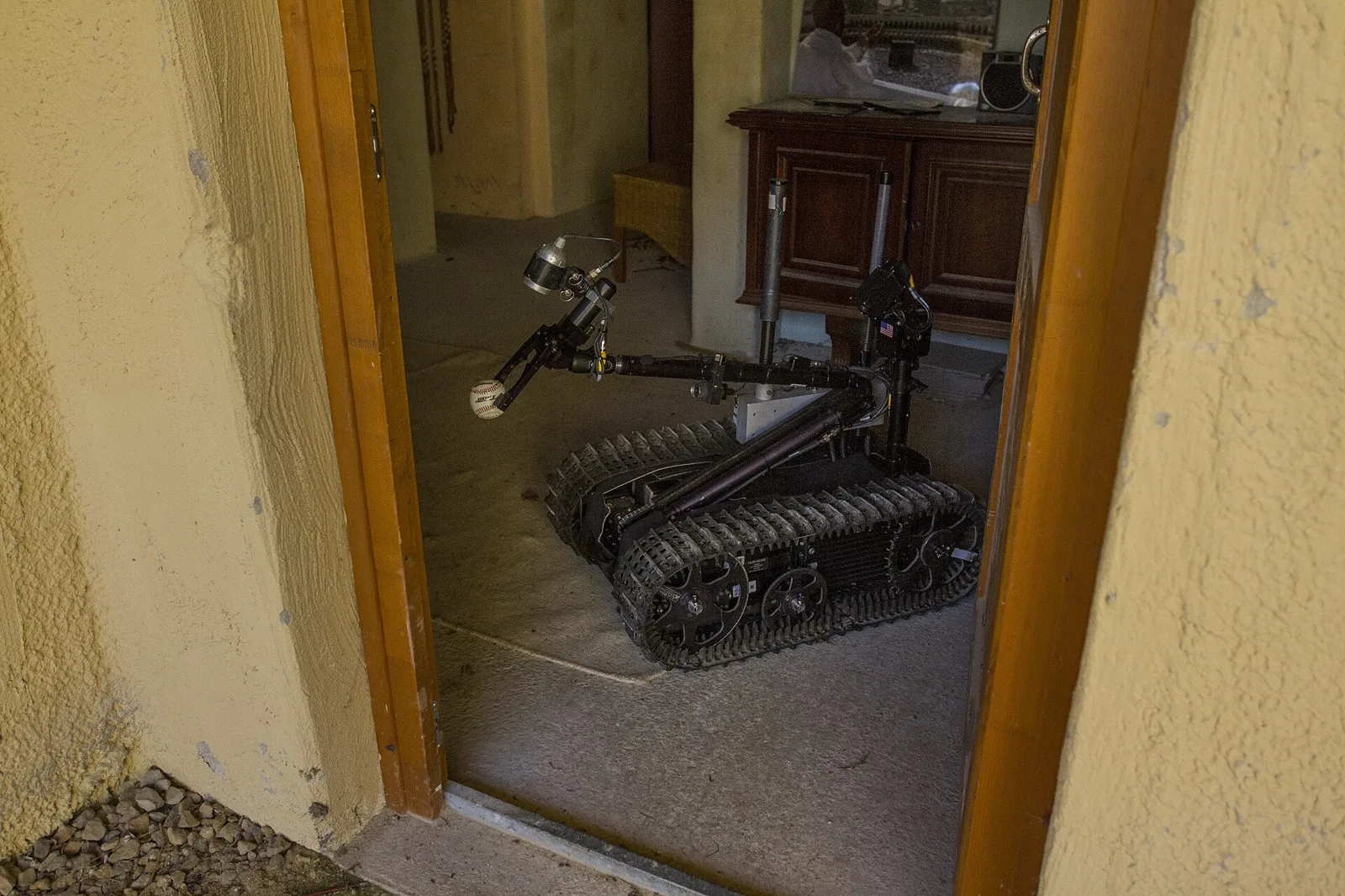
- Explosive ordnance disposal robots: the SSB glossary defines a “bomb disposal robot” as a tool that allows initial reconnaissance, inspection and neutralisation of explosives and suspicious objects without putting experts at risk. The accompanying photo shows a TALON robot operated by an explosive ordnance disposal team.
- Mine-resistant ambush-protected vehicles: such as MRAP vehicles (Arabic) and 4×4 armoured vehicles (Arabic).
- Jamming systems: they disrupt some means of remote activation; see Electronic jamming (Arabic).
- Route clearance and training: NATO points to route clearance projects and field exercises to train teams in high-threat environments.
Arab efforts to counter IEDs
- Tunisia: the United Nations Mine Action Service (UNMAS) says its Threat Mitigation Advisory Team (TMAT) supports the formal accreditation of counter-IED training institutions. It lists the Tunisian Counter-IED Centre of Excellence (TC2E) among the institutions whose accreditation was completed in 2025. (Confirmed – UNMAS)
- Iraq: Defence Arabia covered Iraqi–UN talks on demining and peacekeeping (Arabic).
Information status: the definitions and NATO’s plan are confirmed by official sources. The article deliberately contains no technical information on the assembly or activation of devices.
Frequently asked questions
What is an improvised explosive device?
An unconventional explosive weapon made outside regular military production; it can take any form and is used mostly by non-state actors.
What is the difference between an IED and a mine?
A mine is a regular, militarily manufactured munition. An improvised device is made outside regular production and may use unexploded ordnance, according to the SSB definition.
How do armies protect their soldiers from IEDs?
With protected vehicles, robots, jamming and training, and by disrupting the networks behind the devices before they are planted.
What should I do if I see a suspicious object?
Do not approach or touch it, move away from it, and report it immediately to the competent security authorities.
More: Encyclopedia of defence terms (Arabic).
Information verified on: 3 November 2026.
Sources
- NATO – Improvised explosive devices
- UNMAS – Threat Mitigation Advisory Team (TMAT)
- Presidency of Defence Industries of Türkiye – Savunma Sanayii 360 glossary
Photo: soldiers of the 774th Explosive Ordnance Disposal Company operate a TALON robot during training in Hohenfels, Germany, 21 October 2016 (photo: Adeline Witherspoon / US Army, public domain via Wikimedia Commons).


