Otokar COBRA II: The MRAP Behind Türkiye’s Largest Land Vehicle Export Deal
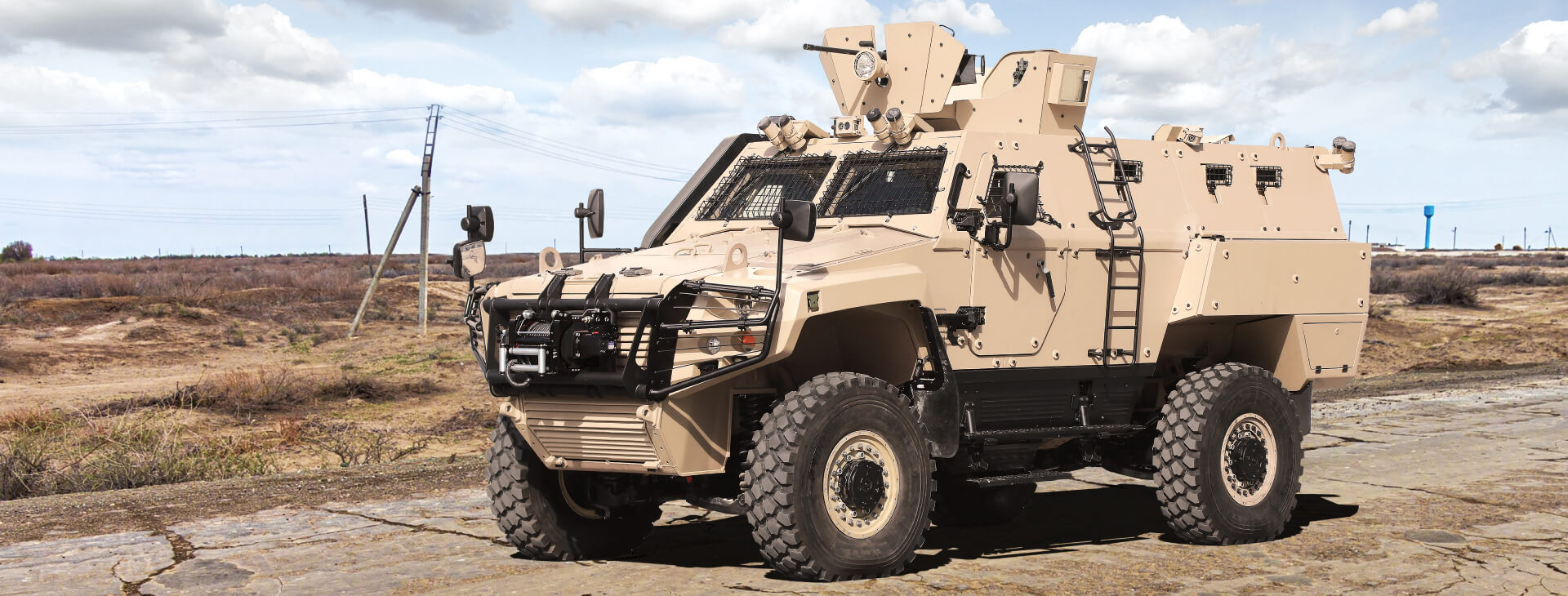
The Otokar COBRA II is a 4×4 mine-resistant ambush protected tactical wheeled armoured vehicle built by Otokar Otomotiv ve Savunma Sanayi A.S., the Koc Holding subsidiary based at Arifiye in Sakarya province. Rated at a maximum weight of 18,000 kg, able to carry up to 11 personnel and offered with turbocharged diesel engines of 360, 375 or 400 hp, it has become the commercial cornerstone of Turkish armoured vehicle exports. In November 2024 Romania ordered 1,059 units in a deal worth roughly 857 million euro, described as the largest single-item land vehicle export contract in the history of the Turkish defence industry.
Otokar COBRA II: A Second-Generation Turkish MRAP
The COBRA II occupies a specific niche in the tactical wheeled vehicle market. It is heavier and more heavily protected than a light protected patrol vehicle, yet smaller and considerably more agile than a 6×6 wheeled armoured personnel carrier. That positioning explains why it has found buyers across such a wide spread of operational environments, from counter-insurgency patrolling to conventional mechanised reconnaissance and United Nations peacekeeping deployments.
From the Cobra to the COBRA II
The original Otokar Cobra established the company as a serious exporter of light armoured vehicles, but it was conceived around a lighter weight class and a narrower protection envelope than modern threat levels demand. The COBRA II is not an incremental update of that design. It carries roughly double the combat weight of its predecessor and is slightly larger in every principal dimension, which gave Otokar the internal volume and the structural margin needed to build in mine and improvised explosive device protection from the outset rather than bolting it on afterwards.
That growth in mass is the defining engineering decision behind the platform. Every subsequent characteristic of the Otokar COBRA II, from the choice of a 6.7-litre diesel powerpack to the independent hydraulic suspension and the central tyre inflation system, follows from the requirement to move an 18-tonne protected hull across broken terrain at useful speed and with acceptable reliability.
What the MRAP Designation Means in Practice
Mine-resistant ambush protected is a category rather than a standard, and vehicles that carry the label vary widely in capability. What they share is a design philosophy in which survivability against buried charges and roadside devices drives the hull geometry, the seating architecture and the suspension layout, rather than being treated as an add-on protection kit. In the COBRA II MRAP this shows in the raised hull, the 450 mm ground clearance that increases the standoff distance between a detonation and the crew compartment, and a seating arrangement designed to isolate occupants from floor-transmitted shock.
The practical consequence for an operator is that a mine-resistant vehicle of this class can be used for route patrol, convoy escort and border security work in environments where lighter armoured cars would be withdrawn after the first serious incident. That is precisely the operational profile that generated demand for the COBRA II in Türkiye and, subsequently, in export markets.
Programme History and Service Entry
Debut at IDEF 2013
Otokar unveiled the COBRA II publicly at IDEF 2013 in Istanbul, presenting it as the successor to a product line that had already been fielded in significant numbers. The timing was deliberate. The international market for protected tactical vehicles had been reshaped by more than a decade of operations in which buried charges and command-detonated devices proved to be the dominant threat to mounted troops, and procurement authorities in dozens of countries were rewriting their requirements accordingly.
Presenting a vehicle at IDEF also placed the design in front of the customer that mattered most in the short term. Turkish security forces were engaged in sustained internal security operations where mine and IED protection was the single most important selection criterion, and the domestic requirement provided the production volume needed to mature the design before it was offered abroad.
Turkish Orders, 2015 and 2016
Türkiye became the primary customer for the type. Contracts placed in 2015 and 2016 covered approximately 262 or more vehicles with a combined value of about 172.8 million US dollars, distributed between the Turkish Armed Forces and other security organisations. Those orders did more than establish a domestic user base. They funded the series production line, validated the logistics and training package, and gave Otokar the in-service reference that export customers invariably demand before committing to a large procurement.
The pattern is familiar in the Turkish defence industry. A domestic requirement absorbs the early production risk, operational use in demanding conditions generates modification data, and the resulting mature product is then marketed internationally with a credible service record behind it. The Otokar COBRA II followed that route almost exactly, and the export success that followed cannot be separated from the Turkish operational experience that preceded it.
The Romania Contract: The Largest Land Vehicle Export Deal in Turkish Defence Industry History
On 27 November 2024, Otokar signed a contract with Romania for 1,059 COBRA II vehicles. The value is approximately 857 million euro, equivalent to about 4.26 billion Romanian lei, with some reporting placing the figure at around 934 million US dollars. The agreement has been described as the largest single-item land vehicle export deal ever concluded by the Turkish defence industry, and by any measure it represents a step change in the scale at which Turkish armoured vehicle manufacturers compete.
Terms and Structure of the Agreement
The contract is not a straightforward export sale. Otokar builds the first 278 vehicles in Türkiye, while the remaining 781 units are produced in Romania over a five-year period beginning in the fourth quarter of 2025. That split places the majority of the production value inside the customer country, which is the structure that large European and NATO competitions now routinely require. It also means the programme is a technology transfer and industrial establishment exercise as much as it is a vehicle delivery.
For a supplier, this arrangement carries real risk. Transferring production know-how, qualifying a foreign assembly line and supporting a distributed supply chain over five years is significantly harder than shipping finished vehicles from a single plant. Otokar accepted that structure because the alternative was exclusion from the competition altogether. European procurement authorities increasingly treat local industrial participation as a threshold condition rather than a negotiable extra.
SAROM and Industrial Establishment at Medias
In April 2025 Otokar and the Romanian company Automecanica S.A. formed a 50-50 joint venture named SAROM, standing for Sisteme Aparare Romania. The joint venture is responsible for local manufacturing, engineering, marketing and after-sales support, and it is based at Medias. Equal ownership matters here. A minority-stake arrangement would have left the Romanian partner as an assembly subcontractor, whereas a balanced joint venture gives the local entity a genuine stake in engineering decisions and in the pursuit of further business.
The after-sales dimension is easy to overlook and difficult to execute. A fleet of more than a thousand mine-resistant vehicles generates a substantial and continuing requirement for spare parts, technical publications, field service support, obsolescence management and mid-life work. Establishing that capability inside Romania converts a one-off procurement into a long-term industrial relationship, and it also positions SAROM as a potential regional support hub for other operators of the type.
First Deliveries in June 2025
The first COBRA II vehicles arrived in Romania on 10 June 2025. The initial batch of 14 delivered units underwent subsystem integration at the Medias facility, which is the normal first step in a transfer-of-production programme. Vehicles built in the supplier country are used to establish and validate the local integration processes before full assembly begins, allowing the receiving facility to work through tooling, quality assurance and workforce training on a small and controlled quantity.
Reaching physical delivery roughly six months after contract signature is a rapid schedule for a programme of this size, and it reflects the fact that the Otokar COBRA II was already a mature, series-produced design rather than a development item. That maturity was almost certainly a significant factor in the Romanian selection, since a customer replacing ageing fleets against a compressed timetable cannot afford a development programme.
Ten Configurations for the Romanian Requirement
The Romanian programme covers ten distinct COBRA II configurations, which is unusually broad for a single vehicle procurement. The named variants include the armoured personnel carrier, a reconnaissance vehicle, a remote controlled weapon station platform, an anti-tank version, a 120 mm mortar carrier, an 81 mm mortar carrier, an engineering variant, a CBRN reconnaissance vehicle and an armoured ambulance.
Procuring this many roles on one chassis is a deliberate logistics strategy. A single base platform means one set of driver training courses, one powertrain spares inventory, one maintenance doctrine and one set of recovery procedures across a large part of the force structure. The alternative, in which each role is filled by a separately optimised vehicle, produces better individual performance in some roles at a considerable cost in fleet complexity. Romania has chosen commonality, and the modular architecture of the 4×4 armoured vehicle is what makes that choice viable.
The 10,500 kg Weight Ceiling
Romanian variants were modified to meet a weight restriction of under 10,500 kg. This is a substantial reduction from the 18,000 kg maximum weight of the baseline vehicle, and it carries direct consequences. Occupant capacity in the modified configuration drops to six, and the vehicle adopts a pickup configuration rather than the fully enclosed rear compartment of the standard armoured personnel carrier.
Weight limits of this kind normally originate in infrastructure and transport constraints, including bridge classifications, road regulations and strategic airlift or rail loading requirements. Whatever the specific driver, the adaptation demonstrates the flexibility of the underlying design and the willingness of the manufacturer to re-engineer the platform to a national specification. It also serves as a reminder that a headline figure such as maximum weight or seating capacity describes one configuration among many, and that the vehicles entering Romanian service will differ meaningfully from the baseline product.
Why an EU and NATO Award Changes the Picture
Romania is the first European Union member state to adopt the COBRA II, and that fact carries weight beyond the contract value. Turkish armoured vehicle exports have historically concentrated on the Middle East, Africa, Central Asia and Southeast Asia, markets where procurement is often driven by price, delivery speed and political relationships. Winning a competitive award inside the European Union, from a NATO member with access to European and American alternatives, tests a product against a different standard.
The Romania contract therefore functions as a reference sale in the strict commercial sense. Future prospects in Europe and elsewhere can point to an EU member that evaluated the Otokar COBRA II against established competitors, selected it, and committed to producing the majority of its fleet domestically under a technology transfer arrangement. That is a materially stronger position than any previous Turkish land systems export has occupied.
Design and Layout of the 4×4 Armoured Vehicle
Dimensions and Hull Architecture
The COBRA II measures 6,350 mm in length excluding the winch, 2,750 mm in width and approximately 2.2 m in height, with a ground clearance of 450 mm. Those proportions describe a vehicle that is compact enough for use in built-up areas and on narrow mountain tracks while retaining the internal volume required for a full dismount team and its equipment.
Ground clearance of 450 mm is the figure that most directly reflects the mine-resistant design intent. Increasing the distance between the ground and the hull floor reduces the blast pressure and impulse transmitted into the crew compartment, and it simultaneously improves obstacle clearance and approach angles off road. The cost is a higher centre of gravity, which is one of the reasons the suspension and braking systems on a vehicle of this class receive as much engineering attention as the armour.
Three-Door and Five-Door Configurations
The platform can be configured as a three-door or a five-door vehicle. This is more consequential than it first appears, because door count determines how the internal volume is partitioned and therefore what mission equipment can be installed. A five-door layout favours rapid crew access and roles where personnel move in and out frequently. A three-door arrangement preserves more uninterrupted hull side structure, which suits weapon system integration, mortar mounting and mission equipment that requires fixed internal space.
All configurations retain a ramp door with an emergency exit at the rear, giving dismounts a protected exit route and providing an alternative egress path if the primary door is obstructed or damaged. The combination of door options and modular internal layouts is the mechanism by which a single chassis supports the wide variant list demanded by customers such as Romania.
Protection: A Mine-Resistant Vehicle by Design
Ballistic, Mine and IED Protection
Otokar describes the COBRA II as offering a high level of protection against ballistic, mine and improvised explosive device threats, with the protected hull forming an integral part of the vehicle structure rather than an applique layer. The base protection level is complemented by an optional mine protection kit for operators facing heavier buried charge threats than the standard configuration addresses.
The rest of the protection philosophy is visible in the standard equipment fit. Run-flat tyres allow the vehicle to continue moving after tyre damage from fragments or small arms fire, which is often the difference between driving out of an ambush and being immobilised inside it. Blackout lighting supports movement at night without revealing position. A rear-view camera and a thermal front camera reduce the blind spots that armoured vehicles inevitably create, improving both crew safety and the ability to operate closed down.
Optional Protection Packages
The optional equipment list allows the protection envelope to be tailored to the threat. RPG protection in the form of slat or bar armour addresses shaped charge weapons, which remain the most widely available anti-armour threat to wheeled vehicles. A CBRN filtration system permits operation in contaminated environments and provides overpressure protection for the crew compartment. Fire detection and suppression systems address the secondary threat that follows a penetrating hit or a fuel system rupture.
A 360-degree situational awareness system is also available. Systems of this type combine multiple cameras into a composite view for the crew, addressing the fundamental tactical weakness of any closed-down armoured vehicle, which is the crew’s restricted ability to see and interpret what is happening immediately around the hull. In urban and complex terrain this capability has become close to mandatory rather than optional.
Powerpack, Transmission and Mobility
Engine Options from 360 to 400 hp
The COBRA II is powered by a turbocharged diesel engine offered in three ratings of 360, 375 or 400 hp. The 360 hp variant is a 6.7-litre six-cylinder unit that develops its rated output at 2,650 rpm and produces 1,100 Nm of torque at 1,400 rpm. The low-rpm torque peak is the significant number for a tactical vehicle, because pulling an 18-tonne hull out of soft ground or up a steep gradient depends far more on torque available just above idle than on peak power at high engine speeds.
Offering three power ratings on a common installation gives customers a straightforward way to match the powerpack to their configuration and operating environment. Heavier variants, hot and high conditions, or the addition of substantial protection kits all push a customer toward the higher ratings, while lighter configurations operating in temperate conditions can be adequately served by the 360 hp engine at lower acquisition and fuel cost.
Transmission, Suspension and Braking
Power reaches the wheels through an automatic transmission, which reduces driver workload and shortens the training pipeline. That consideration matters disproportionately for a vehicle procured in four-figure quantities, since the total training burden scales directly with fleet size.
The vehicle uses an independent hydraulic suspension with coil springs, an arrangement that permits considerably greater wheel travel than a beam axle layout and allows each wheel to follow ground contours independently. The practical result is better traction on broken surfaces, less hull pitching at speed and a lower shock load transmitted to occupants and to sensitive mission equipment. Braking is handled by a dual-circuit system with anti-lock control, a necessity on a heavy high-clearance vehicle where brake failure or wheel lock-up at speed would be difficult to recover.
Performance and Terrain Behaviour
Maximum speed is 110 km/h and range is 700 km. The road speed allows the vehicle to move with civilian traffic and to keep pace in a mixed convoy, while a 700 km range covers most tactical movement requirements without resupply and gives planners meaningful flexibility in positioning refuelling assets.
A central tyre inflation system is fitted as standard, allowing the driver to reduce tyre pressure for soft ground and restore it for road running without leaving the vehicle. Combined with the independent suspension and the high ground clearance, this gives the COBRA II MRAP the off-road performance that its intended patrol, escort and reconnaissance roles require. Climate control and a NATO-compatible electrical system are also standard, the latter simplifying integration of allied mission equipment and interoperability during coalition operations.
Armament and Mission Systems
Weapon Station Options
The COBRA II can be fitted with a remote controlled weapon station accommodating weapons up to 30 mm calibre, along with grenade launchers. A 30 mm capability places the vehicle well above the machine gun armament typical of protected patrol vehicles and gives it a credible capability against light armoured targets and defended positions. Remote operation keeps the gunner inside the protected hull, which removes the most exposed crew position on any turreted or pintle-armed vehicle.
The remote controlled weapon station platform appears as a distinct configuration within the Romanian order, indicating that Romania intends to field a dedicated fire support variant alongside the personnel carrier and specialist versions. The anti-tank configuration extends that capability further, giving mechanised and reconnaissance units an organic means of engaging armoured threats.
Crew Systems and Situational Awareness
Beyond armament, the standard specification includes a thermal front camera for night and reduced-visibility driving, a rear-view camera for reversing and close manoeuvring, blackout lighting, and climate control for crew endurance in extreme temperatures. These are not incidental comforts. Crew performance degrades sharply in a closed armoured compartment at high ambient temperature, and a vehicle that cannot sustain its crew through a long patrol delivers less capability than its specification suggests.
The NATO-compatible electrical system deserves particular attention in the context of the Romania contract. Standardised power supply and interfaces allow the integration of communications equipment, battle management systems and sensors sourced from allied suppliers, which is essential for a NATO member operating within multinational command structures.
Variants and Mission Configurations
The modular architecture of the platform supports a wide range of role-specific builds. The configurations documented across the programme include the armoured personnel carrier, reconnaissance vehicle, remote controlled weapon station platform, anti-tank vehicle, 120 mm mortar carrier, 81 mm mortar carrier, engineering vehicle, CBRN reconnaissance vehicle and armoured ambulance. An amphibious variant of the COBRA II also exists, extending the platform into water crossing operations that would otherwise require dedicated engineering support.
Two mortar carrier configurations at different calibres is a notable inclusion. An 81 mm system provides organic indirect fire at company level with a light ammunition logistics burden, while a 120 mm system offers substantially greater effect at battalion level. Fielding both on a common chassis simplifies the support structure for indirect fire units while preserving the tactical distinction between the two weapon classes.
The armoured ambulance and MEDEVAC configurations have seen documented operational use. Casualty evacuation under fire is one of the most demanding roles for any protected vehicle, requiring internal volume for stretchers and medical personnel, protection sufficient to enter a contested area, and the mobility to leave it quickly.
Otokar COBRA II Technical Specifications
| Characteristic | Value |
|---|---|
| Type | 4×4 mine-resistant ambush protected tactical wheeled armoured vehicle |
| Manufacturer | Otokar Otomotiv ve Savunma Sanayi A.S., Arifiye, Sakarya, Türkiye |
| First public presentation | IDEF 2013 |
| Maximum weight | 18,000 kg |
| Personnel capacity | Up to 11, varying with configuration and crew composition |
| Length | 6,350 mm (excluding winch) |
| Width | 2,750 mm |
| Height | Approximately 2.2 m |
| Ground clearance | 450 mm |
| Engine | Turbocharged diesel, 360, 375 or 400 hp |
| 360 hp engine detail | 6.7-litre six-cylinder, 360 hp at 2,650 rpm, 1,100 Nm at 1,400 rpm |
| Transmission | Automatic |
| Suspension | Independent hydraulic with coil springs |
| Brakes | Dual-circuit with ABS |
| Maximum speed | 110 km/h |
| Range | 700 km |
| Door configurations | Three-door or five-door |
| Standard equipment | Central tyre inflation, run-flat tyres, ramp door with emergency exit, climate control, NATO-compatible electrical system, rear-view camera, thermal front camera, blackout lighting |
| Optional equipment | Mine protection kits, RPG slat armour, CBRN filtration, fire detection and suppression, 360-degree situational awareness, remote controlled weapon station up to 30 mm, grenade launchers |
| Largest export contract | Romania, 1,059 vehicles, approximately 857 million euro, signed 27 November 2024 |
Operators and Export Markets
Türkiye
The Turkish Armed Forces and Turkish security forces remain the largest operators of the type by cumulative procurement history, following the contracts placed in 2015 and 2016 for approximately 262 or more vehicles. Sustained domestic use in demanding internal security and border operations produced the operational feedback loop that shaped the mature product now being exported.
Romania
Romania has 1,059 vehicles on order and is the first European Union member state to adopt the type. With deliveries beginning in June 2025 and Romanian production starting in the fourth quarter of that year, the country will in time operate by far the largest fleet of the vehicle anywhere, exceeding the Turkish inventory by a substantial margin.
Ukraine
COBRA II vehicles have been observed in Ukrainian service since May 2023, and a MEDEVAC variant was reported in use during the Kursk operations of 2024. Employment in a high-intensity conventional conflict against a peer adversary subjects a vehicle to conditions that no proving ground replicates, including artillery fragmentation, drone attack and mine threats laid at scale. Documented use in that environment carries evidentiary weight with prospective customers that no marketing programme can match.
Africa, Latin America, Central Asia and United Nations Missions
The broader operator list includes Ecuador, Ghana, Kazakhstan, Morocco, Rwanda, Senegal and Tunisia, along with use in United Nations peacekeeping missions. This geographic spread is commercially valuable in its own right. It establishes that the vehicle performs across a wide range of climatic and terrain conditions, from West African heat and humidity to Central Asian temperature extremes, and it builds the kind of distributed support network that reassures new customers about long-term parts availability.
United Nations peacekeeping use is a distinct category. Vehicles procured for peacekeeping must protect against mines and small arms while remaining suitable for a mandate that emphasises presence and protection over offensive action, and the mine-resistant vehicle configuration of the COBRA II fits that requirement directly.
The Otokar COBRA II in International Comparison
Against Western Designs
The most obvious Western comparators are the Oshkosh JLTV, the Iveco LMV and MLV families, and the Textron Survivor R. The JLTV occupies a lighter class and was designed around a US requirement emphasising protected mobility and networked integration at high production volume. The Iveco vehicles are well established across European forces and benefit from a mature continental support infrastructure. The Survivor R sits closer to the COBRA II in weight and protection philosophy.
Against this field the Turkish vehicle competes primarily on the combination of price, delivery timescale and willingness to transfer production. Western suppliers frequently face long order backlogs, restrictive export control processes and limited flexibility on local manufacturing. A customer that needs more than a thousand mine-resistant vehicles delivered on a defined schedule, with the majority built domestically, finds that combination difficult to obtain from established Western manufacturers, and the Romania contract is the clearest evidence of that dynamic.
Against Turkish Competitors
Domestic competition is genuine. The Nurol Ejder Yalcin and the BMC Kirpi are both credible protected vehicles with their own export records, and the Paramount Marauder competes for many of the same requirements from a South African industrial base. Turkish manufacturers regularly encounter one another in international tenders.
What distinguishes the Otokar COBRA II within that group is the breadth of its qualified configuration list and the depth of its export operator base. Ten configurations qualified for a single customer, and an operator list spanning four continents, represent an accumulated engineering and support investment that a competitor cannot replicate quickly. In competitions where a customer wants a single chassis to cover most of a brigade’s vehicle requirement, that variant catalogue becomes a decisive discriminator.
Otokar’s Industrial Position
Otokar is the largest privately owned land systems manufacturer in Türkiye and part of Koc Holding, the country’s largest industrial group. Its product range extends well beyond the COBRA II to include the ARMA and ARMA II wheeled armoured vehicle families, the Akrep II, the Tulpar tracked armoured fighting vehicle and early prototype work on the Altay main battle tank programme.
That portfolio matters commercially. A customer assessing a supplier for a multi-year programme with domestic production is not only buying vehicles, but making a bet on the company’s continued existence, engineering capacity and willingness to support the fleet for decades. A manufacturer with a broad product range, private ownership within a major industrial group and an established export record presents a materially lower risk than a single-product supplier.
The Romania contract also changes Otokar’s own position. Executing a five-year technology transfer programme in an EU member state builds capabilities in export compliance, foreign production management and international after-sales support that are transferable to every subsequent competition. The programme is, in effect, a paid apprenticeship in the industrial model that large Western procurements demand.
Outlook for the Otokar COBRA II
The near-term trajectory of the programme is defined by execution in Romania. Delivering 1,059 vehicles across ten configurations, standing up a production line at Medias through the SAROM joint venture and sustaining the fleet over its service life is a demanding undertaking. Successful execution would validate the Turkish defence industry as a supplier capable of meeting European industrial participation requirements. Difficulties in the transfer of production would be equally visible to prospective customers.
The wider market environment is favourable. European defence budgets have expanded substantially, many NATO members are replacing armoured vehicle fleets acquired decades ago, and demand for protected tactical mobility has been reinforced by the observed effect of mines, drones and precision munitions on unprotected vehicles. Established Western manufacturers face backlogs that create genuine openings for suppliers who can deliver on schedule.
Longer term, the design will face pressure from developments that were not central to its original conception, particularly the proliferation of small unmanned aerial systems and loitering munitions attacking from above. Top attack protection, electronic countermeasures and hard-kill active protection are becoming standard elements of vehicle requirements. The modularity of the COBRA II MRAP, which already accommodates a wide range of optional protection and mission equipment, provides a reasonable basis for such additions, and the Romanian production programme gives the platform a guaranteed manufacturing base through the end of the decade in which to incorporate them.
Frequently Asked Questions About the Otokar COBRA II
How many soldiers can the Otokar COBRA II carry?
Otokar gives a personnel capacity of up to 11 for the vehicle, though the figure varies with configuration and crew composition, and some published sources cite a maximum of 10 including the driver and commander. Specialist configurations differ considerably from the baseline. The Romanian variants, which were re-engineered to remain below a 10,500 kg weight limit and adopt a pickup configuration, carry six occupants rather than a full dismount section.
What is the value of the Romania contract for the COBRA II?
The contract signed on 27 November 2024 covers 1,059 vehicles at a value of approximately 857 million euro, equivalent to about 4.26 billion Romanian lei, with some reporting quoting a figure of around 934 million US dollars. It has been described as the largest single-item land vehicle export deal in the history of the Turkish defence industry. Otokar builds the first 278 vehicles in Türkiye and Romania produces the remaining 781 over five years from the fourth quarter of 2025.
What engine and performance does the COBRA II MRAP have?
The vehicle uses a turbocharged diesel engine available in 360, 375 or 400 hp ratings. The 360 hp version is a 6.7-litre six-cylinder unit producing its rated power at 2,650 rpm and 1,100 Nm of torque at 1,400 rpm. Drive is through an automatic transmission with independent hydraulic suspension using coil springs and dual-circuit ABS braking. Maximum speed is 110 km/h and range is 700 km, with a maximum vehicle weight of 18,000 kg.
Which countries operate the Otokar COBRA II?
Türkiye is the original and long-standing operator, through both the Turkish Armed Forces and other security forces. Romania has 1,059 vehicles on order and is the first European Union member state to adopt the type. The vehicle has been observed in Ukrainian service since May 2023, including a MEDEVAC variant reported during the 2024 Kursk operations. Further operators include Ecuador, Ghana, Kazakhstan, Morocco, Rwanda, Senegal and Tunisia, and the type has also been used on United Nations peacekeeping missions.


