Bayraktar KIZILELMA: Türkiye’s First Unmanned Combat Aircraft
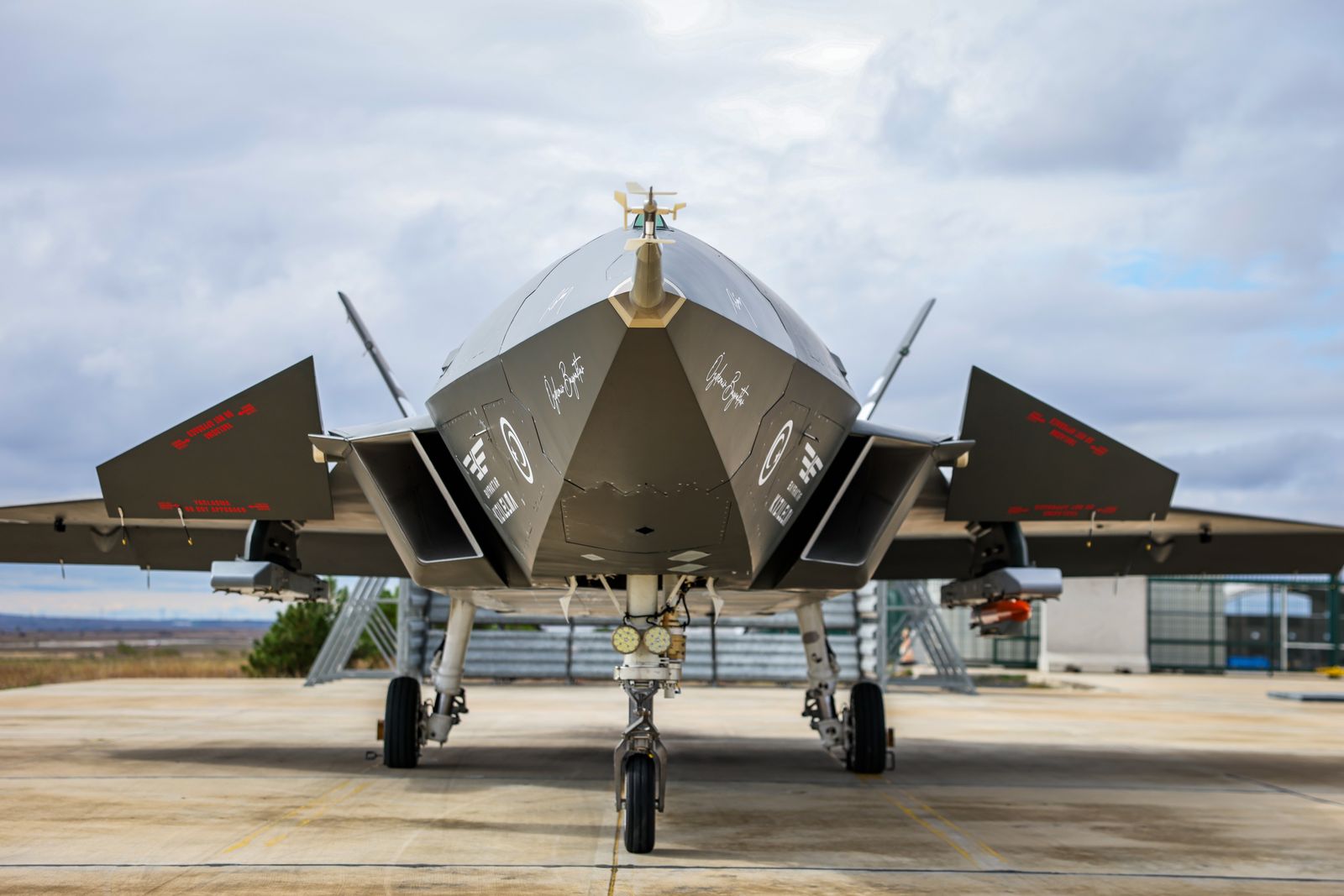
The Bayraktar KIZILELMA is Türkiye’s first indigenous unmanned combat aircraft, a jet-powered platform developed by Baykar Teknoloji with a maximum take-off weight of 8.5 tonnes and a design brief that covers missions previously reserved for manned fighters. Built around a low radar cross-section airframe, an AESA radar and internal weapons bays, the aircraft is intended to fly independently and as a loyal wingman beside crewed fighters, and to operate from the short deck of the amphibious assault ship TCG Anadolu. On 8 October 2025 the programme crossed a decisive threshold when the Bayraktar KIZILELMA conducted its first live-fire strike test, scoring direct hits on ground targets in two separate sorties.
What the Bayraktar KIZILELMA is and why it matters
Formally designated the Bayraktar KIZILELMA Muharip Insansiz Ucak Sistemi, or unmanned combat aircraft system, the platform represents a category shift rather than an incremental improvement on earlier Turkish unmanned aerial vehicles. Where propeller-driven medium-altitude systems are optimised for persistence over permissive airspace, this is a jet aircraft sized and shaped for contested environments, with a cruise speed of Mach 0.6, a maximum speed of Mach 0.9 and a signature-reduced airframe intended to complicate detection and engagement.
A combat aircraft, not a surveillance platform
The role set defined for the aircraft is unusually broad for an unmanned system. Baykar lists air-to-air combat, strategic strike, close air support, cruise-missile strike, and the suppression and destruction of enemy air defences, commonly abbreviated as SEAD and DEAD. Each of these mission types imposes different demands. Air-to-air work requires a radar, high subsonic acceleration and the ability to carry air intercept weapons. Strategic strike requires range and the capacity to carry heavier stores. SEAD and DEAD, historically among the most dangerous tasks assigned to aircrew, are the missions where an attritable unmanned platform offers the clearest operational logic: the aircraft can be pushed into a defended zone that commanders would hesitate to expose a manned fighter and its pilot to.
The loyal wingman concept
The loyal wingman role sits at the centre of how the Bayraktar KIZILELMA is expected to be used. In this concept an unmanned combat aircraft flies in coordination with manned fighters, extending the formation’s sensor coverage, absorbing risk on the leading edge of a strike package and multiplying the number of weapons a single crewed aircraft can bring to bear. The aircraft’s 1,500 kg payload capacity and mixed internal and external carriage give it enough magazine depth to matter in that role rather than serving purely as a decoy or sensor node. Türkiye’s public demonstration of the concept came at TEKNOFEST 2023, when the aircraft flew in formation with F-16 and F-5 jets, flights that Baykar described as firsts in world aviation history.
Türkiye’s first unmanned fighter
The description of the aircraft as Türkiye’s first unmanned fighter is a statement about capability class rather than marketing shorthand. Very few countries have flown a jet-powered, radar-equipped, weapons-carrying unmanned aircraft designed for air combat, and fewer still have fired weapons from one. The programme therefore places Türkiye in a small group of states pursuing this class of system, and it does so with an aircraft developed by a private manufacturer rather than a state arsenal.
Programme history and milestones of the Bayraktar KIZILELMA
The development path of the Bayraktar KIZILELMA has been public and unusually fast by the standards of combat aircraft programmes, with each major test event disclosed by Baykar as it occurred.
TEKNOFEST 2023 and the formation flights
The formation flights with F-16 and F-5 aircraft at TEKNOFEST 2023 were the first widely seen demonstration that the aircraft could be integrated into a mixed manned and unmanned formation. Formation flying is not simply a display manoeuvre in this context. It exercises the flight control laws, the datalink behaviour and the predictability of the unmanned aircraft’s responses in close proximity to crewed aircraft, all of which are prerequisites for the loyal wingman mission. Baykar characterised the flights as firsts in world aviation history.
The first live-fire strike, 8 October 2025
The single most significant milestone to date came on 8 October 2025, when the Bayraktar KIZILELMA carried out its first live-fire strike test. Two sorties were flown from the AKINCI Flight Training and Test Centre at Corlu in Tekirdag province, and both scored direct hits on ground targets. The weapons employed were the ASELSAN TOLUN munition and the ROKETSAN TEBER-82 winged guidance kit, both products of the Turkish defence industry.
The choice of weapons is informative. Employing a guidance kit fitted to a general purpose bomb body alongside a smaller precision munition demonstrates that the aircraft’s stores management, release sequencing and targeting chain function with more than one class of weapon. For a programme aiming at an operational role, hitting a target twice in two sorties on the first attempt is a stronger indicator of system maturity than any single flight-envelope milestone.
Serial production and entry into service
Baykar Chairman Selcuk Bayraktar stated that serial production of the aircraft had begun with the first production example completed, and that higher production volumes were targeted for 2026. The aircraft is targeted to enter inventory in 2026. Taken together with the October 2025 strike test, this positions the Bayraktar KIZILELMA as a system moving from flight test into fielding rather than one still proving basic concepts.
Airframe design and low observability
The physical design of the aircraft reflects the compromises typical of a first-generation unmanned combat aircraft: enough signature reduction to complicate an adversary’s targeting problem, without the cost and complexity of a full very-low-observable programme.
Dimensions and layout
The aircraft has a wingspan of 10 metres, a length of 14.5 metres and a height of 3.5 metres. Those proportions place it in the size class of a light manned fighter, and the relatively short span combined with substantial length is consistent with an airframe optimised for transonic cruise rather than long-endurance loiter. Maximum take-off weight is 8.5 tonnes, of which up to 1,500 kg is payload.
Signature management
Baykar describes the airframe as having a low radar cross-section. Two design choices support that description directly. The first is the shaping of the airframe itself. The second, and operationally more consequential, is the provision of internal weapons bays. External stores are among the largest contributors to a combat aircraft’s radar return, and an aircraft that can carry its weapons internally on penetrating missions retains its shaped signature at the point where it matters most. The design retains external hardpoints for mission profiles where signature is less important than payload, which is the same approach taken by most operational low-observable strike aircraft.
Autonomy in the most demanding phases
The aircraft performs taxi, take-off and landing autonomously. This capability is easy to underrate. Take-off and landing account for a disproportionate share of accidents across aviation generally, and for an aircraft intended to operate from a moving ship deck, autonomous recovery is not a convenience feature but a structural requirement. Removing the pilot from the recovery loop also removes the datalink latency and the human workload that would otherwise constrain shipboard operations.
Powerpack and the engine question
The powerplant is the area where the Bayraktar KIZILELMA is most clearly a work in progress, and Baykar has been transparent about the phased approach it is taking.
Configuration A and the AI-25TLT
The KIZILELMA-A configuration is powered by the AI-25TLT turbofan rated at 16.5 kN. This is a non-afterburning engine, which sets the thrust-to-weight ratio and therefore the acceleration and climb performance of the initial configuration. It is a mature, widely produced powerplant, and using it allowed the airframe, flight control system and mission systems to be matured without waiting on a new engine.
Configurations B and C and the AI-322F
The B and C configurations are to be powered by the AI-322F, rated at 24.5 kN dry and 41 kN with afterburner. The step up is substantial: with reheat the available thrust is roughly two and a half times that of the initial configuration. Afterburning thrust changes what the aircraft can do in the air-to-air role in particular, where the ability to accelerate quickly and to sustain energy through manoeuvres determines whether an aircraft can engage or must disengage.
TEI TF10000 and national independence
Both interim engines are of foreign origin, and this remains the principal open question hanging over the programme. Turkish Engine Industries is developing the TF10000, which is under evaluation for the B and C configurations. A domestically produced engine would remove the export-licence exposure that has repeatedly complicated Turkish defence programmes, and it would give Ankara unrestricted control over the aircraft’s onward sale. Until the TF10000 is qualified and in production, the powerplant is the element of the Bayraktar KIZILELMA most dependent on decisions made outside Türkiye.
Performance and mobility
Published performance figures place the aircraft firmly in the subsonic combat category rather than the high-supersonic interceptor class.
Speed and altitude
Cruise speed is Mach 0.6 and maximum speed is Mach 0.9. Operational altitude is given as 25,000 feet, with some sources reporting a 35,000 foot ceiling for Configuration A. A maximum speed just below the transonic drag rise is a conventional choice for an aircraft in this class, since sustained supersonic flight would demand a substantially larger and thirstier engine and a different airframe.
Radius and endurance
Mission radius is 500 nautical miles, with endurance stated as three hours or more, and some sources give five hours for Configuration A. A 500 nautical mile radius from a land base covers a wide operational area, but the figure becomes more interesting when the launch point is mobile. Operating from a ship, the same radius describes a circle drawn around wherever the vessel happens to be, which is the argument for shipboard compatibility in the first place.
Armament and mission systems
The weapons and sensor fit is what separates an unmanned combat aircraft from a large reconnaissance drone, and it is where the Turkish supplier base becomes visible.
Carriage: internal and external
The aircraft carries weapons in internal bays for low-observable missions, with external hardpoints available for profiles where payload volume outweighs signature considerations. Total payload capacity is 1,500 kg. This dual arrangement gives commanders a genuine choice on each sortie rather than a fixed configuration.
Weapons demonstrated
The October 2025 strike test employed the ASELSAN TOLUN munition and the ROKETSAN TEBER-82 winged guidance kit. Both are indigenous Turkish products, and both are already integrated across other Turkish unmanned platforms, which shortens the qualification path. The declared mission set implies a wider eventual inventory covering air-to-air weapons and stand-off cruise munitions, but the systems demonstrated in live fire to date are those two.
Sensors and situational awareness
The aircraft carries an AESA radar for situational awareness. An active electronically scanned array is the enabling sensor for the air-to-air role: it supports simultaneous search and track, provides resistance to jamming and allows the aircraft to build its own air picture rather than depending entirely on offboard cueing. For a loyal wingman operating ahead of a manned formation, that onboard sensing is precisely the value being added, since the unmanned aircraft can radiate and be targeted while the crewed fighters behind it remain passive.
Configurations of the Bayraktar KIZILELMA
Baykar has defined a family of configurations rather than a single fixed aircraft. The variants announced are KIZILELMA-A, KIZILELMA-B, KIZILELMA-CA, KIZILELMA-CB and KIZILELMA-D. The clearest published differentiator between them is propulsion: the A configuration uses the AI-25TLT, while the B and C configurations use the afterburning AI-322F, with the TEI TF10000 under evaluation for those variants. The staged family approach allows the initial configuration to enter service and generate operational experience while the more capable versions mature behind it, an approach used across most successful combat aircraft programmes.
Carrier operations and TCG Anadolu
The shipboard dimension of the programme is what most distinguishes the Bayraktar KIZILELMA from comparable foreign efforts, most of which are land-based.
The short-deck problem
TCG Anadolu, hull number L-400, has a short flight deck and no catapult. That configuration restricts fixed-wing operations to short take-off and vertical landing aircraft or to aircraft specifically designed for the deck’s constraints. The Bayraktar KIZILELMA is designed for carrier-type operations from short-deck ships of the amphibious assault type, which is the design requirement that has shaped elements of its airframe and its autonomous take-off and landing capability.
Bayraktar TB3 as the pathfinder
Baykar’s Bayraktar TB3 has already flown from TCG Anadolu, and the two aircraft are intended to operate from the ship alongside one another. The TB3 flights validated the deck handling procedures, the launch and recovery sequence and the shipboard control arrangements at lower risk and lower cost than a jet would have allowed. For Türkiye, the combination converts an amphibious assault ship that could not otherwise field a fixed-wing air group into a platform capable of putting armed aircraft into the air at a distance from national territory.
Bayraktar KIZILELMA key characteristics
| Characteristic | Value |
|---|---|
| Manufacturer | Baykar Teknoloji (Türkiye) |
| Type | Unmanned combat aircraft system (UCAV), unmanned fighter |
| Maximum take-off weight | 8.5 tonnes |
| Payload capacity | 1,500 kg |
| Wingspan | 10 m |
| Length | 14.5 m |
| Height | 3.5 m |
| Cruise speed | Mach 0.6 |
| Maximum speed | Mach 0.9 |
| Operational altitude | 25,000 ft (35,000 ft ceiling reported for Configuration A) |
| Mission radius | 500 nautical miles |
| Endurance | 3+ hours (5 hours reported for Configuration A) |
| Engine, Configuration A | AI-25TLT turbofan, 16.5 kN |
| Engine, Configurations B and C | AI-322F, 24.5 kN dry / 41 kN with afterburner |
| National engine under evaluation | TEI TF10000 |
| Radar | AESA |
| Weapons carriage | Internal bays plus external hardpoints |
| Take-off and landing | Autonomous taxi, take-off and landing |
| Configurations | A, B, CA, CB, D |
| Ship compatibility | Short-deck LHD-type ships, including TCG Anadolu (L-400) |
| First live-fire strike | 8 October 2025, Corlu, Tekirdag; ASELSAN TOLUN and ROKETSAN TEBER-82 |
| Targeted entry into inventory | 2026 |
International comparison: where the Bayraktar KIZILELMA stands
The unmanned combat aircraft and collaborative combat aircraft category has become one of the most active areas of military aviation development, and several programmes are running in parallel across the major aerospace powers.
United States programmes
The United States Air Force is pursuing collaborative combat aircraft through the General Atomics YFQ-42A and the Anduril YFQ-44A Fury, both conceived as comparatively affordable aircraft flown in numbers alongside crewed fighters. The American approach places heavy emphasis on autonomy software and on procuring aircraft at a unit cost low enough to accept losses, with the aircraft themselves treated as one component of a broader combat architecture.
Australia, Europe, Russia and China
Boeing’s MQ-28 Ghost Bat, developed with Australia, is the most mature Western loyal wingman effort outside the United States. In Europe, the nEUROn technology demonstrator explored low-observable unmanned flight, and the remote carrier concepts within the Future Combat Air System programme continue that line of work. Russia’s S-70 Okhotnik and China’s GJ-11 are large flying-wing designs aimed principally at penetrating strike. Against that field, the Bayraktar KIZILELMA occupies a distinctive position: it is smaller than the Russian and Chinese flying wings, it carries an air-to-air role in its declared mission set rather than being strike-only, and it is the one design in the group built from the outset for short-deck shipboard operations.
What distinguishes the Turkish approach
Two features separate the Turkish programme from most of its peers. The first is pace. The aircraft moved from formation flying at TEKNOFEST 2023 to a successful live-fire strike in October 2025 and into initial serial production, a timeline compressed by the standards of combat aircraft development. The second is that development has been led by a private company using largely domestic subsystems, with Turkish munitions from ASELSAN and ROKETSAN integrated early. The main dependency running against that pattern is the engine, which remains foreign pending the TEI TF10000.
Baykar’s industrial position
The Bayraktar KIZILELMA is the most technically demanding product in a portfolio that has made Baykar one of the most visible unmanned systems manufacturers in the world.
Export footprint
Baykar describes itself as the world’s largest unmanned aerial vehicle company and states that its export agreements cover 36 countries. Whatever weight is given to the ranking claim, an export base of that breadth carries practical consequences for the Bayraktar KIZILELMA programme: it supplies revenue that can fund development, it establishes customer relationships and support infrastructure into which a new product can be sold, and it creates a body of operational experience with Turkish unmanned systems among foreign air forces.
The wider Turkish combat air roadmap
The aircraft is one element of a broader Turkish plan for future combat aviation. That plan includes KAAN, the manned fifth-generation fighter; Hurjet, the jet trainer and light combat aircraft; Anka-3, a flying-wing unmanned aircraft; and the Bayraktar KIZILELMA. The intent is a mixed manned and unmanned force structure in which crewed fighters direct unmanned aircraft that carry sensors and weapons into higher-risk airspace. Sustaining four combat aircraft programmes simultaneously is demanding for any aerospace industry, and the engine, sensor and software supply chains are shared across them, so progress on one programme tends to benefit the others.
Outlook for the Bayraktar KIZILELMA
The programme enters its next phase with the hardest technical questions answered and the harder institutional ones still open. Flight testing, formation flying with manned fighters, autonomous take-off and landing and live weapons employment have all been demonstrated. Serial production has begun, and entry into inventory is targeted for 2026.
What remains to be proven falls into three areas. The first is the engine: qualifying the TEI TF10000 would convert the Bayraktar KIZILELMA from a system with a foreign critical component into a fully national one, with the export freedom that follows. The second is shipboard operations at scale, where the Bayraktar TB3 has shown the concept works from TCG Anadolu but the jet must still demonstrate routine launch and recovery in operational conditions. The third, and least visible, is the autonomy and command architecture that determines how many unmanned aircraft one crew can usefully direct, which is the factor that ultimately decides whether the loyal wingman concept delivers a genuine multiplication of combat power or simply adds airframes to a formation.
If those three questions resolve favourably, Türkiye will field one of the few operational unmanned combat aircraft capable of air-to-air engagement and shipborne operation, produced domestically and available for export. That is a materially different position from the one the Turkish aerospace industry occupied a decade ago.
Frequently asked questions about the Bayraktar KIZILELMA
What is the Bayraktar KIZILELMA?
The Bayraktar KIZILELMA is Türkiye’s first indigenous unmanned combat aircraft, developed by Baykar Teknoloji. It is a jet-powered aircraft with a maximum take-off weight of 8.5 tonnes, a 1,500 kg payload capacity, a low radar cross-section airframe, an AESA radar and internal weapons bays. Its declared missions include air-to-air combat, strategic strike, close air support, cruise-missile strike and the suppression and destruction of enemy air defences, and it is designed to operate as a loyal wingman alongside manned fighters.
Can the Bayraktar KIZILELMA operate from TCG Anadolu?
The aircraft is designed for carrier-type operations from short-deck ships of the LHD or amphibious assault type, which includes TCG Anadolu (L-400). That ship has a short flight deck and no catapult, so it can only support short take-off and vertical landing aircraft or unmanned aircraft designed specifically for those constraints. Baykar’s Bayraktar TB3 has already flown from TCG Anadolu, and the two aircraft are intended to operate from the ship together. The Bayraktar KIZILELMA performs taxi, take-off and landing autonomously, which is a prerequisite for shipboard use.
Which engines power the Bayraktar KIZILELMA?
Propulsion depends on the configuration. KIZILELMA-A uses the AI-25TLT turbofan producing 16.5 kN. The B and C configurations use the AI-322F, which produces 24.5 kN dry and 41 kN with afterburner. Both are foreign engines, and Turkish Engine Industries’ TF10000 is under evaluation for the B and C variants as the route to a fully national powerplant. The engine remains the most significant foreign dependency in the programme.
Has the Bayraktar KIZILELMA fired weapons?
Yes. The first live-fire strike test took place on 8 October 2025 at the AKINCI Flight Training and Test Centre in Corlu, Tekirdag. Two sorties were flown and both scored direct hits on ground targets. The weapons used were the ASELSAN TOLUN munition and the ROKETSAN TEBER-82 winged guidance kit. Baykar Chairman Selcuk Bayraktar has stated that serial production has begun with the first aircraft produced and that higher volumes are targeted for 2026, with the aircraft targeted to enter inventory that year.