
FNSS ZAHA: Türkiye’s New Armoured Amphibious Assault Vehicle
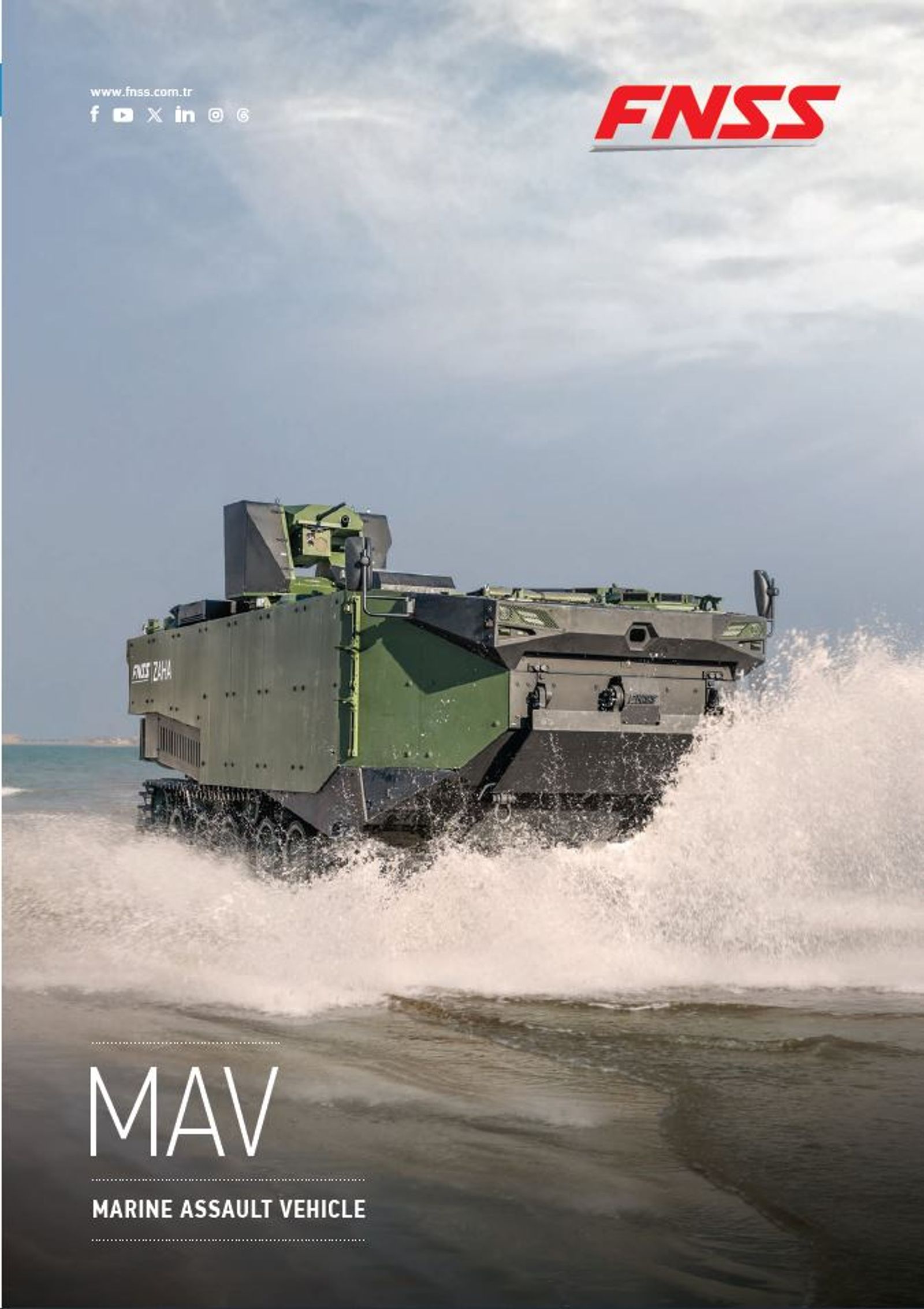
The FNSS ZAHA vehicle represents one of the most notable projects produced by Turkish defence industry in the past decade, combining the demands of open-water amphibious combat with those of an armoured personnel carrier in a single platform. The ZAHA amphibious assault vehicle is known by its full Turkish name, Zırhlı Amfibi Hücum Aracı, while it is marketed internationally under the export designation MAV, short for Marine Assault Vehicle. It was developed by Turkish company FNSS Savunma Sistemleri for the Turkish Naval Forces, specifically the Amphibious Marine Brigade, to serve as the backbone of amphibious landing operations launched from the assault ship TCG Anadolu and from landing craft, before continuing the fight ashore as a fully capable armoured amphibious vehicle.
What Is FNSS ZAHA and Why It Marks a Turning Point
This platform doesn’t belong to the category of armoured vehicles that had limited water-crossing capability bolted on — it was designed from the ground up as an amphibious assault vehicle capable of operating in open water before continuing to fight inland. That design distinction is fundamental: conventional swimming-capable armoured vehicles cross rivers and calm waterways at very low speeds, whereas an amphibious assault vehicle built for a naval landing must launch from a mother ship’s well deck out at sea, withstand waves and currents, maintain its stability and buoyancy for the entire distance to shore, cross the surf zone near the coast — the hardest leg of the journey — and then arrive on the sand with crew and payload ready to engage.
Naming and Operator
The name ZAHA is an abbreviation of the Turkish designation that literally means armoured amphibious assault vehicle, precisely reflecting the platform’s function. Its primary user is the Turkish Naval Infantry within the Amphibious Marine Brigade, the formation tasked with carrying out landing operations, seizing coastal beachheads, and supporting expeditionary operations beyond national borders. This vehicle is the first amphibious platform in the Turkish Armed Forces’ inventory to feature self-righting capability — the ability to return to its normal position if it capsizes in the water — alongside open-ocean operating capability.
Why the Programme Matters
Much of the programme’s significance stems from how rare the industrial capacity to design and produce this class of vehicle is. The head of Türkiye’s Presidency of Defence Industries, Prof. Dr. Haluk Görgün, has noted that the project’s goal was to develop a fully indigenous platform in the armoured amphibious assault vehicle class — a category only a limited number of countries in the world are capable of designing and producing. FNSS, for its part, asserts that it is the only supplier within NATO operating a working production line for this type of vehicle — an industrial position that gives Ankara leverage in a narrow, specialised market.
Programme Timeline: From Prototype to the First Batch of 27 Vehicles
The programme began with a contract between Türkiye’s Presidency of Defence Industries and FNSS to supply 27 vehicles across three configurations: 23 armoured personnel carriers, two command-and-control vehicles, and two recovery vehicles. This breakdown isn’t a minor detail — it reflects the logic of forming a complete landing wave: a transport force carrying the fighters, a command node managing the wave and staying in contact with the mother ship, and a recovery capability to handle breakdowns and vehicles stuck in coastal sand or mud before a disabled vehicle becomes an obstacle blocking the rest of the wave.
Public Unveiling and the Test Programme
The vehicle was first shown to the public in May 2019 at the IDEF international defence industry exhibition in Istanbul, a practical announcement that the programme had moved past the paper-design stage. Five prototypes were built and underwent a full qualification test programme, including mine and blast testing alongside naval and land performance testing. This phase carries particular weight for amphibious platforms specifically, because any failure in hull sealing or hydrodynamic balance is only discovered at sea, and because blast trials on an aluminium hull must prove that watertight integrity holds up after exposure to shock.
Deliveries Began in March 2023
Deliveries to the Turkish Naval Forces began on March 25, 2023, moving the platform from the development phase into actual service. By 2026, the vehicle will have spent more than two years in operational service — enough time for units to build real operational experience: crew training, establishing maintenance cycles, standardising launch-and-recovery procedures from the ship, and assessing the platform’s behaviour under varying sea conditions. This operational experience is what gives any later decision to expand the fleet a real-world basis rather than one resting solely on factory test results.
The May 2026 Second-Phase Contract Expands the FNSS ZAHA Fleet
On May 7, 2026, Türkiye’s Presidency of Defence Industries and FNSS signed a purchase contract at the Istanbul Expo Center for an additional 27 armoured amphibious assault vehicles. This doubles the programme’s total size to 54 vehicles across both batches — a significant number for a class whose fleets are typically measured in the tens rather than hundreds, given its high specialisation and steep unit cost.
Reading the Contract’s Timing
The timing of this contract — more than two years after the first batch entered service — carries a clear signal in defence-procurement logic. In this case, the second batch isn’t the completion of a split original order, but a later decision made after the user had the chance to operate and test the platform in its real environment. When a buyer comes back to order the same quantity again, professional convention reads that as an indicator that field performance met expectations and that operational need exceeds what the first batch covered.
The Industrial Impact on the Production Line
The second-phase contract’s impact goes beyond vehicle count. Production-line continuity is the hardest challenge in low-volume specialised categories, since a line halting after a small batch means work teams disband, accumulated expertise is lost, and the local supply chain is disrupted. By extending production, FNSS keeps ready the line it describes as the only one of its kind operating within NATO — strengthening its negotiating position with any potential foreign customer seeking a supplier capable of delivering from an existing line rather than one that needs to be restarted.
The Hull and Sealed Hydrodynamic Structure
The hull is the core engineering challenge in any armoured amphibious vehicle, because it must satisfy two conflicting sets of requirements: boat-like requirements for buoyancy, stability, and a hull shape that cuts through water with minimal resistance, and armoured-vehicle requirements for rigidity and resistance to fragments and blast waves. For this platform, FNSS adopted an aluminium hull with a sealed, hydrodynamically optimised design.
The Aluminium Choice and Watertight Integrity
The choice of aluminium here isn’t arbitrary — it reduces overall weight, a decisive factor for a platform that must float and move through water at full troop and equipment load, and it resists corrosion better than steel in a saltwater environment, one of the harshest operational environments for equipment. The resulting gap in protective capability is offset by adding supplementary armour plating to the base hull, a common approach that allows protection levels to be adjusted according to mission type and available weight budget.
Self-Righting Capability and Operating in Rough Seas
The most distinctive feature setting this platform apart from its predecessors in the Turkish inventory is its self-righting capability — if the vehicle capsizes in the water, it can return to an upright position. This isn’t a luxury feature but a direct survivability trait: a vehicle carrying a crew of three and up to twenty-one marines capsizing out at sea means a human catastrophe if the platform cannot right itself. This capability is tied to the design of mass distribution, centre of gravity, and hull shape, which together also give the vehicle the ability to operate in rough seas and open water — an indispensable requirement if launches will happen from a mother ship far offshore, beyond the range of coastal defences.
An Integrated Protection Suite
Protection in this class isn’t limited to ballistic armour — it includes an integrated package addressing threats of different natures, from bullets all the way to saltwater itself.
Ballistic and Mine Protection
The aluminium hull provides ballistic protection and mine-blast protection, supplemented by add-on armour plating that raises the protection level further. Mine protection carries particular importance in amphibious missions, because the beach and its approaches are among the most heavily mined and IED-laden zones, and a vehicle emerging from the water is at its most tactically vulnerable: relatively slow, exposed, and loaded with a large number of fighters. The platform underwent mine and blast testing as part of its qualification programme.
Protection Against Contamination, Fire, and Corrosion
The platform includes a nuclear, biological, chemical, and radiological protection system — known by the Turkish abbreviation KBRN — which allows the crew and fighters to remain inside the vehicle in a contaminated environment. It also includes a fire-and-explosion detection and suppression system, which reacts within fractions of a second to extinguish ignited fuel or gases inside the crew compartment before it turns into a full fire. Added to this is a cathodic protection system against corrosion — a feature specific to the marine environment, aimed at extending the life of the hull and metal components exposed to seawater. The package is rounded out with smoke-grenade launchers that provide a concealment screen when exposed or withdrawing.
Powerpack, Transmission, and Land Performance
After reaching the shore, the platform transforms into an armoured personnel carrier expected to keep pace with land manoeuvre, which is why it’s fitted with a diesel powerpack paired with a fully automatic transmission, delivering a power-to-weight ratio of 20 horsepower per tonne.
Engine, Transmission, and Suspension
The 20 hp/tonne power-to-weight ratio puts the platform in a good range for its class — a ratio required twice over: once in the water, where the waterjets need enough power to move a large mass against water resistance and current, and once on land, where the vehicle needs enough acceleration to clear the exposed beach area quickly. The suspension relies on torsion bars, a proven solution combining durability with relative maintenance simplicity, while steering is handled through the transmission, as is standard for tracked vehicles.
Speed and Obstacle Crossing
Top road speed reaches up to 70 km/h. Obstacle-crossing capability includes climbing a 60% frontal grade, moving on a 40% side slope, crossing a 0.9-metre vertical obstacle, and clearing a 2-metre-wide trench. In practical terms, these figures mean the platform isn’t confined to flat coastal areas but can accompany the landed force across rough terrain and push inland once the beachhead is secured.
Waterjet Propulsion and Naval Performance
In the water, the platform relies on two stern-mounted waterjets, reaching a top waterborne speed of seven knots. Waterjet propulsion is the standard choice in modern amphibious assault vehicles because it delivers far greater thrust than tracks alone can provide in water, gives precise manoeuvring and steering when approaching the mother ship’s well deck or positioning within a landing wave formation, and is less prone to damage than exposed propellers when nearing the sandy bottom in shallow water.
What Seven Knots Means in Practice
Seven knots may sound like a modest figure by boat standards, but within the armoured amphibious vehicle class it represents solid performance for an armoured mass measuring 8.3 metres long, 3.3 metres wide, and 3.8 metres tall, loaded with twenty-four personnel. This speed effectively determines how far offshore the mother ship can stand: the higher the waterborne speed, the farther out — and safer — the wave can be launched while keeping transit time within acceptable limits. This is paired with open-ocean operating capability, meaning the crossing doesn’t have to stop at the first deterioration in sea state.
The Remote-Controlled CAKA Turret and Armament
Personnel-carrier variants are armed with the remote-controlled CAKA turret, produced by FNSS itself — an unmanned turret that keeps the gunner inside the hull under armour protection, rather than exposing them to fire in a traditional manned turret.
Armament and Elevation Arc
The turret combines a 12.7 mm M2 HB heavy machine gun with a 40 mm automatic grenade launcher, offering an elevation arc from seven degrees below the horizon to forty-five degrees above it. This elevation range is useful in two environments: coastal terrain, where targets may sit on high ground overlooking the beach, and urban terrain, where targets are spread across upper floors. Combining a 12.7 mm weapon with a 40 mm launcher gives the vehicle a graduated fire response, from precise direct fire to area fragmentation fire.
Stabilisation and Automatic Tracking
The turret includes weapon stabilisation, automatic target tracking, and a thermal sight, all in a lightweight design. Stabilisation carries double importance on an amphibious platform, since firing from a vehicle that’s moving through water or has just emerged from it happens from an unstable base — stabilisation is what makes that fire actually effective in that critical moment. Automatic tracking, meanwhile, reduces the cognitive load on the gunner in a beach scene crowded with targets and movement.
Sensors, Battle Management, and Communications
No modern platform’s value is complete through mechanical specifications alone — it also depends on its ability to see, communicate, and integrate into a networked force. The platform includes day and night vision systems, 360-degree situational awareness, a battle-management system, a navigation suite, and VHF and UHF communications.
360-Degree Situational Awareness
Full-perimeter situational awareness is critical in a vehicle transporting soldiers in an enclosed space with no windows. The crew relies entirely on sensors to build a picture of their surroundings — whether in the water, where collisions with other wave vehicles must be avoided, or on the beach, where distances close and blind spots multiply. The navigation system plays a doubly important role during the water crossing, since heading toward a designated landing point in darkness or poor visibility cannot rely on visual landmarks alone.
Integration into the Amphibious Operation Network
The battle-management system allows the picture of the situation to be shared between wave vehicles and with the command echelon, turning a scattered group of vehicles into a cohesive formation. VHF and UHF communications carry added importance in an amphibious operation because the communication chain stretches from the mother ship to the vehicles in the water and then to the force ashore — any break in that chain means losing control at the most dangerous stage of the entire operation.
Key Specifications Table
| Item | Detail |
|---|---|
| Name | ZAHA / Armoured Amphibious Assault Vehicle |
| Export designation | MAV — Marine Assault Vehicle |
| Manufacturer | FNSS Savunma Sistemleri (Türkiye) |
| User | Turkish Naval Forces — Amphibious Marine Brigade |
| Crew | 3 (commander, driver, gunner) |
| Troop capacity | Up to 21 marines |
| Length | 8.3 m |
| Width | 3.3 m |
| Height | 3.8 m |
| Power-to-weight ratio | 20 hp/tonne |
| Powerpack | Diesel engine with fully automatic transmission |
| Suspension | Torsion bars; steering via transmission |
| Land speed | Up to 70 km/h |
| Water speed | Up to 7 knots via twin stern waterjets |
| Gradient climb | 60% |
| Side slope | 40% |
| Vertical obstacle | 0.9 m |
| Trench crossing | 2.0 m |
| Hull | Sealed aluminium, hydrodynamic design, with self-righting capability |
| Armament | Remote CAKA turret: 12.7 mm M2 HB machine gun and 40 mm grenade launcher |
| Elevation arc | -7 to +45 degrees |
| Protection | Ballistic and mine protection, add-on armour, KBRN (NBC), fire detection and suppression, cathodic protection, smoke grenade launchers |
| Variants | Personnel carrier, command and control, recovery, and a mine-clearance variant |
Variants and Configurations
The programme was designed as a family rather than a single platform — an approach that reduces logistics-support costs since the different configurations share the hull, powerpack, and spare parts.
Personnel Carrier and Command-and-Control Variants
The CAKA-turreted personnel-carrier variant forms the backbone of the fleet, with 23 vehicles in the first batch — the variant that carries marines from ship to shore and then fights alongside them as an armoured personnel carrier. The command-and-control variant, two vehicles in the first batch, is tasked with coordinating the wave of vehicles and maintaining contact with the TCG Anadolu — the node linking the landed force to the naval centre of gravity behind it. Having this node within the wave itself, not solely aboard the ship, reduces decision-making time in moments when the picture changes rapidly.
Recovery and Mine-Clearance Variants
The recovery variant replaces the turret with a crane and towing winch, with two vehicles in the first batch. Its core task is handling disabled vehicles or those stuck in coastal sand and mud — a recurring situation in a beach environment. A mine-clearance variant is also planned within the family, its role being to open safe lanes through coastal minefields ahead of the rest of the wave — a task that alone can determine the success or failure of a landing against a defended coastline.
FNSS ZAHA and TCG Anadolu in the Blue Homeland Doctrine
This platform cannot be read in isolation from the ship it launches from. The assault ship TCG Anadolu, hull number L-400, is the vessel that gives Türkiye genuine naval reach, but a landing ship without landing vehicles capable of reaching the shore remains an incomplete platform. This is precisely where the ZAHA amphibious assault vehicle comes in: it’s the tool that converts the ship’s payload from soldiers aboard into a fighting force on the ground.
The Ship-to-Shore Link
The platform operates from TCG Anadolu and from landing craft, moving marines from ship to shore quickly, then continuing to fight ashore as an armoured personnel carrier. This sequence is the essence of the amphibious concept: a single platform covering both the crossing and the land-combat phases without needing to transfer fighters to other vehicles at the water’s edge — the most dangerous moment in the entire operation.
The Blue Homeland Concept
The programme fits within the Turkish naval doctrine known as the Blue Homeland (Mavi Vatan), a doctrine that emphasises protecting maritime interests and possessing amphibious expeditionary capability that allows operations far from national shores. From this perspective, investing in an indigenous amphibious assault vehicle isn’t merely an arms purchase — it’s a component within a broader capability structure spanning the mother ship, landing craft, and support and communication systems.
International Comparison: Where the Turkish Platform Stands
The armoured amphibious assault vehicle class includes a limited number of platforms worldwide, which makes comparison both possible and useful.
The Previous Generation: AAV-7A1
The American AAV-7A1 remained the global standard for decades and was previously in Turkish service, giving the Turkish user a direct basis for comparison built on actual operating experience rather than catalogue reading. FNSS presents its platform as a modern replacement generation for this class — aimed at users seeking an alternative to fleets that have reached the end of their operational life.
Contemporary Competitors
At the contemporary level, the comparison includes the ACV 1.1 produced by BAE Systems in partnership with Iveco, South Korea’s KAAV, and China’s ZBD-05 family. This short list illustrates the size of the industrial club Türkiye has joined: the number of countries capable of designing and locally producing an armoured amphibious assault vehicle remains extremely limited, which explains the Turkish side’s emphasis on the design’s complete originality. Adding to that, FNSS’s assertion that it’s the only NATO supplier with a working production line in this class is both a marketing and an industrial differentiator.
FNSS’s Industrial Standing and Export Prospects
This programme didn’t appear out of nowhere — it rests on a long industrial track record. FNSS emerged as a joint venture and produced the ACV-15 and ACV-19 armoured vehicle families, the PARS family in 4×4, 6×6, and 8×8 configurations, the KAPLAN family, alongside the KUNDUZ, an armoured amphibious combat engineering vehicle. This accumulated experience across tracked, wheeled, and amphibious vehicles is the engineering foundation that made the move into the amphibious assault class possible.
Export Track Record
The company holds a strong export record including Malaysia with the AV-8 Gempita, Indonesia with the Kaplan MT (known locally as Harimau), in addition to Oman, the United Arab Emirates, the Philippines, and Saudi Arabia. This customer network gives the company a foothold in markets spanning several countries with long coastlines and growing interest in amphibious capabilities.
Potential Export Opportunities
The export pitch rests on three points: an indigenously designed platform free of third-party licensing restrictions, a working, continuous production line thanks to the two domestic orders, and a vehicle that has actually entered service with a NATO-member naval force. Actual in-service status carries particular weight with buyers, since many markets avoid acquiring platforms that haven’t been adopted by their own country of origin. The platform is offered internationally under the MAV designation, aimed at users who operate or plan to operate amphibious assault ships.
Summary and Future Outlook
After more than two years in operational service and a second contract for an additional 27 vehicles signed in May 2026, this platform has moved past the concept-proving stage into programme maturity. Three indicators point to this: continuity of the production line, the same user repeating an order of the same size, and the family expanding into specialised configurations including command and control, recovery, and mine clearance.
What’s Worth Watching
Three open questions remain for the programme in the foreseeable term. The first is the mine-clearance variant entering actual production — the variant that completes the coastal-assault capability. The second is achieving a first foreign export, the true test of the claim to industrial uniqueness within NATO. The third is how the armament and sensor package evolves through upgrade cycles, particularly regarding small drones, which have changed the rules of engagement in recent years — a threat that strikes slow, exposed vehicles emerging from the water more than any other. In all cases, what has been achieved so far places Türkiye in an industrial position reached by only a few countries in this narrow, costly class.
Frequently Asked Questions
What does the name ZAHA mean, and what’s the vehicle’s export designation?
ZAHA is short for the Turkish designation Zırhlı Amfibi Hücum Aracı, meaning armoured amphibious assault vehicle. In foreign markets it’s offered under the designation MAV, short for Marine Assault Vehicle. The manufacturer is Turkish company FNSS Savunma Sistemleri, and the primary user is the Amphibious Marine Brigade of the Turkish Naval Forces.
How many vehicles have been contracted so far?
The first contract covered 27 vehicles: 23 personnel carriers, two command-and-control vehicles, and two recovery vehicles. On May 7, 2026, Türkiye’s Presidency of Defence Industries and FNSS signed a purchase contract at the Istanbul Expo Center for an additional 27 vehicles, bringing the total contracted to 54 vehicles.
What capabilities set this platform apart from an ordinary swimming-capable armoured vehicle?
The core difference lies in three elements: a sealed, hydrodynamically designed aluminium hull enabling operation in open and rough seas; self-righting capability that returns the vehicle to an upright position if it capsizes — the first of its kind in the Turkish inventory; and a twin stern-waterjet propulsion system delivering up to seven knots in water. Added to this is a cathodic protection system specifically designed to resist corrosion from the marine environment.
What’s the vehicle’s relationship to the TCG Anadolu?
The platform operates from the assault ship TCG Anadolu and from landing craft, moving marines from ship to shore quickly and then fighting ashore as an armoured personnel carrier. The command-and-control variant coordinates the wave of vehicles and maintains contact with the ship, making the two interconnected components of Turkish amphibious capability within the Blue Homeland doctrine.


