Saudi Arabia vs UAE: comparing air power by numbers and criteria
Editor’s assessment: This file compares air power alone in Saudi Arabia and the UAE, not the two armed forces as a whole. It separates what has actually been delivered from what is an order, a sale approval or a negotiation, and relies on the US State Department and US Air Force, manufacturer statements (Boeing, Dassault, Airbus and Saab) and SIPRI for spending. Source confidence: high for announced contracts and deliveries, low for current operational numbers, because neither country publishes official tables of its fleets. Note: the comparison declares no winner and does not predict the outcome of any confrontation; the two countries are partners in the Gulf Cooperation Council.
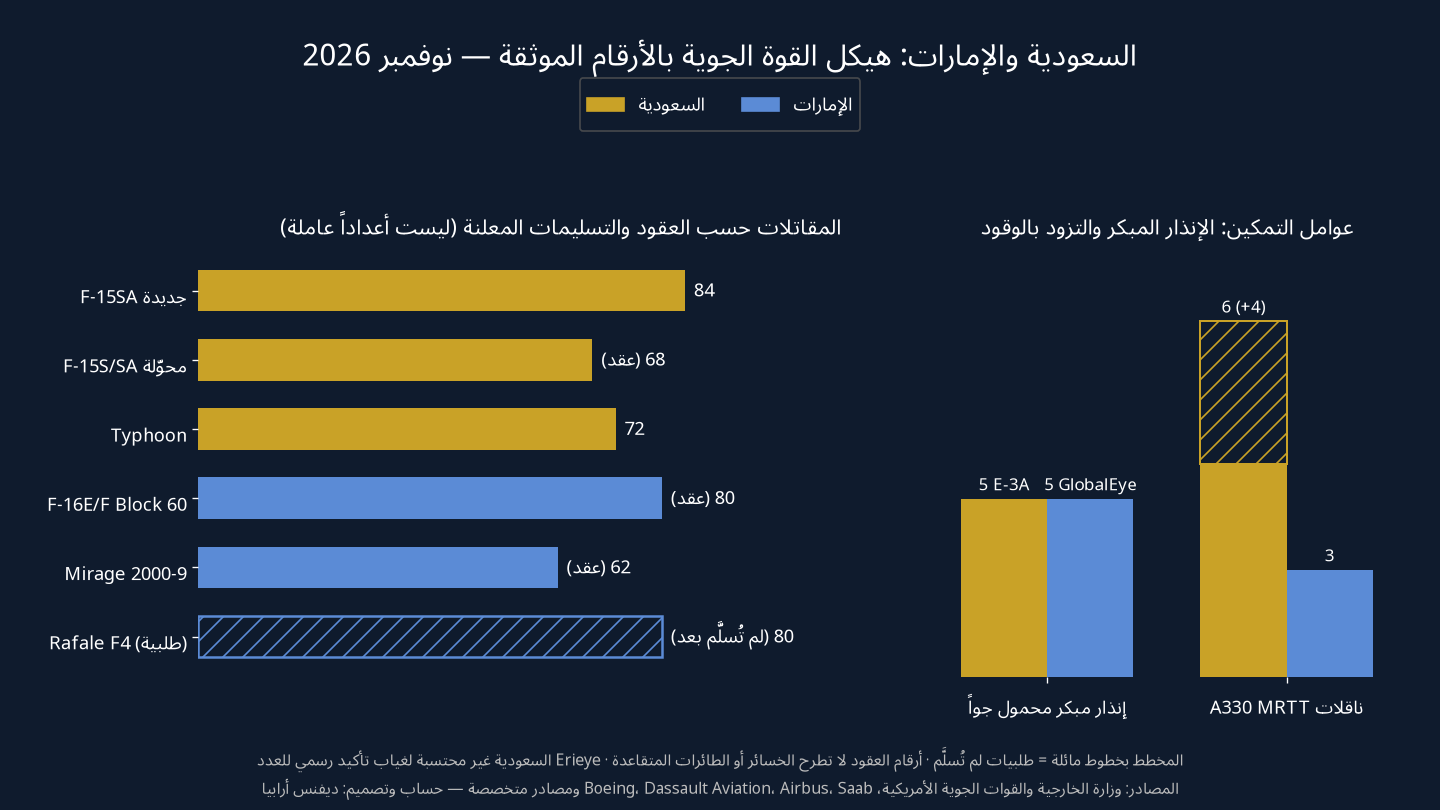
Saudi Arabia has a larger fighter fleet in terms of announced contracts and deliveries, built on the F-15SA and Typhoon, and a larger tanker fleet. The UAE has the newest airborne early warning fleet in the Gulf (5 GlobalEye) and is awaiting the first of 80 Rafale F4 fighters. The Saudi F-35 deal is still a possible sale approval, not a contract.
We have previously compared the two countries at the level of the whole military in Saudi Arabia or the UAE: which Gulf military is stronger in 2026? and a comprehensive comparison of Gulf military capabilities, and compared their arms sources in Saudi and UAE armament compared (all in Arabic). This file differs from them in three ways: it is limited to air power, it gives every figure a clear status (in service, contracted, sale approval, negotiations), and it gives declared weight to enablers such as early warning and air-to-air refuelling, not to fighters alone.
The question matters especially now, because both countries are in the middle of a major modernisation: Riyadh is studying options for additional Typhoons, the F-35 and a sixth-generation programme, Abu Dhabi is about to receive its first Rafale F4, and both are building support fleets that extend the reach of their fighters.
The short answer
- Delivered fighters: Saudi Arabia is larger. It received 84 new F-15SA fighters (deliveries completed in December 2020) and 72 Typhoons (deliveries completed in 2017), in addition to a programme to convert 68 F-15S fighters to the SA standard. The UAE has 80 F-16E/F Block 60 and 62 Mirage 2000-9 fighters; these are contract figures that do not subtract losses.
- Orders: The UAE is awaiting 80 Rafale F4 contracted since 2021, and as of 16 November 2026 no aircraft operating on UAE soil had been announced. Saudi Arabia has a possible US sale approval for 48 F-35As with no signed contract, and negotiations for up to 54 additional Typhoons.
- Early warning: Each country has five principal aircraft, but the difference is age: the Saudi E-3As were delivered in 1986–1987 and are undergoing upgrade programmes, while the UAE GlobalEyes were delivered between 2020 and 2024.
- Air-to-air refuelling: Saudi Arabia has 6 A330 MRTTs in service and 4 more expected to enter service in 2027, against 3 A330 MRTTs for the UAE.
Scope of the comparison
- Data reference date: 16 November 2026.
- What we count: aircraft whose delivery or contract has been officially announced by the US government, the manufacturer or specialist sources reporting their announcements. We give the contract figure as it is and do not subtract losses or retired aircraft, because these are not officially announced.
- What we do not mix: we do not add fighters, transport and training aircraft and helicopters into a single “total aircraft” figure. Nor do we count orders or sale approvals as part of the existing fleet.
- What we mention without counting: Saudi Tornado fighters and Saudi Saab 2000 Erieye aircraft, because we found no officially confirmed operational number.
- What the file does not measure: ground-based air defence (Patriot and THAAD), helicopters, drones, munitions stocks, pilot flying hours and actual readiness.
How did we measure? Methodology and weights
We divided “air capability” into six criteria and gave each a weight reflecting its effect on an air force’s ability to operate continuously and far from its bases. The weights are editorial and declared, and readers can reorder them according to what they consider most important:
| Criterion | Weight | Reason for the weight |
|---|---|---|
| Size and modernity of the delivered fighter fleet | 30% | Fighters are the primary mission tool, and modernity (AESA radar, digital electronic warfare) determines the value of the numbers |
| Enablers: early warning and refuelling | 20% | They determine fighters’ reach and situational awareness, and are harder to buy and operate than the fighters themselves |
| Modernisation path: orders and their stages | 15% | It shapes the force after 2027, but carries less weight because an order is not an existing capability |
| Sustainment and industrial support | 15% | An aircraft without maintenance and spare parts does not fly; we measure announced support contracts and localisation |
| Supplier diversification | 10% | It reduces the risk of political restrictions on spare parts and munitions, but raises integration costs |
| Data and spending transparency | 10% | It determines how far we can trust the figures themselves and affects comparability |
Why don’t we add the weights into a final score? Because current operational numbers are not officially published in either country, and because a criterion such as readiness lacks sufficient reliable data. Any “final score” would suggest a precision that does not exist. So for each criterion we state where each side leads and why, and leave the overall judgement to the reader.
Defence spending: why don’t we compare the two budgets directly?
SIPRI estimated Saudi military spending in 2025 at about $83.2 billion, or about 6.5% of GDP; this is an estimate by the institute, not a detailed official figure. For the UAE, SIPRI’s 2025 table contains no value, as the institute describes its spending as non-transparent, with no information available since 2014. There is therefore insufficient reliable data to compare the two countries’ spending, let alone their spending on air power specifically, and neither publishes a separate air force budget. We explained SIPRI’s method in Arab military spending relative to the economy (Arabic).
Royal Saudi Air Force: the strength of the F-15 and Typhoon
The Saudi strike force is built on the F-15 family. In 2010 the US government notified Congress of a deal including 84 new F-15 fighters and the upgrade of 70 existing ones, and the US Air Force announced delivery of the last F-15SA aircraft on 10 December 2020. The F-15SA features an AESA radar, a digital electronic warfare system, an infrared search and track system and a digital fly-by-wire flight control system. In 2012 Boeing received a contract to convert 68 F-15S fighters to the same standard. We found no official announcement confirming that the conversion has actually been completed, so we classify it as unconfirmed. Our F-15SA vs F-15QA comparison (Arabic) details the technical differences between the Saudi and Qatari versions.
The second pillar is 72 Eurofighter Typhoons ordered in 2007, the first delivered in 2009 and the last in 2017. For the Tornado, we found no officially confirmed operational number, so we classify it as insufficient reliable data. In enablers, the Kingdom operates five E-3A early warning aircraft delivered in 1986–1987 under the Peace Sentinel programme, which have undergone several subsequent upgrade programmes, alongside 6 A330 MRTT tankers in service. In July 2024 the Kingdom ordered 4 additional tankers, which Airbus says will enter service in 2027.
In sustainment, the US State Department approved on 3 February 2026 a possible sale of F-15 sustainment services to the Kingdom at an estimated value of $3 billion. The contract for the additional tankers provided for industrial participation with GAMI and knowledge transfer through SAAMS, the joint company of SAMI and Airbus.
UAE Air Force and Air Defence: F-16 Block 60 and Mirage awaiting the Rafale
In 1998 the UAE announced the purchase of 80 F-16s in a more advanced version than the US Air Force was operating at the time, later known as the F-16E/F Block 60. From France it ordered 62 Mirage 2000-9s, 32 of them new and 30 older aircraft upgraded to the same standard, according to Dassault. Abu Dhabi does not publish an official operational number for either fleet, so we use contract figures and describe the operational number as unconfirmed. Our page on the UAE Air Force (Arabic) presents the fleet in greater detail.
The biggest shift is the Rafale F4. The UAE signed a contract for 80 aircraft on 3 December 2021. Dassault presented the first Emirati Rafale on 29 January 2025, but it remained at the company’s flight test centre in France. The company says in its presentation of first-half 2026 results that it is “preparing for the first deliveries to the UAE at the end of 2026”. The current stage is therefore: production and testing, with no announced operational delivery as of the data reference date.
In early warning, the UAE was the first customer for Saab’s GlobalEye and received the fifth and last in August 2024, completing five aircraft in less than ten years from contract. It has 3 A330 MRTT tankers, the third of which was delivered in 2013. As for the F-35, the UAE suspended its negotiations in 2021, and a UAE official told Reuters in 2024 that the country does not plan to reopen them. We therefore do not count it as an existing order.
Technical table: what has and has not been delivered
| Category | Saudi Arabia | UAE | Status |
|---|---|---|---|
| US multirole fighters | 84 new F-15SA | 80 F-16E/F Block 60 (contract figure) | In service (current operational number unconfirmed) |
| European fighters | 72 Eurofighter Typhoon | 62 Mirage 2000-9 (32 new + 30 upgraded) | In service (current operational number unconfirmed) |
| Fighter upgrade programmes | Conversion of 68 F-15S to SA standard (2012 contract) | — | Saudi Arabia: completion of conversion unconfirmed |
| Older fighters | Tornado | — | Insufficient reliable data on operational number |
| Contracted fighters | — | 80 Rafale F4 (contract of 3 December 2021) | Production and testing; first delivery scheduled for end-2026 |
| Sale approvals and negotiations | 48 F-35A (possible sale approval, 17 September 2026); up to 54 Typhoons (negotiations) | F-35: negotiations suspended since 2021 | No signed contract in any of them |
| Airborne early warning | 5 E-3A (delivered 1986–1987, upgraded); Saab 2000 Erieye (per reports; number not officially confirmed) | 5 GlobalEye (delivered 2020–2024) | In service |
| Refuelling tankers | 6 A330 MRTT + 4 ordered (service 2027) | 3 A330 MRTT (deliveries completed 2013) | In service / contracted |
| Military spending 2025 (SIPRI) | About $83.2 billion (SIPRI estimate), 6.5% of GDP | Insufficient reliable data | Calculation methods not comparable |
Strengths and weaknesses
Royal Saudi Air Force
- Strength: a larger, fully delivered heavy fighter fleet centred on the relatively modern F-15SA (last delivery 2020).
- Strength: a larger tanker fleet, with a contracted increase to 10 aircraft.
- Strength: announced support and localisation contracts, including F-15 sustainment and industrial participation in the MRTT contract.
- Weakness: E-3A early warning aircraft from the 1980s, despite upgrades.
- Weakness: the decision on the next fighter has not been settled: the F-35 has no contract, and additional Typhoons are under negotiation.
- Weakness: heavy dependence on the US supplier for heavy fighters.
UAE Air Force and Air Defence
- Strength: the newest early warning fleet in the Gulf (GlobalEye), with delivery completed.
- Strength: clear diversification between US and French fighters; the Rafale F4 will add a modern fighter in large numbers.
- Weakness: today’s operational fighter fleet is older: the latest F-16E/F and Mirage 2000-9 deliveries date back to the first decade of this century.
- Weakness: a time gap between contract and squadron: the Rafale has not yet entered actual service, and the F-35 file is suspended.
- Weakness: a smaller tanker fleet (3 aircraft) and less transparency in spending data.
Criterion-by-criterion assessment
| Criterion | Weight | Who has the relative edge? | Reasoning |
|---|---|---|---|
| Size and modernity of the delivered fighter fleet | 30% | Saudi Arabia | A larger number of relatively modern heavy fighters (F-15SA and Typhoon), fully delivered |
| Enablers | 20% | Close | The UAE is newer in early warning; Saudi Arabia is larger in tankers |
| Modernisation path | 15% | UAE clearer | 80 Rafales contracted and in production, against a Saudi sale approval and negotiations with no contract |
| Sustainment and industrial support | 15% | Saudi Arabia (medium confidence) | More announced support and localisation contracts; but UAE support data is of limited public availability (including a GlobalEye support contract) |
| Supplier diversification | 10% | UAE | A clearer spread between the United States, France and Sweden across the main platforms |
| Data and spending transparency | 10% | Saudi Arabia | A SIPRI estimate is available for Saudi Arabia but not for the UAE |
The correct reading of this table is that the two countries chose different models: Saudi Arabia built a large force around heavy fighters and tankers, while the UAE invested early in early warning and diversification and is betting on the Rafale to modernise its fighter fleet. No single criterion is enough to judge overall “strength”.
Conclusion and limits
On documented figures, Saudi Arabia has a larger fighter and tanker fleet, while the UAE has a newer early warning fleet and a contractually clearer fighter modernisation path. Much of this picture will change between 2027 and 2031 depending on three variables: the pace of Rafale deliveries to the UAE, whether or not the Saudi F-35 approval is turned into a contract, and a decision on the additional Typhoon order. Our file on Saudi Arabia and the GCAP programme (Arabic) follows the sixth-generation track.
Limits of the comparison: (1) Contract figures do not subtract lost or retired aircraft, because neither country publishes this. (2) We did not measure pilot readiness, flying hours or munitions stocks owing to a lack of data. (3) We excluded ground-based air defence, even though the UAE force is named “Air Force and Air Defence”. (4) The weights are editorial and declared, and changing them changes the reading. (5) This comparison is not suitable for predicting the outcome of any conflict; the two countries are allies.
Frequently asked questions
How many combat aircraft does Saudi Arabia have?
The Kingdom does not publish a single official figure. Documented by contract: 84 new F-15SA and 72 Typhoons, and a programme to convert 68 F-15S to the SA standard. There is insufficient reliable data on the number of Tornados in operation.
How many fighter aircraft does the UAE Air Force have?
Contract figures: 80 F-16E/F Block 60 and 62 Mirage 2000-9. The current operational number is not officially confirmed, and 80 Rafale F4 will be added once delivered.
Does Saudi Arabia have F-35 fighters?
No. The US State Department approved on 17 September 2026 a possible sale of 48 F-35As at an estimated value of $24.3 billion, but no contract signing or delivery schedule has been announced.
When will the UAE receive its Rafale fighters?
Dassault says the first deliveries are scheduled for the end of 2026. The first aircraft, presented in January 2025, remained at the test centre in France.
Which is stronger in the air: Saudi Arabia or the UAE?
We declare no winner. Saudi Arabia is larger in fighters and tankers, while the UAE is newer in early warning and contractually clearer in fighter modernisation. Actual strength depends on factors for which no data is published, such as readiness and training.
Sources
- US State Department — Kingdom of Saudi Arabia: F-35 Lightning II, congressional notification, 17 September 2026 — state.gov.
- US Defense Security Cooperation Agency (DSCA) — Major arms sales list: Saudi Arabia, F-15 sustainment, 3 February 2026 — dsca.mil.
- US Air Force — Delivery of the final F-15SA aircraft to the Royal Saudi Air Force, 11 December 2020 — af.mil; and The Guardian — Congressional notification of the 2010 deal (84 new fighters and 70 upgrades), 21 October 2010 — theguardian.com.
- Airforce Technology — Boeing contract to convert 68 F-15S fighters to the SA standard, 4 November 2012 — airforce-technology.com.
- Boeing — Upgrade of the Saudi five-aircraft E-3 early warning fleet, 20 September 2007 — boeing.mediaroom.com.
- Airbus — Saudi Arabia orders 4 additional A330 MRTTs, 10 July 2024 — airbus.com; and Aviation Week — Current Saudi fleet of 6 MRTTs, 10 July 2024 — aviationweek.com.
- Warsight — The Saudi air force’s path: Typhoon (72 aircraft, 2007–2017) and the F-35, 23 September 2026 — warsight.com; and FlightGlobal — Prospect of a Saudi order for 54 additional Typhoons, 13 February 2026 — flightglobal.com.
- Dassault Aviation — Presentation of the first UAE Rafale, 29 January 2025 — dassault-aviation.com; and presentation of first-half 2026 results — dassault-aviation.com.
- Dassault Aviation — Mirage 2000-9 file (62 aircraft: 32 new and 30 upgraded) — dassault-aviation.com.
- Arms Control Association — UAE buys 80 F-16 fighters, May 1998 — armscontrol.org.
- Saab — Delivery of the fifth GlobalEye to the UAE, 17 September 2024 — saab.com; and Shephard — GlobalEye support contract — shephardmedia.com.
- Al Defaiya — Delivery of the third A330 MRTT to the UAE, 7 August 2013 — defaiya.com.
- Reuters — UAE does not plan to reopen F-35 negotiations, 14 September 2024 — reuters.com.
- SIPRI — Military Expenditure Database 1949–2025, April 2026 — sipri.org.
Published: 18 November 2026. Data reference: official announcements and manufacturer statements up to 16 November 2026. We will update this file when the first Rafale is delivered to the UAE, or when an F-35 or Typhoon contract is signed for Saudi Arabia.