
What is a bunker buster bomb? And how does it penetrate concrete
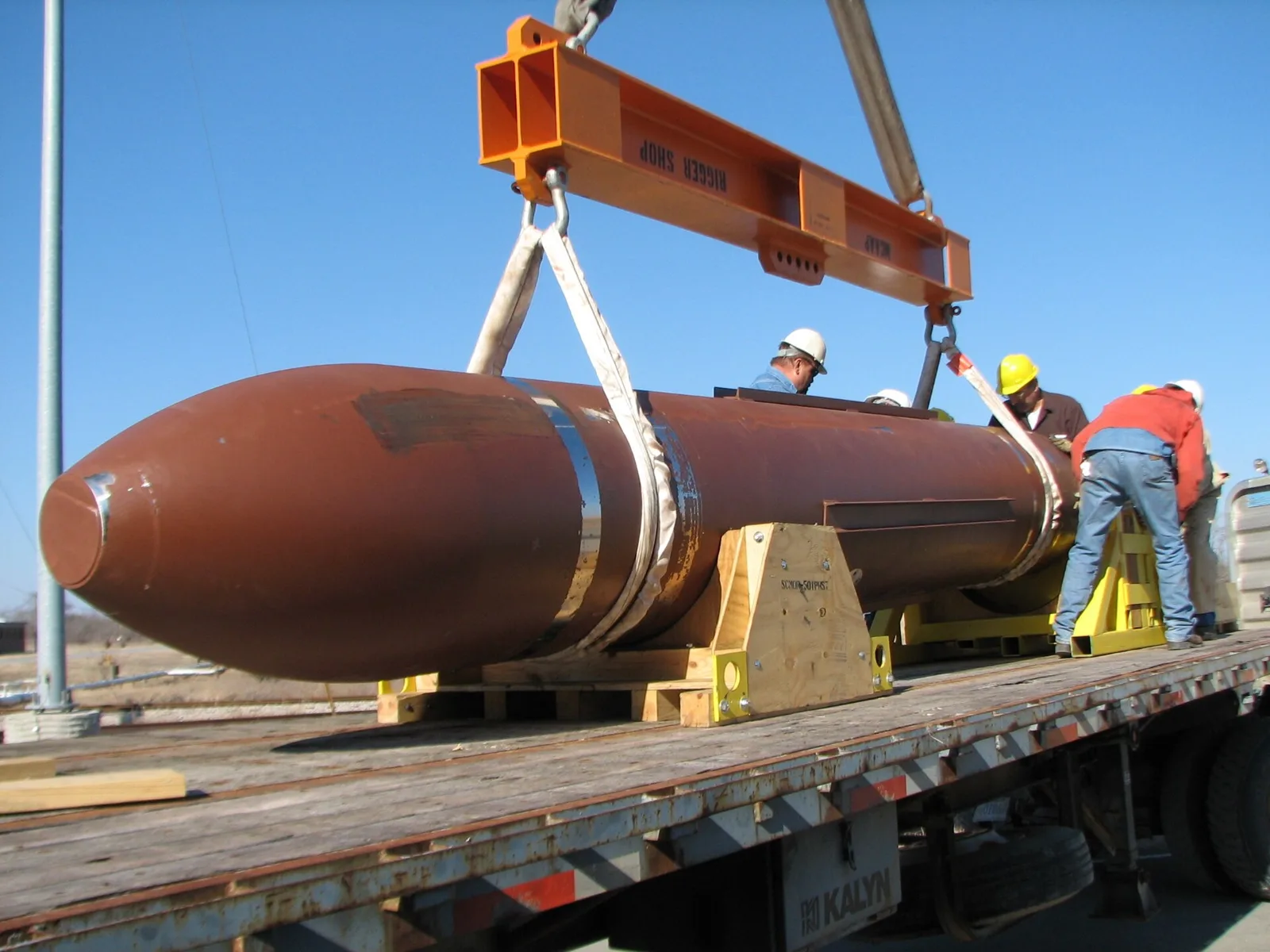
The direct answer: A bunker buster is a munition designed to penetrate layers of soil or reinforced concrete before detonating, in order to destroy bunkers and hardened or deeply buried facilities. The glossary of Türkiye’s Presidency of Defence Industries (SSB) defines a “penetrating warhead” as a warhead designed to penetrate armour and concrete surfaces.
How do bunker-busting bombs work?
The concept rests on three elements:
- A heavy, robust casing: keeps the bomb intact during penetration.
- Precise guidance: ensures the intended point is hit, often using GPS.
- A delayed fuze: postpones detonation until the bomb reaches the required depth.
The greater the bomb’s mass and its velocity at impact, the greater the potential depth of penetration.
The US 30,000-pound-class MOP
The US Air Force says the GBU-57 “Massive Ordnance Penetrator” (MOP) was designed to reach and destroy weapons of mass destruction located in well-protected facilities, and that it is more powerful than the BLU-109. The Defense Threat Reduction Agency (DTRA) began testing it in 2004. A Congressional Research Service (CRS) report describes it as a 30,000-pound-class precision-guided penetrator designed to defeat hardened and deeply buried targets. The report states that the United States used it for the first time in strikes on Iranian nuclear facilities in 2025; we mention this here for context only.
| Category | General description |
|---|---|
| Penetrating warheads on standard bombs | Penetrating versions of general-purpose bombs, such as the BLU-109 warhead referred to by the US Air Force |
| Very heavy penetrating bombs | Such as the 30,000-pound-class GBU-57 MOP |
| Penetrating missiles and warheads | Tandem (Arabic) or penetrating warheads on cruise missiles and air-to-surface missiles |
Arab capabilities
Defence Arabia covered the announcement by the UAE’s EDGE Group that it had completed development of the MK82 Penetrator bunker-busting bomb (Arabic), one of the few publicly announced indicators of local Arab development in this field. For the guidance kits that turn bombs into precision munitions, see our articles on JDAM, laser guidance and air-to-surface missiles (all in Arabic).
Information status: The MOP’s characteristics are confirmed by the US Air Force and the Congressional Research Service. The EDGE munition is based on the company’s announcement as we covered it; we have not verified its service status.
Frequently asked questions
What is a bunker-busting bomb?
A munition with a heavy casing and a delayed fuze that penetrates soil or concrete before detonating in order to destroy hardened facilities.
What is the largest bunker-busting bomb?
Among the heaviest is the US GBU-57 MOP, which the Congressional Research Service describes as a 30,000-pound-class weapon.
What is the difference between a penetrating warhead and a tandem warhead?
A penetrating warhead relies on mass and a robust casing to penetrate concrete. A tandem warhead uses two successive charges, often to defeat reactive armour or fortifications.
Why do bunker-busting bombs need precise guidance?
Because penetration requires impact at a specific point and at a suitable angle; a small error can greatly reduce their effect.
Further reading: Encyclopedia of defence terms (Arabic).
Information verified on: 3 November 2026.
Sources
- US Air Force – Massive Ordnance Penetrator Fact Sheet
- Congressional Research Service – IF11353
- Presidency of Defence Industries of Türkiye – Savunma Sanayii 360 glossary
Image: Defense Threat Reduction Agency (DTRA) personnel lower a 30,000-pound MOP in preparation for testing (US Department of Defense photo, public domain via Wikimedia Commons).