Katmerciler EREN 4×4: Türkiye’s Armoured Vehicle for Urban Operations
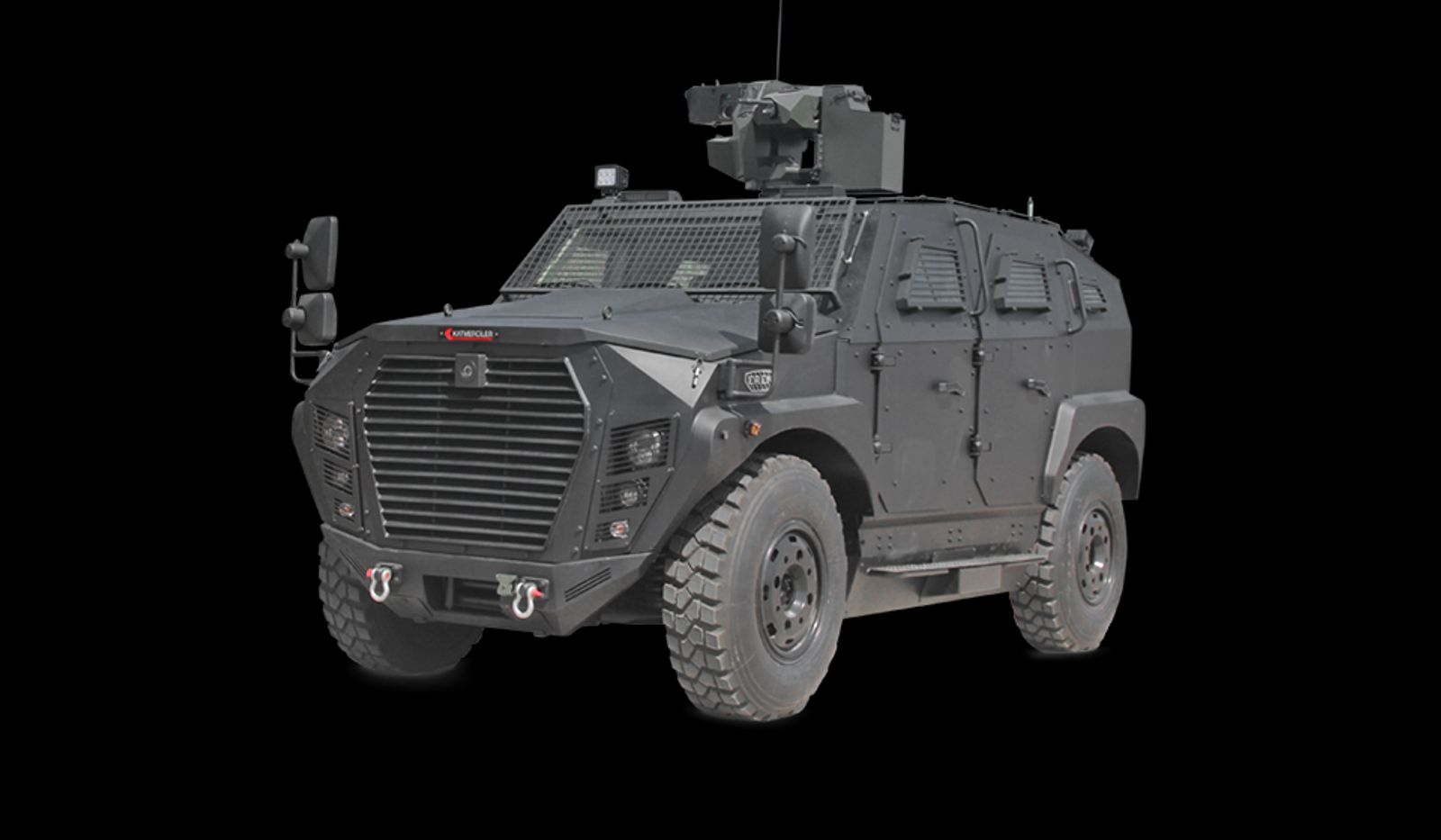
The Katmerciler EREN 4×4 is a compact armoured urban response vehicle developed as a private venture by the Izmir-based manufacturer Katmerciler for internal security forces working in densely built-up terrain. Unveiled at IDEF’21 and declared ready for serial production later the same year, it occupies a deliberately narrow niche in an otherwise crowded Turkish armoured vehicle market. The vehicle is small enough to operate in streets that a full-size mine-resistant hull cannot negotiate, yet protected, powered and equipped to a standard that allows a five-person team to survive, fight and withdraw from a contested urban environment.
What the Katmerciler EREN 4×4 Is and Why It Matters
Formally designated the EREN 4×4 Meskun Mahal Mudahale Araci, and marketed in English as the EREN 4×4 Tactical Urban Warfare Vehicle, the design belongs to a category that Turkish industry has spent two decades refining: the internal security vehicle. This is not a battlefield armoured personnel carrier scaled down, nor a police van with steel plate bolted to it. It is a purpose-built platform intended for gendarmerie, police special operations and army units conducting operations inside towns and cities, where the threat spectrum runs from rifle fire and improvised explosive devices to petrol bombs, thrown masonry and barricades.
A vehicle sized for the street, not the highway
The defining characteristic of the EREN 4×4 is its footprint. At 4,700 mm long, 2,100 mm wide and 2,150 mm high, it is dimensionally closer to a large pickup truck than to the mine-resistant vehicles that dominate photographs of Turkish counter-terrorism operations. That is a design decision rather than a compromise. Urban response work is governed by geometry: the width of an alley, the radius of a corner, the load rating of an old bridge, the clearance under a balcony or an overhead cable. A vehicle that cannot reach the objective offers no protection at all, regardless of how thick its armour is.
Why the segment matters
Internal security has become one of the most commercially significant segments of the global armoured vehicle market, and one of the few in which a mid-sized manufacturer can compete against far larger primes. Requirements are written by interior ministries and national police forces rather than defence procurement agencies, order quantities are steady rather than spectacular, replacement cycles are driven by hard use rather than by generational technology shifts, and export customers frequently want local assembly. The EREN 4×4 is a direct expression of that market logic, and the joint production agreement Katmerciler signed with Malaysia’s DEFTECH in July 2025 confirms it.
The Name: Eren Bulbul and the IDEF’21 Launch
Turkish armoured vehicles are usually given names drawn from mythology, geography, or predatory animals. The EREN is an exception, and understanding the name explains a good deal about how the vehicle was positioned when it was introduced.
The commemoration
The vehicle is named after Eren Bulbul, a 15-year-old boy killed by the terrorist organisation on 11 August 2017 in the Macka district of Trabzon. The naming also commemorates Jandarma Astsubay Kidemli Cavus Ferhat Gedik, who died attempting to rescue him. Both deaths became national reference points in Türkiye for the human cost of rural and semi-urban counter-terrorism operations, and the decision to attach those names to an internal security vehicle framed the product explicitly as an instrument of domestic protection rather than as an expeditionary combat platform.
The IDEF’21 debut alongside HIZIR II
The EREN 4×4 was unveiled at IDEF’21, the 15th International Defence Industry Fair, at a launch attended by President Recep Tayyip Erdogan and hosted by Katmerciler Board Chairman Ismail Katmerci. The vehicle shared its debut with HIZIR II, an enhanced version of the HIZIR platform that Katmerciler had first launched in 2016. Presenting the two together allowed the company to show a coherent product line rather than a single item: HIZIR II for mine-resistant tactical work over open and rural ground, and the EREN for the confined urban environment where HIZIR is simply too large.
The wider Katmerciler stand
Two further products rounded out the IDEF’21 display. The KIRAC criminal investigation vehicle addressed the forensic and evidence-handling side of internal security, a niche rarely covered by armoured vehicle manufacturers. UKAP, described as Türkiye’s first unmanned ground vehicle fitted with a remote controlled turret, signalled that the company intended to follow the wider Turkish industry into robotic systems. Taken together, the four products defined Katmerciler as a supplier to the internal security customer across the full spectrum from investigation to armed intervention.
The Urban-Operations Requirement and Design Philosophy
The EREN 4×4 was designed against a requirement that is easy to state and difficult to satisfy: deliver meaningful ballistic and mine protection, plus the ability to carry an armed team and a weapon station, inside a vehicle small enough to manoeuvre through a historic town centre or an unplanned urban district.
Lessons from internal security operations
The practical background to that requirement is Türkiye’s own experience of counter-terrorism operations in the southeast, of urban operations conducted in built-up districts, and of border security work. Those operations demonstrated repeatedly that the vehicles best suited to open ground are frequently the wrong tool once a unit crosses into a dense street grid. Long wheelbases and high hulls that provide excellent blast standoff on a rural track become liabilities where the turning circle is dictated by two rows of parked cars, and where a vehicle that cannot reverse quickly out of a cul-de-sac is a target rather than an asset.
Design priorities
Katmerciler describes the EREN as fast, strong, dynamic, highly manoeuvrable, ergonomic, versatile and simple to maintain, and suited to a wide range of climate conditions. Stripped of its promotional framing, that list identifies the trade space the engineers worked in. Speed and dynamism matter because urban intervention is a matter of arriving before a situation consolidates. Manoeuvrability is the entry ticket to the mission. Ergonomics matter because a five-person team in body armour needs to mount and dismount rapidly through a small aperture. Maintainability matters because internal security fleets accumulate hours in short, hard cycles, often maintained by police or gendarmerie workshops rather than by specialist armoured vehicle depots.
The compactness trade-off
Every kilogram of armour on a small vehicle is more expensive, in engineering terms, than the same kilogram on a large one. There is less structural depth to work with, less volume for standoff, and a tighter power-to-weight budget. The design response visible in the EREN 4×4 is to make the hull itself do the structural work, to concentrate protection where the crew actually sits, and to accept a five-person capacity rather than chase the eight- to twelve-seat figures typical of larger Turkish armoured vehicles.
Armoured Monocoque Hull and Dual-Layer Protection
The structural heart of the vehicle is an armoured monocoque hull designed by Katmerciler in-house. This is the single most important technical claim the company makes about the platform, and it is the feature that separates a purpose-built armoured vehicle from an armoured conversion.
Monocoque construction
In a monocoque design, the armour envelope is the load-bearing structure. There is no separate commercial chassis frame carrying a bolted-on protected capsule; the hull itself absorbs suspension, drivetrain and payload loads while providing protection. The advantages in this class are substantial. Structural mass and protective mass are the same mass, which is decisive in a vehicle with a small footprint. Joints, seams and the aperture surrounds that are the traditional weak points of add-on armour are designed in from the outset rather than engineered around. Hull geometry can be shaped for blast deflection rather than inherited from a truck.
The corresponding cost is industrial. A monocoque armoured hull demands cutting, forming and welding capability for armour steel, dimensional control across a large welded assembly, and a validation programme conducted on complete vehicles rather than on sample panels. That capability is precisely what Katmerciler built up through the HIZIR programme and applied to the smaller EREN.
The dual-layer armour approach
Katmerciler specifies a dual-layer armour protection system providing what the company describes as a high level of ballistic and mine protection. In an internal security vehicle, a layered arrangement addresses a threat set that is genuinely mixed. The urban threat is not only the armour-piercing rifle round; it is also fragmentation from an improvised device, spalling behind the primary plate, incendiary attack against the crew compartment, and the accumulation of impact damage from thrown objects that would degrade a single-layer solution over time. A layered structure also allows the vehicle to be repaired at a component level, replacing damaged outer elements without rebuilding the hull.
Firing ports and crew fightability
The EREN 4×4 has four firing ports. In an era of remote weapon stations and vision systems, firing ports can look anachronistic, but in the urban response role they remain relevant. They allow the embarked team to engage threats at very close range and at high elevation angles, including from upper floors, without opening a hatch or dismounting. They also give the crew a way of applying non-lethal or less-lethal means from behind armour, which is often the decisive requirement in a public order or hostage-adjacent scenario. Combined with the vehicle’s compact silhouette, four ports represent a sensible allocation of protected apertures for a five-person crew.
Dimensions, Manoeuvrability and Confined-Space Performance
The published dimensions are worth examining individually, because each one maps onto a specific urban constraint.
The numbers in context
A length of 4,700 mm keeps the vehicle inside the envelope of a standard parking space and, more importantly, keeps the turning circle small enough for junctions in unplanned urban development. A width of 2,100 mm is roughly that of a large commercial van and allows passage through gateways, gaps between bollards and single-lane alleys that would stop a wider tactical vehicle. A height of 2,150 mm matters for underpasses, tunnel entrances, car park structures, overhead wiring and low-hanging balconies, and it also reduces the vehicle’s exposure to fire from upper storeys by limiting how much of the roof is visible from street level.
What the footprint buys operationally
The operational payoff of these dimensions is access. An urban response vehicle that can enter the objective street rather than stopping two blocks away changes the tactical problem: the dismount point moves from an exposed approach march to the doorway itself. Reduced dimensions also improve the vehicle’s ability to reverse out of a compromised position, to use side streets as alternate routes, and to be transported. A vehicle of this size fits inside standard containerised and air transport envelopes far more easily than a full-size mine-resistant platform, which materially reduces the cost of moving a deployable reserve between provinces or of demonstrating the product to an export customer.
Crew accommodation
The EREN 4×4 carries five personnel: a driver, a commander and three more. That is a squad element rather than a full section, and it fits the way urban intervention teams actually work, in small groups moving between covered positions. Two vehicles carry a full intervention team with redundancy, which is generally preferable to a single larger vehicle that becomes a single point of failure in a street where mobility is the primary form of protection.
Powerpack: Cummins ISB and Allison Automatic Transmission
The EREN 4×4 uses a proven commercial powerpack rather than a bespoke one, which is the correct choice for an internal security vehicle intended for export.
The Cummins ISB 250 hp diesel
Power comes from a Cummins ISB turbodiesel of 4.5 litres producing 250 hp. The ISB family is one of the most widely fielded medium-duty diesel families in the world, used across commercial trucks, buses, fire appliances and tactical vehicles, and that ubiquity is the point. Spare parts, service literature, diagnostic equipment and trained technicians exist in essentially every market a Turkish manufacturer might sell into. For a police or gendarmerie fleet operator without a specialist armoured vehicle depot, that logistical familiarity is worth more than a marginal gain in specific output.
Two hundred and fifty horsepower in a vehicle of this size gives the EREN a power-to-weight ratio appropriate to rapid urban response, including the standing starts, sharp accelerations and steep ramp climbs that characterise city driving. A 4.5-litre displacement also keeps the engine bay short, which in turn helps the frontal geometry and driver visibility that matter so much in confined manoeuvring.
Allison 2000 series six-speed automatic
Drive is through an Allison 2000 series fully automatic transmission with six forward speeds. Allison automatics are the default choice across the internal security and tactical vehicle world for a set of practical reasons. A fully automatic gearbox removes clutch management from a driver who may be operating under stress, wearing gloves and body armour, watching for threats and coordinating with a commander. It smooths torque delivery in stop-start driving and on slippery surfaces such as wet cobbles and debris. It reduces driver training time, which matters for police forces that rotate personnel. And it substantially extends drivetrain life in a duty cycle dominated by low-speed manoeuvring.
The combination of a widely supported medium-duty diesel and an equally widely supported automatic transmission is also an export enabler. It is far easier to negotiate a local production arrangement, as Katmerciler has done in Malaysia, when the major driveline components are already supported in the partner country through existing commercial channels.
Speed, Range and Mobility
Road performance
Maximum speed is quoted at 110 km/h. For an internal security vehicle this figure is less about pursuit than about self-deployment. A unit that can move between districts, or reinforce another city, on its own wheels at motorway speed does not need transporters, and does not lose hours to loading and unloading. It also allows a small fleet to cover a wide area of responsibility from a central base rather than requiring dispersed garrisons.
Endurance and logistics
Range is quoted at more than 600 km. In the urban response role, endurance is consumed differently than in field operations: much of it is spent idling at cordons, moving at walking pace behind dismounted teams, and running auxiliary loads. A range figure beyond 600 km therefore translates into a long operational day without refuelling, and into an ability to reposition across a region and still arrive with usable fuel. Combined with the vehicle’s compact dimensions, it also makes the EREN 4×4 practical as a border security or convoy escort asset in areas where fuel resupply is intermittent.
All-terrain capability
Although the vehicle is optimised for built-up areas, the 4×4 driveline and the mine-protected hull mean it is not confined to asphalt. Urban operations rarely stay urban: approach routes cross rubble, unmade tracks, riverbeds and agricultural land, and the boundary between a town’s edge and open country is where much internal security work actually takes place. Katmerciler emphasises suitability across a wide range of climatic conditions, a claim consistent with a commercial driveline designed for global service and with the hot, cold and dusty environments found within Türkiye itself.
Weapon Station Options and Optional Equipment
The EREN 4×4 is offered as a configurable platform rather than as a fixed specification, which is standard practice in the internal security market where two customers rarely want the same fit.
Remote controlled weapon station
The principal armament option is a stabilised remote controlled weapon station, offered with 12.7 mm or 7.62 mm machine guns or a 40 mm automatic grenade launcher. The operational argument for a remote station on a small urban vehicle is straightforward: it lets the commander observe, identify and if necessary engage without exposing a body through a roof hatch, which is the single most vulnerable posture in street fighting. Stabilisation permits observation and accurate fire on the move, which matters in a role where stopping is often more dangerous than continuing.
The choice between calibres reflects the breadth of the internal security mission. A 7.62 mm station is the proportionate option for police and gendarmerie work where collateral risk dominates. A 12.7 mm station addresses light vehicles, improvised armour and structures. A 40 mm automatic grenade launcher provides area effect and defilade engagement in situations closer to open combat. Because the station is optional and modular, a fleet can be configured unit by unit, and vehicles can be re-roled without structural modification.
Smoke grenade launchers and recovery winch
Smoke grenade launchers give the crew an immediate means of breaking contact, screening a dismount or covering the extraction of casualties, and in the internal security role they can also be loaded with less-lethal payloads depending on national practice. A recovery winch is a more mundane but arguably more frequently used item: it allows the vehicle to clear a barricade, drag an obstructing car out of a street, or recover itself or a companion vehicle without waiting for a specialist recovery asset that may not be able to reach the location at all.
CBRN, Fire Suppression, CTIS and Other Systems
CBRN positive-pressure system
An optional chemical, biological, radiological and nuclear protection system using positive pressure, or overpressure, is available. In practice, the most common use of overpressure in an internal security vehicle is not battlefield chemical warfare but the everyday problem of riot control agents and smoke. A crew supporting a public order operation frequently drives through its own or another unit’s gas, and an overpressure system with filtration allows the vehicle to keep operating with the crew unmasked. The same system provides genuine protection against industrial hazards, which is a realistic concern in urban response near chemical plants, and against deliberate chemical or radiological contamination.
Fire detection and suppression
An automatic fire detection and suppression system is offered as an option. This is close to mandatory equipment in the urban role, where incendiary attack is one of the most likely threats a vehicle will actually face. Petrol bombs and burning barricades are far more common in city operations than anti-tank weapons, and an automatic system that detects and extinguishes a fire in the engine bay or crew compartment within milliseconds is the difference between an incident and a total loss.
Central tyre inflation
A central tyre inflation system allows the driver to change tyre pressures from the cab to suit the surface, lowering pressure for soft ground and raising it for road running. In an urban context CTIS has an additional value: it helps a vehicle keep moving after tyre damage from debris, glass and deliberately laid obstacles, extending the distance the crew can cover before they are forced to stop and change a wheel in an exposed position.
Systems integration as the real product
Individually, none of these subsystems is unique to the EREN. What matters is that they are integrated into a hull of this size without compromising the crew volume or the vehicle’s dimensions. Packaging an overpressure filtration unit, a suppression system, CTIS plumbing, a winch, a weapon station and its power supply into a 4,700 mm vehicle that still seats five is the genuine engineering achievement, and it is the sort of work that only becomes possible when the manufacturer controls the hull design rather than adapting someone else’s chassis.
Key Characteristics of the Katmerciler EREN 4×4
| Characteristic | Detail |
|---|---|
| Designation | EREN 4×4 Meskun Mahal Mudahale Araci / EREN 4×4 Tactical Urban Warfare Vehicle |
| Manufacturer | Katmerciler Arac Ustu Ekipman Sanayi ve Ticaret A.S., Izmir, Türkiye |
| Role | Urban response vehicle for internal security forces, armed forces and law enforcement |
| Length | 4,700 mm |
| Width | 2,100 mm |
| Height | 2,150 mm |
| Crew and capacity | 5 personnel (driver, commander and three others) |
| Hull | Armoured monocoque designed by Katmerciler; dual-layer armour protection system |
| Firing ports | Four |
| Engine | Cummins ISB turbodiesel, 4.5 litres, 250 hp |
| Transmission | Allison 2000 series fully automatic, six forward speeds |
| Maximum speed | 110 km/h |
| Range | More than 600 km |
| Weapon station (optional) | Stabilised remote controlled weapon station with 12.7 mm, 7.62 mm or 40 mm automatic grenade launcher |
| Other optional equipment | Recovery winch, fire detection and suppression system, smoke grenade launchers, CBRN positive-pressure system, central tyre inflation system |
| Public debut | IDEF’21, alongside HIZIR II |
| Programme status | Test programme completed; declared ready for serial production in September 2021 |
| Export cooperation | Joint production agreement with DEFTECH (Malaysia), signed 24 July 2025 at IDEF 2025 |
Serial Production Readiness and the Test Programme
An in-house private venture
The EREN 4×4 was designed and tested entirely within Katmerciler’s own research and development facilities, funded as a private venture rather than under a state development contract. That distinction carries real weight in the Turkish defence industry, where many programmes originate from a customer requirement backed by public funding. A private venture means the company carried the development risk itself and retained full commercial control of the design, which is precisely what makes an arrangement such as the DEFTECH agreement straightforward to conclude: there is no third-party programme office whose approval is needed before the intellectual property can be taken abroad.
The September 2021 statement
On 30 September 2021, Katmerciler research and development manager Fahrettin Akpak stated that the EREN had completed its test programme, that the results exceeded customer requirements, and that the vehicle was ready to enter service whenever required. In other words, the platform was ready for serial production roughly two months after its public debut, which indicates that the IDEF’21 unveiling presented a mature design rather than a concept demonstrator.
What test completion implies
A completed qualification programme for a vehicle in this class normally covers ballistic and blast validation of the hull, automotive endurance over mixed surfaces, braking, gradient and side-slope performance, cooling and cold-start behaviour across climatic extremes, electromagnetic compatibility for the vehicle’s electronic systems, and functional testing of each optional subsystem in its installed configuration. Katmerciler’s ability to conduct that work in its own facilities reflects the infrastructure the company built for the HIZIR family, and it shortens the interval between an export customer’s technical evaluation and a production decision.
Early international interest
Strong interest from foreign security forces was reported at and before IDEF 2021. That interest is consistent with the market structure described earlier: interior ministries in many countries operate ageing fleets of converted commercial vehicles and are looking for purpose-built replacements that are small enough for their cities and affordable enough for large fleet buys.
The July 2025 DEFTECH Agreement and the Malaysian Route to Market
The most significant development in the programme since the launch came four years later, and it was commercial rather than technical.
What was signed at IDEF 2025
On 24 July 2025, at IDEF 2025 in Istanbul, Katmerciler and the Malaysian defence company DEFTECH signed a cooperation agreement covering the joint manufacture of the EREN 4×4 in Malaysia and its export from Malaysia to regional markets. Katmerciler was represented by chief executive Mehmet Katmerci and DEFTECH by chief executive Mohammad Shanaz. It was the first cooperation agreement concluded for the EREN 4×4, which makes it the decisive commercial milestone in the vehicle’s history to date.
Why local production is the standard structure
Local production and offset arrangements are now the normal shape of defence exports into Southeast Asia. Governments in the region attach industrial participation conditions to procurement, expecting technology transfer, local employment and the creation of domestic maintenance capability rather than the delivery of finished vehicles from abroad. For a mid-sized manufacturer, this is both an obstacle and an opportunity. It rules out simple export sales, but it also allows a company that is willing to transfer production to reach markets that would otherwise be closed by policy rather than by price or performance.
Why the EREN suits this model
The EREN 4×4 is unusually well suited to a licensed production arrangement. Its powerpack and transmission are globally supported commercial items already present in the Malaysian market through civil channels. Its size means the manufacturing facility does not need the very large fixtures and handling equipment that a heavier platform demands. And because the design is a private venture wholly owned by Katmerciler, the negotiation is bilateral. The hull remains the demanding element, since armour steel forming and welding is the capability that separates a genuine manufacturer from an assembler, and it is exactly the capability an established partner such as DEFTECH is positioned to build or extend.
Regional export implications
The agreement explicitly covers export from Malaysia to regional markets. That structure gives the EREN 4×4 a base inside the region rather than a supply line running from the eastern Mediterranean, with the shorter lead times, lower transport costs and easier through-life support that implies. It also situates the vehicle within a market where internal security requirements, urban density and climate all align closely with the conditions the platform was designed for. Katmerciler used the same IDEF 2025 appearance to display the HIZIR 4×4 mine-resistant armoured vehicle and the O-IKA 2 unmanned ground vehicle, presenting the EREN as one element of a broader portfolio rather than as a single product on offer.
Competitors and Segment Analysis
Any assessment of the EREN 4×4 has to account for the fact that Türkiye produces more distinct armoured wheeled vehicle designs than almost any other country, and that several of them are marketed into overlapping roles.
The Turkish field
Nurol Makina’s Ejder Yalcin is the benchmark Turkish 4×4 tactical wheeled armoured vehicle, a considerably larger and heavier platform built around a substantial crew capacity and a heavy weapon fit, and the company’s NMS extends that family. BMC’s Kirpi is a mine-resistant vehicle in the classic MRAP mould, tall and heavy, designed for blast survivability on rural routes, while the same manufacturer’s Vuran is a multirole tactical vehicle. Otokar fields the Cobra II, a widely exported 4×4 tactical vehicle available in numerous configurations, and the Akrep II, a notably compact platform aimed at reconnaissance and light strike work.
Against that field the EREN 4×4 is not a direct substitute for any of them. Ejder Yalcin, Kirpi and Vuran are all substantially larger vehicles whose value proposition rests on protected volume and blast standoff, and whose dimensions rule out the tightest urban environments. Cobra II is the closest in general concept but is a tactical vehicle first and an internal security vehicle second. Akrep II is the nearest match in size, but is positioned around reconnaissance and armed missions rather than the carriage and protection of an intervention team. The EREN’s distinguishing combination is a small footprint plus five seats plus firing ports plus urban-specific optional equipment, which is a specification written around the internal security customer rather than around the army.
International equivalents
Internationally, the comparison set includes Paramount’s Marauder and the lighter Maverick, which established the template for the purpose-built internal security vehicle in export markets; Streit Group, whose broad catalogue competes primarily on price and availability across Africa, the Middle East and Central Asia; and the American manufacturers Textron and Oshkosh, whose armoured wheeled vehicles occupy the heavier end of the tactical segment. The Maverick family is the most instructive comparison, because it targets the same policing and gendarmerie customer and demonstrates the same design logic of trading capacity for access.
Where the EREN sits
The segment can be understood as a single trade-off curve running from protection and capacity at one end to access and manoeuvrability at the other. Kirpi sits firmly at the protection end. Ejder Yalcin and Cobra II sit in the middle, with Cobra II leaning towards flexibility. The EREN 4×4 is deliberately placed near the access end, and its competitive argument is that for the urban response mission the access end is the correct place to be. The risk in that position is that it is a narrower market than the general-purpose tactical segment; the compensating advantage is that fewer manufacturers build a genuinely purpose-designed vehicle for it, most preferring to offer a scaled-down version of a larger product.
Katmerciler’s Industrial Position
From equipment integrator to armoured vehicle manufacturer
Katmerciler Arac Ustu Ekipman Sanayi ve Ticaret A.S. is based in Izmir and listed on Borsa Istanbul. The company’s origins are in vehicle-mounted equipment, a background that shaped its approach to defence products: it is fundamentally an integrator that learned to build hulls, rather than a chassis manufacturer that learned to integrate. That heritage is visible in the EREN, whose value lies as much in the density of integrated subsystems as in the hull itself.
The significance of listed status and private venture funding
Being publicly listed imposes a discipline that matters for an export customer evaluating a supplier: financial reporting is public, and the company’s ability to fund a production ramp is visible. Financing the EREN as a private venture, and completing its test programme without a launch customer, demonstrates a willingness to carry programme risk that is not universal among mid-sized manufacturers. It also means the company owns a complete, qualified, exportable product that it can offer without programme-office constraints.
A portfolio strategy
The product line visible at IDEF’21 and IDEF 2025 shows a coherent strategy. HIZIR and HIZIR II cover the mine-resistant tactical requirement. The EREN 4×4 covers urban response. KIRAC covers criminal investigation support. UKAP and the O-IKA 2 unmanned ground vehicle address the robotic systems segment that has become central to Turkish defence exports. A customer ministry can therefore source several distinct capabilities from a single supplier with common support arrangements, which is a meaningful advantage in tenders where through-life cost is weighted heavily.
Outlook
The EREN 4×4 has spent an unusually long period in the state of being technically ready without a publicly announced serial order, from the September 2021 readiness statement to the July 2025 agreement with DEFTECH. That gap is not unusual for a private venture in the internal security market, where procurement cycles are driven by interior ministry budgets that move more slowly and less visibly than defence budgets, and where fleet replacement decisions are frequently deferred.
The DEFTECH agreement changes the vehicle’s trajectory in three ways. It provides a manufacturing base inside a region with substantial demand for internal security vehicles. It supplies the reference that export customers look for, since a joint production arrangement with an established national manufacturer functions as a form of third-party validation. And it converts a Turkish product into a locally produced one for the purposes of regional procurement rules, which in several markets is the difference between being eligible to bid and not.
The measures to watch from here are concrete. The first is whether the Malaysian arrangement progresses from a signed cooperation agreement to an actual production line with a named customer, which is the step at which many such agreements stall. The second is whether a Turkish internal security order emerges, since a domestic reference fleet remains the strongest sales argument available to any Turkish manufacturer. The third is whether Katmerciler evolves the platform, as it did with HIZIR II, since the internal security market increasingly expects integrated situational awareness, non-lethal effectors and unmanned teaming rather than protection and mobility alone.
What is not in doubt is the coherence of the design. The Katmerciler EREN 4×4 was conceived around a specific and well-understood problem, built with an in-house monocoque hull rather than an adapted commercial chassis, powered by a driveline chosen for global supportability, equipped with the subsystems that urban operations actually consume, and tested to completion before a customer was in hand. In a segment where many offerings are compromises derived from larger vehicles, that focus is the product’s principal competitive asset.
Frequently Asked Questions
What is the Katmerciler EREN 4×4?
The Katmerciler EREN 4×4 is a compact armoured urban response vehicle, formally the EREN 4×4 Meskun Mahal Mudahale Araci or EREN 4×4 Tactical Urban Warfare Vehicle, developed by the Turkish manufacturer Katmerciler. It carries five personnel in an armoured monocoque hull with a dual-layer armour protection system, and is intended for internal security forces, the Turkish Armed Forces, law enforcement including the Jandarma and Emniyet, and for export.
Why is the vehicle called EREN?
It is named after Eren Bulbul, a 15-year-old boy killed by the terrorist organisation on 11 August 2017 in the Macka district of Trabzon. The naming also commemorates Jandarma Astsubay Kidemli Cavus Ferhat Gedik, who died attempting to rescue him. The vehicle was unveiled under that name at IDEF’21 at a launch attended by President Recep Tayyip Erdogan.
What engine and transmission does the EREN 4×4 use?
The EREN 4×4 is powered by a 4.5-litre Cummins ISB turbodiesel producing 250 hp, driving through an Allison 2000 series fully automatic transmission with six forward speeds. Maximum speed is 110 km/h and range is more than 600 km.
Is the EREN 4×4 in production, and who is building it?
Katmerciler stated in September 2021 that the vehicle had completed its test programme with results exceeding customer requirements and was ready for serial production. On 24 July 2025, at IDEF 2025 in Istanbul, Katmerciler signed its first cooperation agreement for the EREN 4×4 with Malaysia’s DEFTECH, covering joint manufacture of the vehicle in Malaysia and export from there to regional markets.