F-15SA or F-15QA? The difference between Saudi Arabia’s “Eagle” and Qatar’s “Ababil”
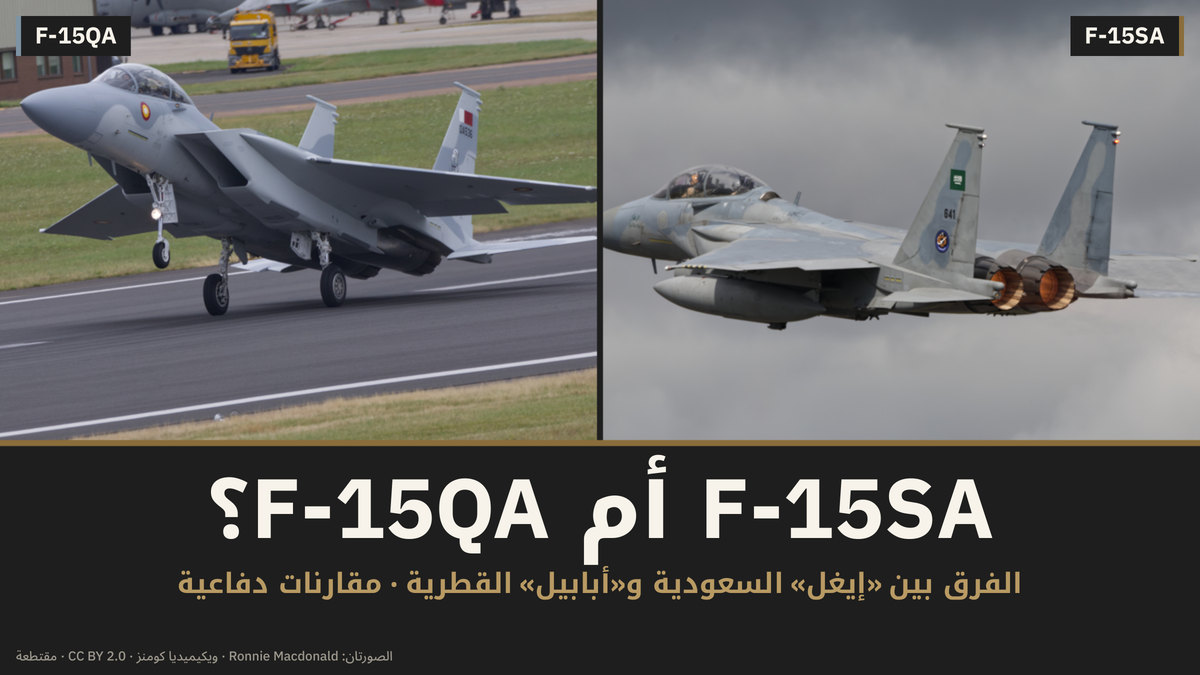
Defence comparisons | Data updated to 16 November 2026
The question “F-15SA or F-15QA?” is often framed as a choice between two competing aircraft, but in reality both are built by Boeing in St. Louis and sold through the US Foreign Military Sales (FMS) programme. This comparison relies on the two Defense Security Cooperation Agency (DSCA) notifications of 2010 and 2016, data from Boeing and the US Air Force and specialist press coverage, with a clear separation between notification, contract, delivery, company claims and what has not been published. For details on the number of Qatari aircraft, see How many F-15QA fighters does Qatar have? (Arabic), and for a deeper look at the US software standard see The risks of relying on software updates in the F-15SA and F-15QA (Arabic).
What is the difference between the F-15SA and F-15QA? A quick introduction to the two aircraft
Saudi F-15SA “Eagle” (Saudi Advanced)
A Saudi export variant based on the two-seat F-15E Strike Eagle. On 20 October 2010 the US State Department, through DSCA, announced a possible sale of 84 new F-15SA aircraft along with the upgrade of 70 existing F-15S aircraft to the SA standard, at an estimated value of $29.432 billion including munitions, training and infrastructure. The US Air Force announced the signing of the Letter of Offer and Acceptance worth about $29.4 billion and described it as including the largest foreign military sales contract in US history. The first new F-15SA flew in St. Louis on 20 February 2013; Saudi Arabia received its first four aircraft in December 2016 (two new-build aircraft and two converted from the F-15S standard), and then the final new-build batch on 10 December 2020, according to the US Air Force.
Qatari F-15QA “Ababil” (Qatar Advanced)
A Qatari variant that Boeing describes as the most advanced version of the F-15, and that reports describe as derived from the F-15SA. On 17 November 2016 Washington notified Congress of a possible sale of up to 72 aircraft worth $21.1 billion ($11.5 billion in major defence equipment and $9.6 billion in other items), but the actual 2017 contract was for 36 aircraft. The first F-15QA flew on 14 April 2020, and the first three aircraft arrived at Al Udeid Air Base on 16 November 2021 after a stopover in the United Kingdom, according to Aviation Week. It was named “Ababil” at the rollout ceremony in August 2021, a reference to birds mentioned in the Holy Quran, according to reports covering the ceremony.
Technical comparison table: what can actually be compared
| Item | F-15SA (Saudi Arabia) | F-15QA (Qatar) | Type of source |
|---|---|---|---|
| Congressional notification (DSCA) | 20 October 2010: 84 new aircraft and upgrade of 70 F-15S; $29.432 billion | 17 November 2016: up to 72 aircraft; $21.1 billion | Official notification (DSCA) [1] [2] |
| First flight | 20 February 2013 | 14 April 2020 | US Air Force and press coverage [6] [10] |
| First delivery | December 2016 (4 aircraft: two new-build and two converted) | 16 November 2021 (3 aircraft arrived at Al Udeid) | US Air Force and press coverage [5] [8] |
| New-build deliveries | 84 aircraft, final batch 10 December 2020 | 36 aircraft (final 5 in August 2023 according to Boeing); 12 more announced, starting with four in July 2024 | US Air Force and press coverage [4] [5] [10] [9] |
| Radar | AN/APG-63(V)3 AESA | AN/APG-82(V)1 AESA | Official notification (DSCA) [1] [2] [13] |
| Flight control | Digital fly-by-wire | Digital fly-by-wire | US Air Force and Boeing [4] [7] |
| Engine | F110-GE-129 | F110-GE-129 | Official notification (DSCA) [1] [2] |
| Infrared search and track | AN/AAS-42 IRST | AN/AAS-42 IRST | Official notification (DSCA) [1] [2] |
| Wing and fuselage weapon stations | 11 (up from 9 on the F-15E) per the Advanced Eagle family description | 11 (up to 16 AIM-120 missiles according to The War Zone) | Specialist coverage (Janes and The War Zone) [11] [13] |
| Cockpit | Advanced displays; Saudi Arabia did not take the large-display option according to Janes | 10×19-inch large-area displays (LAD) according to The Aviationist | Specialist coverage (Janes and The War Zone) [4] [11] [16] |
| Helmet-mounted cueing | JHMCS | Digital JHMCS for the pilot and weapon systems officer | Official notification (DSCA) [1] [2] [16] |
| Electronic warfare | Digital DEWS | Digital DEWS (exact model not officially disclosed) | Official notification (DSCA) [1] [2] [16] |
| Air-to-air missiles in the notification | 500 AIM-120C/7 and 300 AIM-9X | 250 AIM-120C7 and 200 AIM-9X | Official notification (DSCA) [1] [2] |
| Anti-ship and anti-radiation missiles in the notification | 400 AGM-84 Block II and 600 AGM-88B | 80 AGM-84L-1 and 100 AGM-88 | Official notification (DSCA) [1] [2] |
| Bombs and air munitions in the notification | 1,100 GBU-24, 1,000 GBU-31B V3 and 1,300 CBU-105 | 200 AGM-154 JSOW, 200 AGM-65 Maverick, 500 GBU-38, 500 GBU-31, 250 GBU-54 and 250 GBU-56 | Official notification (DSCA) [1] [2] |
| Stated performance | No separately documented performance figures for the variant in the sources we reviewed | About 30,000 lb of munitions and a ceiling of about 70,000 ft (US Air Force text citing Boeing) | US Air Force text citing Boeing [17] |
| Upgrade of the older fleet | Yes: F-15S to F-15SA/F-15SR programme (70 planned; 66 locally after two losses according to an April 2021 source) | No: new aircraft purchase only | Official notification and press coverage [1] [18] |
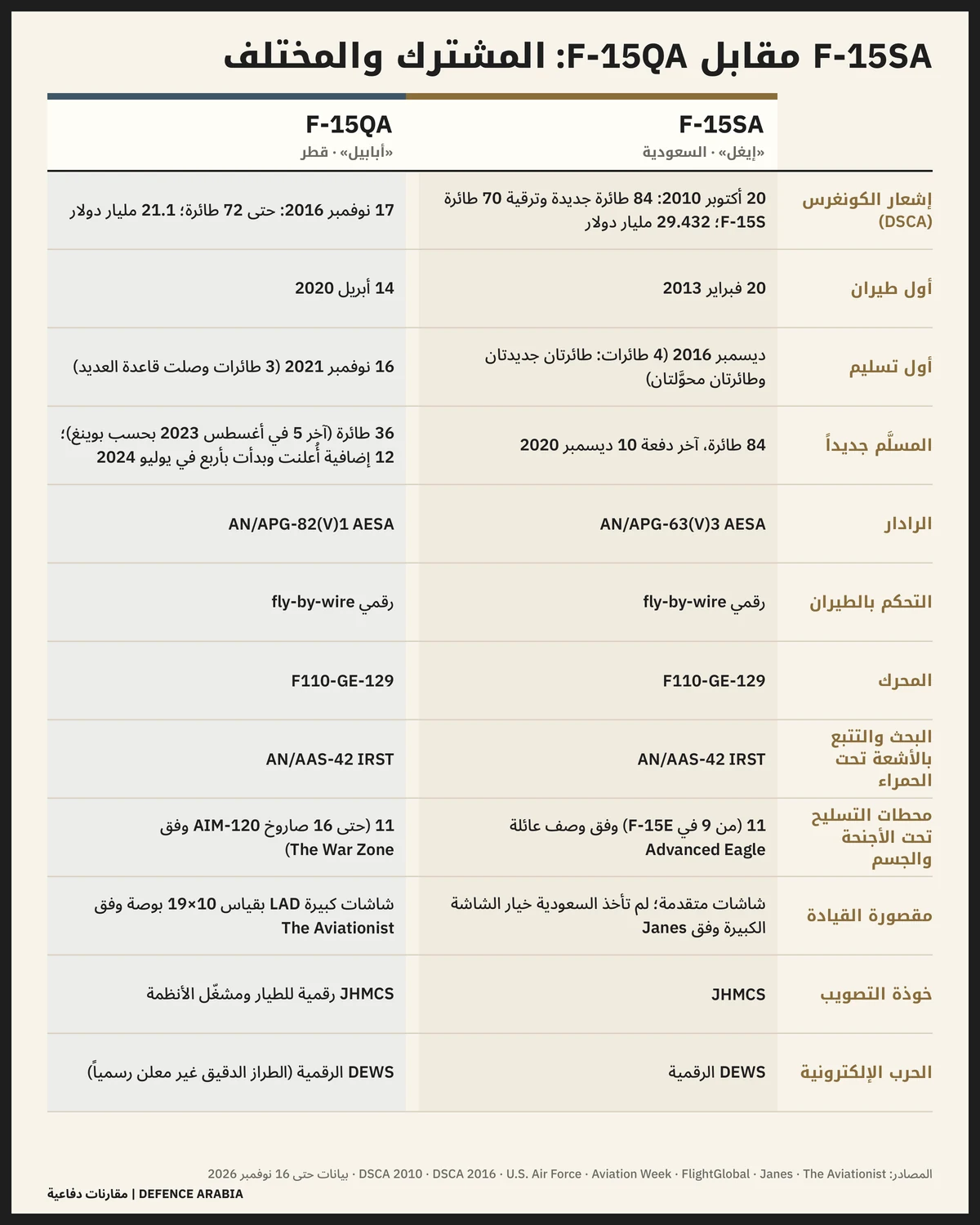
Methodological note: notification figures are authorisation ceilings reported to Congress, not inventory or deliveries, and the scope of the two notifications differs (the Saudi notification includes the upgrade of 70 existing aircraft). We do not divide the value by the number of aircraft because it includes training, support, infrastructure and munitions.
Radar and cockpit: where does the real difference lie?
The clearest published technical difference between the two variants is the radar. The 2010 notification lists 170 Raytheon AN/APG-63(V)3 radar sets for the F-15SA programme, while the 2016 notification lists eighty AN/APG-82(V)1 radars for the F-15QA. According to the report by the Pentagon’s Director, Operational Test and Evaluation (DOT&E) on the US F-15E Radar Modernization Program, the APG-82(V)1 borrows the antenna and power supply of the APG-63(V)3, while its receiver and processor are based on the APG-79 radar of the F/A-18E/F. Raytheon says the radar provides detection and tracking of multiple targets at longer range than before, without publishing range figures. This is a company claim rather than an independent measurement, and there are no documented, published range figures with which to compare the two radars.
In the cockpit, Janes reports that the Advanced Eagle family offers a large-area display (LAD) cockpit option and that Saudi Arabia did not take this option. The Aviationist reports that the F-15QA is fitted with 10×19-inch large-area displays (LAD) and a digital JHMCS helmet for the pilot and weapon systems officer. This is a difference in the crew interface, not in flight performance, and open sources offer no figures measuring its effect on decision-making speed.
According to descriptions by The War Zone and Janes, both aircraft share two additional underwing stations (from 9 to 11 stations), the DEWS digital electronic warfare system and the F110-GE-129 engine. The War Zone notes that the Qatari aircraft can carry up to 16 AIM-120 missiles at once, while Saudi Arabia’s actual use of all the additional stations remains unconfirmed in the sources we reviewed.
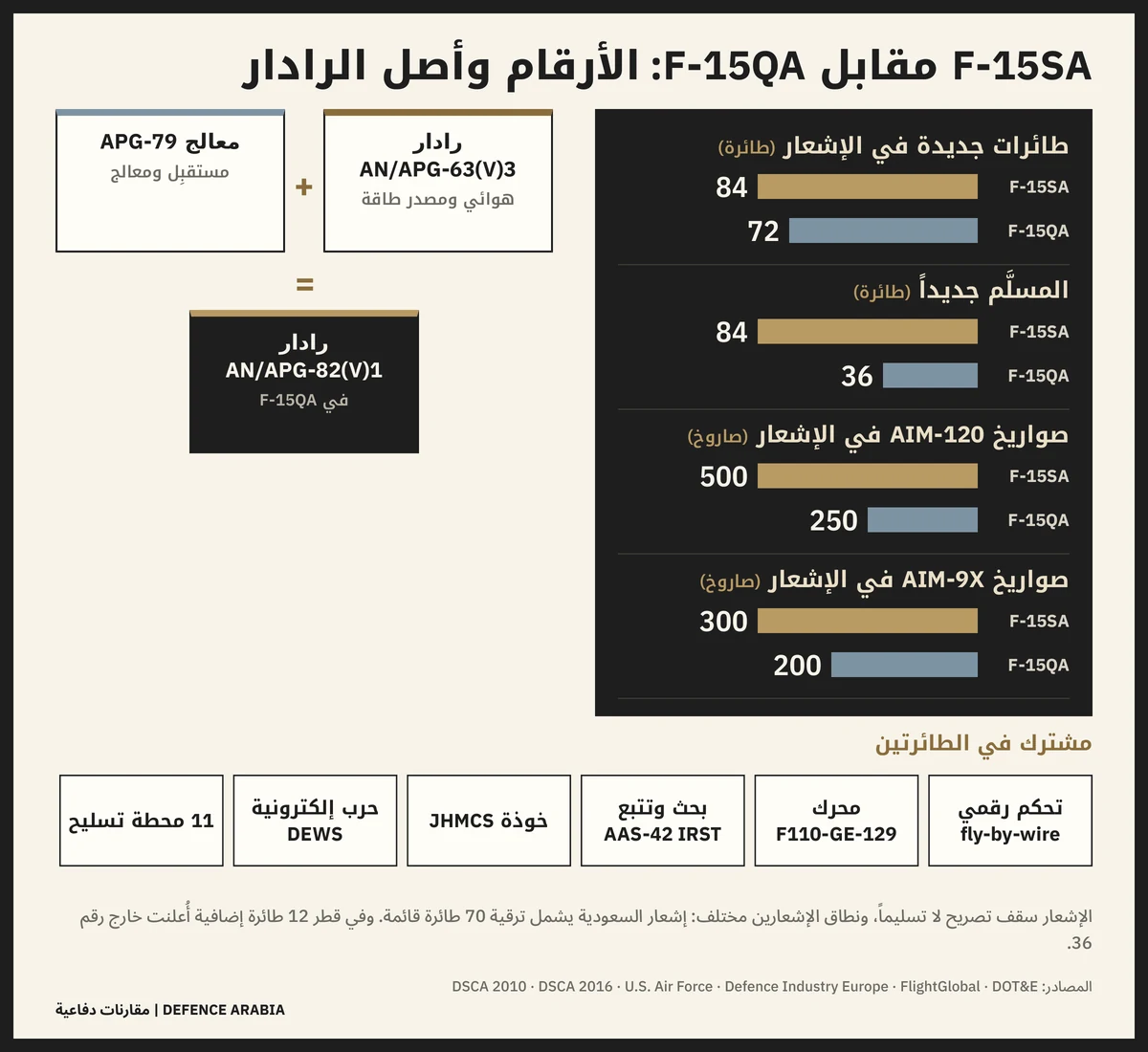
Sensors and armament as shown in the DSCA notifications
The two weapons packages are similar in categories but differ in quantities and details. These are authorisation ceilings and do not mean that every munition was delivered or is in inventory today:
- Air-to-air: 500 AIM-120C/7 and 300 AIM-9X missiles in the Saudi notification, versus 250 AIM-120C7 and 200 AIM-9X in the Qatari notification.
- Anti-ship and anti-radiation: 400 AGM-84 Block II Harpoon and 600 AGM-88B HARM missiles for Saudi Arabia, versus 80 AGM-84L-1 and 100 AGM-88 missiles for Qatar.
- Air-to-ground: the Saudi notification lists 1,100 GBU-24, 1,000 GBU-31B V3 and 1,300 CBU-105 bombs, and the Qatari notification lists 200 AGM-154 JSOW, 200 AGM-65 Maverick, 500 GBU-38, 500 GBU-31, 250 GBU-54 and 250 GBU-56.
- Targeting: both notifications list the AN/AAQ-33 Sniper pod (158 for Saudi Arabia and 80 for Qatar) and the AN/AAS-42 IRST system.
As for performance, a US Air Force article published by DVIDS in June 2020 states that the F-15QA takes off with about 30,000 lb of munitions and reaches a ceiling of about 70,000 ft, a description that follows Boeing’s claims rather than independent testing. Boeing claims the Qatari aircraft offers “more speed, range and payload than any other fighter in the world”, a marketing slogan we do not treat as a figure. So far, the sources we reviewed do not publish separate performance figures for the F-15SA.
Missions: when does the difference matter?
Both aircraft are two-seat multirole fighters, and by category there is no difference between their stated missions: air superiority, precision strike and suppression of air defences. The likely practical difference lies in the mission environment: a newer radar and a larger cockpit display help when targets multiply and information is dense, while a larger fleet with accumulated flight hours and training experience helps when tasks expand. No party publishes operational comparison data between the two variants, so we refrain from assigning a particular mission to a particular variant.
Arab users: notification, contract and delivery
| Country | F-15SA | F-15QA | Confirmation status |
|---|---|---|---|
| Saudi Arabia | 84 new aircraft delivered by 10 December 2020 | Does not operate the F-15QA | 2010 notification followed by completed delivery; the local F-15S upgrade is planned to run to June 2026 and we have not verified its completion [1] [4] [5] [18] |
| Qatar | Does not operate the F-15SA | 36 delivered according to Boeing by August 2023 | 12 more announced, with deliveries beginning July 2024; one source cites 50 aircraft and completion in Q1 2025 [9] [10] [12] [19] |
| Other Arab states | No confirmed operator | No confirmed operator | We found no third Arab operator of either variant in the sources [4] [9] |
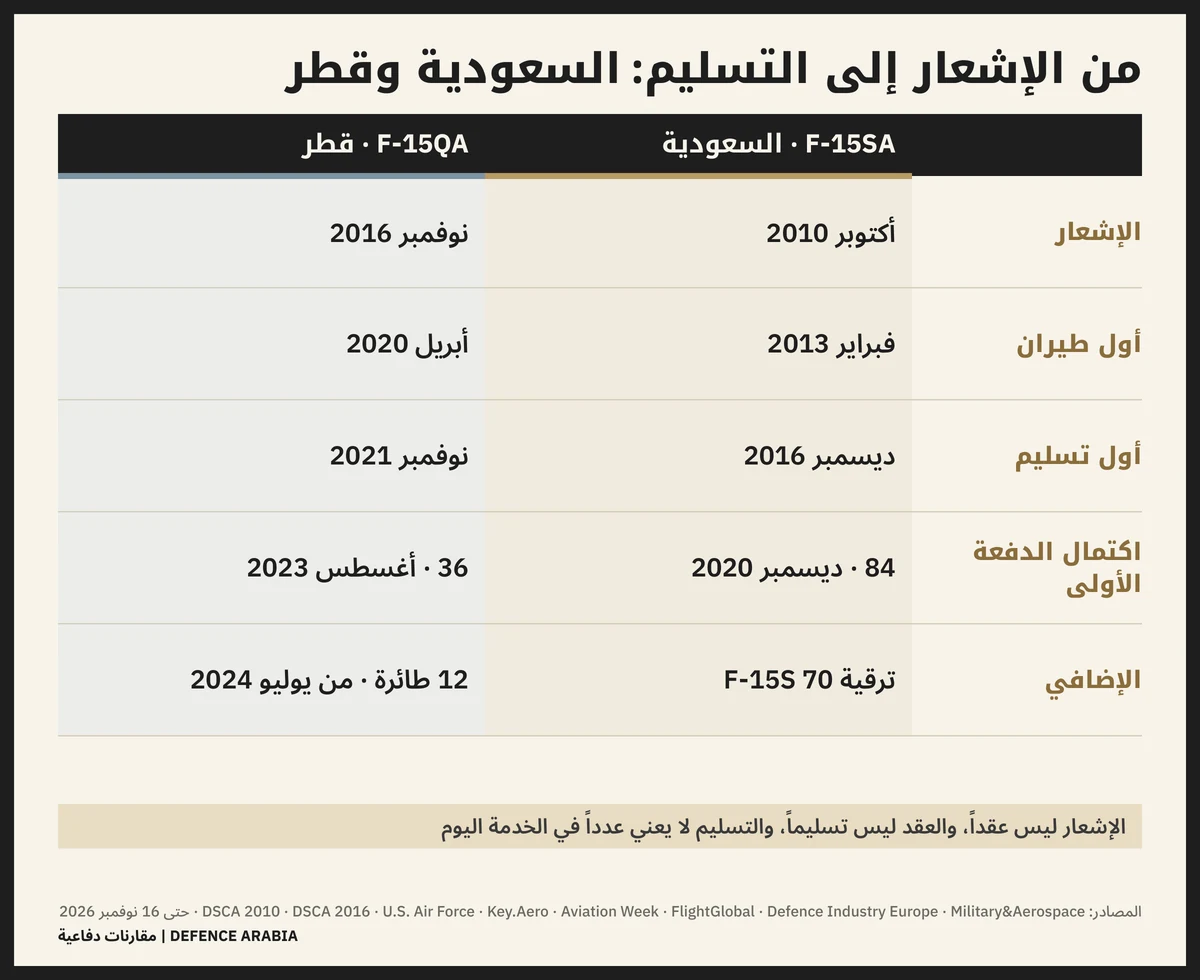
Saudi Arabia is the only confirmed operator of the F-15SA, and Qatar is the only confirmed operator of the F-15QA. The figures in the table are attributed to their sources: Saudi deliveries to the US Air Force and Key.Aero, and Qatari deliveries to Boeing as reported by Defence Industry Europe, and to FlightGlobal and Janes. On the additional Qatari order there are three accounts: FlightGlobal reports that Doha added 12 aircraft and that four of them were delivered in July 2024; Janes states that the official order was 36 and that US data in mid-2020 pointed to 48; and Zbiam.pl alone said in May 2025 that Qatar ordered 50 and that the last of them was delivered in the first quarter of 2025. We do not adopt a final figure because official Qatari and US sources have not confirmed it in what we reviewed. For wider context, see Who operates the Rafale, F-15SA and Typhoon in the Arab world?, Why does Qatar operate three different fighters at once? and The Royal Saudi Air Force (Arabic).
The upgrade programme for the older Saudi fleet
Unlike Qatar’s, the Saudi agreement includes upgrading existing aircraft from the F-15S standard to the F-15SA standard; the converted aircraft is often called the F-15SR. Global Defense Corp reported in April 2021 that 70 upgrade kits were ordered, that the loss of two aircraft reduced the number planned for local conversion to 66, and that the last aircraft would be delivered by June 2026. We have not verified a recent source confirming the programme’s completion, so we do not state the number of converted aircraft in service today.
Strengths and limitations (editorial assessment based on the sources)
- Strengths: a larger new-build fleet than Qatar’s confirmed fleet (84 aircraft), in service since 2017, and a programme to upgrade older aircraft to the same standard.
- Limitations: the APG-63(V)3 radar is earlier in the series than the APG-82(V)1, Saudi Arabia did not take the large-display option according to Janes, and no separately documented performance figures are available.
- Strengths: the APG-82(V)1 radar and large-area LAD displays, the basis on which the US F-15EX was built according to Boeing and Aviation Week.
- Limitations: a smaller fleet (36 confirmed plus an additional order), a total number of aircraft not settled between sources, and no independent test figures for its performance.
In both cases, the US decision chain remains present in software, spare parts and munitions, a subject we covered in The risks of relying on software updates (Arabic). For a comparison with a non-US aircraft, see Rafale or F-15EX? and our F-15EX file (Arabic).
Which suits which mission? A balanced assessment
The F-15QA is not absolutely “better” than the F-15SA; it is a later version of the same baseline. If the criterion is the newer radar and the larger crew display, the F-15QA leads according to the published description. If the criterion is fleet size, accumulated service and the programme to upgrade older aircraft, the F-15SA leads. The decisive criterion, however, is the mission, the basing, US support and the munitions ecosystem available to each country, not the name of the variant. Comparing the value of the two notifications ($29.432 billion versus $21.1 billion) is not a valid judgement of effectiveness, because their scope differs.
What has not been published?
- The precise differences in flight and mission software and electronic warfare capabilities between the two variants
- The range of the AN/APG-63(V)3 and AN/APG-82(V)1 radars in documented, independent figures
- F-15SA performance in speed, payload and range separately from the F-15QA
- Whether Saudi Arabia actually uses all the additional weapon stations
- The confirmed total number of F-15QA aircraft after the additional order (48 or 50)
- The price of a single aircraft: contract and notification values include munitions, training, support and infrastructure
- The completion status of the Saudi F-15S upgrade to the SA/SR standard to date
Frequently asked questions
What is the difference between the F-15SA and F-15QA in brief?
Both aircraft belong to Boeing’s Advanced Eagle family. The F-15SA is the first, Saudi version (first flight in February 2013), and the Qatari F-15QA is derived from it (first flight in April 2020). They share digital fly-by-wire flight controls, the F110-GE-129 engine and the AN/AAS-42 infrared search and track system, and differ mainly in the radar: AN/APG-63(V)3 for Saudi Arabia and AN/APG-82(V)1 for Qatar according to the two DSCA notifications, and in the cockpit: a large-area LAD display in the Qatari aircraft, an option Saudi Arabia did not take according to Janes.
Is the F-15QA better than the F-15SA?
This cannot be determined from open sources. The F-15QA has a newer radar and cockpit according to the published description, but there are no independent test figures comparing the performance of the two variants, nor separately documented performance figures for the F-15SA. The choice depends on the mission, fleet size and US support for each country.
Which Arab countries operate the two aircraft?
Saudi Arabia operates the F-15SA and had received 84 new aircraft by 10 December 2020 according to the US Air Force, and Qatar operates the F-15QA, with Boeing announcing the delivery of 36 aircraft by August 2023. Qatar added 12 aircraft according to FlightGlobal, and we found no third Arab operator of either variant.
How much does an F-15SA or F-15QA cost?
No official unit price has been published. The Saudi notification is worth $29.432 billion and covers 84 aircraft, the upgrade of 70 existing aircraft, munitions, training and infrastructure, and the Qatari notification is worth $21.1 billion for up to 72 aircraft with a weapons and support package. Dividing the value by the number of aircraft to derive a unit price is not valid, and FlightGlobal cites Boeing’s 2017 contract for 36 Qatari aircraft at $6.2 billion with a different scope.
Is the F-15QA the basis of the US F-15EX?
Aviation Week reports that the Qatari configuration is the basis for the airframe and avionics of the US Air Force’s F-15EX, and coverage of the 2021 rollout ceremony cites Boeing as saying its design became the basis of the F-15EX. This information comes from industry and press coverage, not from an official US document we have seen.
Sources
1. DSCA — Transmittal 10-43: Saudi Arabia – F-15SA Aircraft (news release, published copy) (2010-10-20): Link
2. Federal Register / DSCA — Transmittal 16-58: Government of Qatar – F-15QA Aircraft With Weapons and Related Support (2016-11-28 (report to Congress 2016-11-17)): Link
3. U.S. Air Force (AFNS) — Saudi Arabia to purchase 84 F-15SA, upgrade current F-15 fleet (LOA announcement (undated in fetched text)): Link
4. U.S. Air Force (AFLCMC) — AFLCMC delivers final F-15SA to Royal Saudi Air Force (2020-12): Link
5. Key.Aero — Saudi Arabia receives final new-build Boeing F-15SAs (2020-12): Link
6. Military & Aerospace Electronics — Maiden flight completed for Saudi F-15SA jet fighter with fly-by-wire flight control, digital EW, infrared search avionics (2013-04-01): Link
7. Boeing — Boeing, U.S. Air Force and Qatar Emiri Air Force celebrate rollout of F-15QA (news release) (2021-08-25): Link
8. Aviation Week — F-15QAs Delivered To Qatar After UK Sojourn (2021-11-16): Link
9. FlightGlobal — Boeing to deliver Qatari F-15QAs at the conclusion of Farnborough air show (2024-07): Link
10. Defence Industry Europe — Boeing delivers final batch of F-15QA Ababil fighters to Qatar (2023-08): Link
11. Janes — Maiden flight for Qatari F-15QA (2020-04): Link
12. Janes — Farnborough 2024: Boeing debuts latest variant F-15 at RIAT, Farnborough (2024-07): Link
13. The War Zone — Watch Boeing's F-15QA For Qatar Make A Spectacular 'Viking Takeoff' On Its First Flight (2020-04): Link
14. Raytheon (RTX) — AN/APG-82(V)1 AESA Radar (accessed 2026-11-16): Link
15. DOT&E (U.S. DoD) — F-15E Radar Modernization Program (RMP), FY2014 Annual Report (FY2014): Link
16. The Aviationist — Here Are The First Four F-15QA Eagle Jets For The Qatar Emiri Air Force (2021-10-29): Link
17. DVIDS (U.S. Air Force) — Qatar Emiri Air Force partners with U.S. to gain newest F-15 to their fleet (2020-06-25): Link
18. Global Defense Corp — Alsalam Aerospace Industries (AAI) Completed Conversion of F-15s Into F-15SA Standard (2021-04-06): Link
19. Zbiam.pl — Boeing zakończył produkcję i dostawy samolotów F-15QA do Kataru (2025-05-12): Link
20. Key.Aero — The Secretive Super Eagle (c.2013): Link
21. Overt Defense — Boeing Officially Rolls Out Qatar's F-15QA Ababil (2021-08-30): Link
22. Reuters — U.S. announces $60 billion arms sale for Saudi Arabia (2010-10-20): Link