RPG-7 launcher: specifications, range and types of rounds
The RPG-7 is a shoulder-fired, man-portable anti-armour weapon developed by the GSKB-47 state design bureau in Moscow. It entered service with the Soviet Army in 1961, 14 years after its predecessor, the RPG-2. Its tube has a calibre of 40 mm, a length of 950 mm and a weight of 6.3 kg with the optical sight, and its sighting range reaches 700 m depending on the round, according to Russia’s National Guard. The launcher fires anti-armour, thermobaric and fragmentation rounds, and Russia’s Rosoboronexport still offers its modern RPG-7V2 version for export.
What is the RPG-7 launcher?
The name “RPG” is an abbreviation of the Russian phrase “Ruchnoy Protivotankovy Granatomyot”, meaning “hand-held anti-tank grenade launcher”. Russia’s National Guard (Rosgvardia) classifies it as a hand-held anti-tank grenade launcher that fires single shots, with a combat rate of fire of 4 to 6 rounds per minute.
The launcher works on a simple principle: a reloadable steel tube, with the round fitted at its front end; in most types the round’s warhead is wider than the tube. The tube carries a primary optical sight and a backup iron sight.
Russia’s National Guard says the standard PGO-7 sight was designed specifically for this launcher, with 2.7x magnification. In addition to the main aiming scale, its reticle includes a lateral-correction scale and a rangefinding scale.
History of the RPG-7: from the RPG-2 to service in 1961
Hand-held anti-tank launchers appeared in the US and German armies during the Second World War and quickly proved effective, according to Russia’s National Guard. The Soviet Union began work on a similar weapon in the late stages of the war, which ended in 1947 with the adoption of the RPG-2.
Fourteen years later the RPG-7 replaced the RPG-2. It was developed by State Union Design Bureau No. 47 (GSKB-47) in Moscow and is produced by the Degtyarev Plant in the city of Kovrov. Russia’s National Guard says that, despite its age, the launcher is still used by Russian security agencies today.
The modern Russian versions, the RPG-7V1 and RPG-7V2, differ from the original in their sights, which have scales for firing heavy rounds, and in a folding, detachable bipod supplied with the launcher.
RPG-7 specifications in figures
The following table brings together official data published by Russia’s National Guard and Rosoboronexport, Russia’s state arms-export intermediary.
| Item | Value | Source |
|---|---|---|
| Calibre (tube) | 40 mm | Rosgvardia / Rosoboronexport |
| Length | 950 mm | Rosgvardia |
| Weight with optical sight | 6.3 kg | Rosgvardia |
| RPG-7V2 weight with bipod | 6.68 kg | Rosoboronexport |
| RPG-7V1 weight without sight and accessories | 6.7 kg | Rosoboronexport |
| PGO-7V3 sight weight | 0.5 kg | Rosoboronexport |
| Maximum sighting range | Up to 700 m (depending on round) | Rosgvardia / Rosoboronexport |
| Combat rate of fire | 4–6 rounds/min | Rosgvardia |
| Specified service life (RPG-7V1) | 250 rounds | Rosoboronexport |
| Temperature range (RPG-7V2) | −50 to +50 °C | Rosoboronexport |
| Firing mode | Single shot | Rosgvardia |
RPG-7 range by type of round
The RPG-7 has no single fixed range, because range changes with the weight and shape of the round. Rosoboronexport publishes the maximum sighting range of the RPG-7V1 as follows:
| Round | Maximum sighting range |
|---|---|
| PG-7V, PG-7VM and PG-7VS | 500 m |
| PG-7VL | 300 m |
| PG-7VR and TBG-7V | 200 m |
| PG-7VR and TBG-7V with UP-7V sighting device | 550 m |
| OG-7V (with UP-7V device) | 700 m |
The UP-7V add-on sighting device weighs about 0.55 kg. It is used with the PGO-7V3 sight to fire the OG-7V fragmentation round and to extend the range of the heavy PG-7VR and TBG-7V rounds, according to the company.
Types of RPG-7 rounds
PG-7VL: single-charge anti-armour round
The PG-7VL is a 93 mm high-explosive anti-tank (HEAT) round with an effective range of 300 m. According to Rosoboronexport, it penetrates at least 0.5 m of rolled homogeneous armour steel, 1.7 m of brick, 1.2 m of reinforced concrete and 2.4 m of timber and earth.
PG-7VR: tandem round against explosive reactive armour
The PG-7VR is a 105 mm tandem-charge (Tandem HEAT) round with an effective range of 200 m. The first charge is designed to detonate explosive reactive armour (ERA), after which the second charge penetrates the main armour. The round penetrates at least 0.6 m of homogeneous steel behind reactive armour, 2 m of brick, 1.5 m of reinforced concrete and 3.7 m of timber and earth.
TBG-7V: thermobaric round
The TBG-7V is a 105 mm round with a thermobaric warhead, weighing 4.5 kg. It targets personnel in the open and inside fortifications and trenches, as well as light armoured vehicles. Its effective range reaches 500 m depending on the launcher type, and its destructive capacity inside buildings is 300 cubic metres, according to Rosoboronexport.
OG-7V: anti-personnel fragmentation round
The OG-7V is a 40 mm fragmentation round weighing 2 kg, intended for personnel wearing body armour in the open and in field shelters, and for unarmoured vehicles. Its direct-fire range is 170 m and its lethal area against armour-protected personnel is 150 square metres. Its sighting range reaches 280 m from the RPG-7V, 350 m from the RPG-7V1 and 700 m with the UP-7V device.
To understand the levels of protection these rounds face on vehicles, see the explainer on ballistic protection and STANAG 4569 levels (Arabic).
Quick comparison of RPG-7 rounds
The following table summarises the four main rounds that Russia’s National Guard lists as part of the launcher’s ammunition, using Rosoboronexport figures.
| Round | Type | Calibre | Effective range | Main use |
|---|---|---|---|---|
| PG-7VL | Single-charge anti-armour (HEAT) | 93 mm | 300 m | Armoured vehicles and fortifications; penetration of at least 500 mm |
| PG-7VR | Tandem anti-armour | 105 mm | 200 m (550 m with UP-7V) | Tanks fitted with reactive armour; penetration of at least 600 mm behind it |
| TBG-7V | Thermobaric | 105 mm | Up to 500 m depending on launcher | Personnel inside buildings and trenches, and light vehicles |
| OG-7V | Fragmentation | 40 mm | Direct-fire range 170 m; sighting range up to 700 m | Personnel in the open and unarmoured vehicles |
Difference between the RPG-7V1 and RPG-7V2
Rosoboronexport supplies the RPG-7V1 with a PGO-7V3 optical sight, an iron sight and a bipod. It says the launcher fires the PG-7V, PG-7VM, PG-7VS, PG-7VL and PG-7VR anti-armour rounds and the TBG-7V thermobaric round, and fires the OG-7V fragmentation round when the UP-7V device is fitted.
The RPG-7V2 is the latest version offered by the company, which describes it as compatible with various rounds and grenades. The company states that it weighs 6.68 kg with the bipod and operates in temperatures between 50 degrees below zero and 50 degrees above.
Russia’s National Guard notes that the left side of the launcher carries a mount for the optical sight. The optical sight is the primary aiming device, while the iron sight is used if the optical sight fails.
Why has the RPG-7 stayed in service for more than 60 years?
Rosoboronexport describes the RPG-7V2 as a “highly cost-effective” weapon against heavy and light armoured vehicles, fortifications and personnel. The company says its combat-proven design features make it easy to maintain and shorten the time needed to train gunners.
The company attributes particular danger to the launcher in urban areas against tanks with various types of armour, including reactive armour, when tandem rounds are used. The flexibility of its ammunition allows the gunner to choose the round according to the mission, target and environment.
Nikolai Sereda, head of the design centre at Russia’s Bazalt company, told TASS in June 2021 that the Russian Army had adopted the RPG-7V2 and that upgrades were being made under a contract with the Defence Ministry to improve accuracy through new sighting systems. He explained that the current launcher’s dispersion is 40–50 cm at 150 m, and that the upgrade would enable it to engage a main battle tank at ranges of up to one kilometre, according to Army Recognition.
Sereda added that the RPG-7V2 would remain an effective support weapon for about another 30 years or more, and that it is still the main anti-armour weapon of Russian infantry.
Weaknesses and limitations
The effective range of the heavy rounds remains relatively short, at 200 m for the PG-7VR tandem round without an add-on sighting device. This puts the gunner within range of direct enemy fire.
The RPG-7 has no guidance after launch, unlike anti-tank guided missiles such as Javelin and Kornet. As a result, the chance of a hit declines as distance or wind strength increases. For a comparison with guided weapons, see TOW vs Javelin vs Kornet-EM for Arab armies (Arabic).
In addition, modern tanks fitted with active protection systems and composite armour are less vulnerable to older single-charge rounds. To read what recent wars have revealed about tanks’ vulnerability to anti-armour weapons, see Abrams tank performance in combat (Arabic).
The RPG-7 and alternatives in the Arab region
Rosoboronexport offers the RPG-7V2 for export and describes it as meeting global demand for this type of weapon in modern conflicts. The company does not publish a list of importing countries.
In Jordan, the newer RPG-32 launcher is produced under Russian licence as the Nashshab. For details on this launcher, see the page Nashshab (RPG-32): the anti-armour launcher produced in Jordan (Arabic).
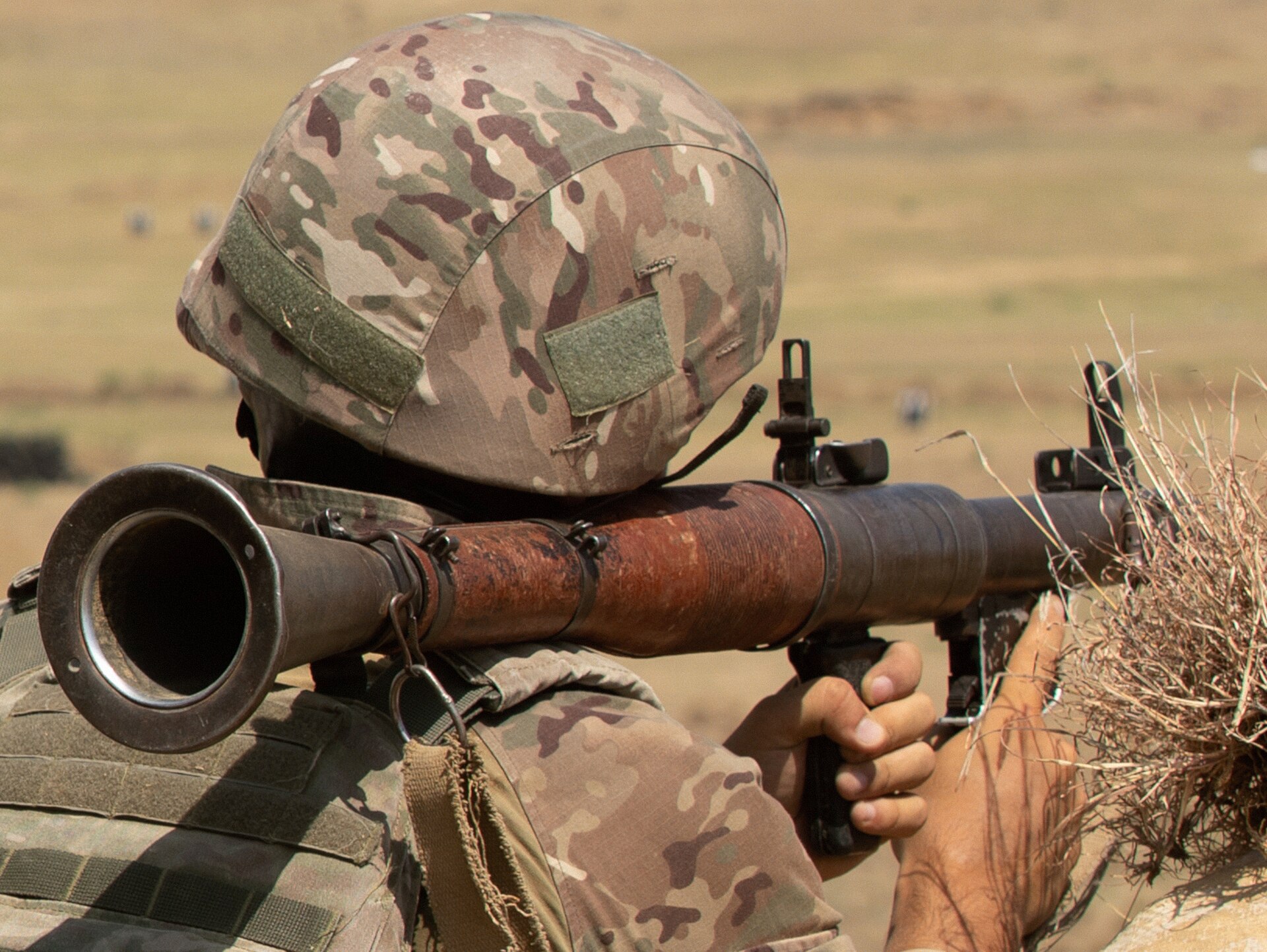
Western armies also use the RPG-7 in training to simulate adversary weapons. The main image on this page shows troops from the 22nd Multinational Battalion training with it in Georgia during Exercise Agile Spirit 25 in August 2025, according to the US National Guard.
How much does an RPG-7 cost?
Neither Rosoboronexport nor official Russian bodies publish a price for the launcher or its rounds, and prices in arms deals vary by manufacturer, quantity, ammunition and accompanying training. There are no documented unit-price figures in open official sources, so this page does not include a price figure.
RPG-7 frequently asked questions
What is the range of the RPG-7?
The maximum sighting range reaches 700 m with the OG-7V fragmentation round and the UP-7V device. It is 500 m for the PG-7V rounds, 300 m for the PG-7VL, and 200 m for the heavy PG-7VR and TBG-7V rounds.
How much does the RPG-7 launcher weigh?
It weighs 6.3 kg with the optical sight according to Russia’s National Guard, while the RPG-7V2 weighs 6.68 kg with the bipod according to Rosoboronexport.
What does the abbreviation RPG stand for?
It is a Russian abbreviation meaning “hand-held anti-tank grenade launcher”.
Can the RPG-7 penetrate modern tanks?
The PG-7VR tandem round penetrates at least 600 mm of homogeneous steel behind reactive armour, according to Rosoboronexport. However, its ability to disable a modern tank depends on the type of armour, the point of impact and the presence of active protection systems.
When did the RPG-7 enter service?
It entered service with the Soviet Army in 1961, 14 years after the RPG-2 was adopted in 1947.
Main image: a soldier carrying an RPG-7 during training at the Vaziani range in Georgia, 4 August 2025. Source: Sgt. Alex Lopez / US Army National Guard via Wikimedia Commons (public domain).
Sources
- Russian National Guard (Rosgvardia), “RPG-7V2 hand-held anti-tank grenade launcher” — rosguard.gov.ru
- Rosoboronexport, “RPG-7V2” — roe.ru
- Rosoboronexport, “RPG-7V1” — roe.ru
- Rosoboronexport, “PG-7VL”, “PG-7VR”, “TBG-7V” and “OG-7V” — roe.ru
- Army Recognition, “Russian defense industry upgrades RPG-7V2 rocket launcher” (citing TASS), 16 June 2021 — armyrecognition.com
- DVIDS (US Army National Guard), “Hill gone next”, August 2025 — dvidshub.net