What is a sniper rifle? Types, calibres and how it differs from a designated marksman rifle
A sniper rifle is a military rifle designed to hit individual targets at long range with high accuracy. It relies on a precision-made barrel, consistent ammunition, a magnifying optical sight and a light, consistent trigger. Türkiye’s Presidency of Defence Industries (SSB) defines it in its glossary as “a rifle used to deliver hits from long distances with a high rate of accuracy”. The essential difference between a sniper rifle and an assault rifle is that the latter is designed for volume of fire at short and medium ranges, whereas the sniper rifle is designed for a precise single-shot hit at longer ranges.
This guide explains how a sniper rifle works; its types, from the bolt-action rifle to semi-automatic models and 12.7 mm anti-materiel rifles; the difference between a sniper rifle and a designated marksman rifle (DMR); and what the MOA accuracy measure means, with documented examples from the Emirati, Turkish and American small arms industries.
What is a sniper rifle in brief?
A sniper rifle is an individual weapon that is “precise” rather than “fast”: it usually sacrifices rate of fire and light weight for accuracy and range. It is normally used within a sniper team made up of the sniper and a spotter who helps with observation, range estimation and assessing wind conditions. A modern sniper system consists of:
- The weapon itself: a heavier, more precisely manufactured barrel than that of a standard rifle, and a tight locking mechanism.
- Optics: a magnifying day scope, to which night or thermal sights may be added.
- Ammunition: ammunition made to precise, consistent specifications, because variation between rounds is reflected directly in accuracy.
- Accessories: a bipod or monopod, an adjustable stock and, in some cases, a suppressor.
How does a sniper rifle work?
A sniper rifle works like any rifle: the propellant in the cartridge ignites and drives the projectile through the rifled barrel, which spins it to stabilise it in flight. What sets it apart is control over every factor that affects accuracy:
- The barrel: its length and twist rate are chosen to suit the weight and calibre of the projectile.
- The locking mechanism: in bolt-action rifles the shooter cycles and locks the bolt manually after each shot, which reduces moving parts during firing. Semi-automatic rifles use gas pressure or recoil to chamber the next round automatically.
- The scope: it magnifies the target image and allows aim to be corrected for range and wind through the reticle and adjustment turrets.
- External ballistics: at long range, the projectile’s trajectory is affected by gravity, wind and air density, so the sniper must calculate these factors precisely.
What does MOA accuracy mean in sniper rifles?
Sniper rifle accuracy is usually measured in minutes of angle (MOA); one minute of angle is 1/60 of a degree. In practice, one MOA equals about 2.9 cm at 100 metres and about 29 cm at 1,000 metres. If a rifle is said to have 1 MOA accuracy, its shot group is expected to fall within a circle about 2.9 cm in diameter at 100 metres under test conditions. Measurement conditions differ between manufacturers (ammunition type, number of shots and distance), so published MOA figures are not always suitable for direct comparison.
Types of sniper rifles
1. Bolt-action sniper rifle
The traditional type most closely associated with sniping. It is simple, accurate and reliable, but has a slower rate of fire. Examples include the CSR rifles produced by the Emirati company CARACAL.
2. Semi-automatic sniper rifle
It fires one round with each trigger pull without the need for manual reloading, allowing faster follow-up on a target or engagement of more than one target. Examples include the Turkish KNT-76 from MKE.
3. Anti-materiel rifle
Heavy-calibre rifles, usually 12.7×99 mm (.50 BMG), intended mainly to hit equipment such as light vehicles, radars and parked aircraft at long range. Among the best known is the American Barrett family.
4. The designated marksman rifle (DMR) and where it fits
A designated marksman rifle is not a sniper rifle in the strict sense, but a precise semi-automatic rifle issued at platoon or squad level to extend the range of accurate fire. The difference is illustrated by two US Army rifles: the 7.62 mm M110A1 SDMR is intended for infantry, reconnaissance and engineer squads with an effective range of 600 metres, while the bolt-action, multi-calibre Mk22 PSR precision sniper rifle (7.62 mm, .300 Norma Magnum and .338 Norma Magnum) is intended to engage personnel and materiel out to 1,500 metres, according to the US Army’s Program Executive Office for Ground Combat Systems.
Common sniper rifle calibres
- 7.62×51 mm NATO: the most widespread calibre in military sniper and designated marksman rifles. The civilian .308 Winchester is close to it in dimensions, but pressure and ammunition specifications are not entirely identical, so manufacturers specify the approved calibre for each rifle.
- 8.59×70 mm (.338 Lapua Magnum): a calibre intended for longer ranges than 7.62 mm.
- 12.7×99 mm (.50 BMG): the calibre of heavy anti-materiel rifles.
Military uses of the sniper rifle
- Long-range precision fire against specific high-value targets.
- Reconnaissance and surveillance: thanks to its optics and position, a sniper team is often an important source of battlefield information.
- Counter-sniping and the protection of forces and facilities.
- Hitting equipment with heavy-calibre rifles.
- Internal security and counter-terrorism missions by special police and gendarmerie units; MKE, for example, notes that the KNT-76 version offered on the US market is intended for law enforcement use.
Modern systems also include precision weapons mounted on remotely controlled turrets. To learn more about this category, see: What is a remote weapon station? (Arabic)
Documented examples: from the UAE and Türkiye to the United States
UAE: CARACAL (EDGE) CSR rifles
CARACAL, part of the Emirati EDGE Group, produces two bolt-action sniper rifles. According to company data, the CSR 308 is chambered in .308 Winchester with a 24-inch barrel and a 1:11 twist rate, uses SR-25/AR-10 magazines holding 10 or 20 rounds, weighs 5.07 kg and is 1,160 mm long with the stock extended and 890 mm folded. The CSR 338 is chambered in .338 Lapua Magnum with a 27-inch barrel, a 10-round magazine, a weight of 6.5 kg and a length of 1,288 mm extended and 1,015 mm folded, with an integrated monopod. EDGE did not publish effective range figures or user details in these materials. For the industrial background: EDGE, Morocco and the CARACAL localisation MoU (Arabic).
Türkiye: MKE’s KNT-76 and KNT-859
Turkish company MKE produces the KNT-76 semi-automatic sniper rifle in 7.62×51 mm NATO. According to the company’s official website, the rifle uses a gas piston and rotating bolt, has 1.5 MOA accuracy, an effective range of 800 metres, a weight of 5,000 grams, a 508 mm barrel and a 20-round magazine. The company’s US website gives an effective range of 850 yards (about 777 metres), reflecting a difference in presentation between the two sources. The MKE catalogue also lists the KNT-859 semi-automatic rifle in 8.59×70 mm, with 1 MOA accuracy, an effective range of 1,500 metres, a weight of 7,200 grams and a 686 mm barrel. To learn more about the company: Turkish company MKE (Arabic).
United States: Mk22, M110A1 and Barrett M107A1
The US Army has adopted the bolt-action, multi-calibre Mk22 PSR precision sniper rifle. The Program Executive Office states that its effective range in the 7.62 mm configuration is 1,000 metres and that the rifle engages personnel and materiel out to 1,500 metres. The Army also fields the M110A1 designated marksman rifle with an effective range of 600 metres. In the anti-materiel category, Barrett describes its M107A1 as a recoil-operated, semi-automatic rifle in .50 BMG with a 29-inch barrel, a weight of 28.7 pounds and a 10-round magazine, with a shorter version featuring a 20.6-inch barrel.
Jordan: sniper training in Exercise Eager Lion
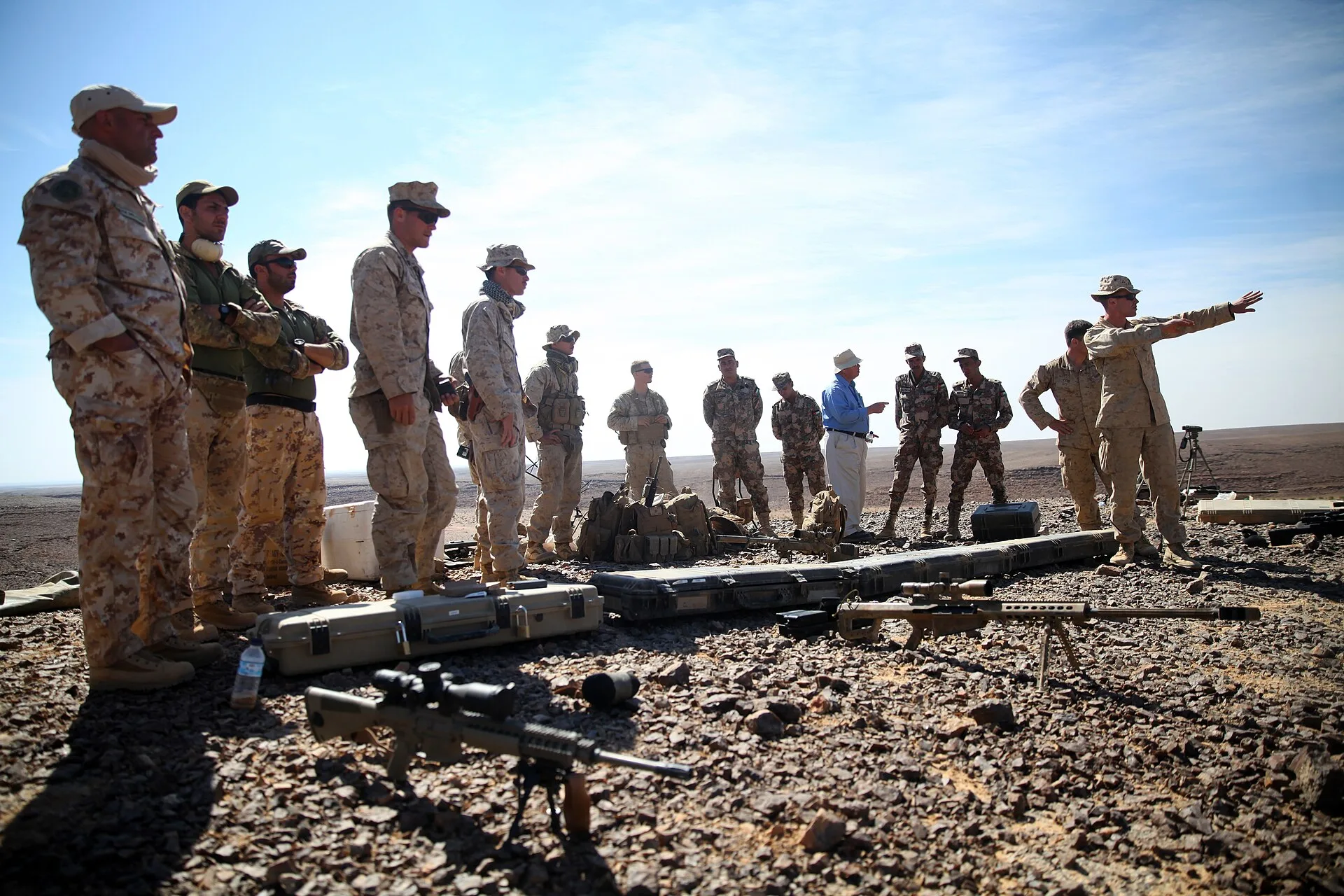
The multinational Exercise Eager Lion in Jordan has included live-fire sniper training. According to the US Marine Corps, snipers from the 24th Marine Expeditionary Unit conducted live fire with the Jordan Armed Forces during Exercise Eager Lion 2015 on 7 May 2015, as part of an exercise aimed at strengthening interoperability among partner nations.
Comparison table: sniper rifle examples in this guide
| Rifle | Maker / country | Type | Calibre | Stated weight | Stated range / accuracy |
|---|---|---|---|---|---|
| CSR 308 | CARACAL (EDGE) / UAE | Bolt-action | .308 Winchester | 5.07 kg | Not published in the materials reviewed |
| CSR 338 | CARACAL (EDGE) / UAE | Bolt-action | .338 Lapua Magnum | 6.5 kg | Not published in the materials reviewed |
| KNT-76 | MKE / Türkiye | Semi-automatic | 7.62×51 mm NATO | 5,000 g | 800 m effective; 1.5 MOA |
| KNT-859 | MKE / Türkiye | Semi-automatic | 8.59×70 mm | 7,200 g | 1,500 m effective; 1 MOA |
| Mk22 PSR | US Army | Multi-calibre bolt-action | 7.62 mm / .300 NM / .338 NM | 13.9 lb (7.62 configuration, without suppressor) | 1,000 m effective (7.62); up to 1,500 m |
| M110A1 SDMR | US Army | Semi-automatic (designated marksman) | 7.62 mm | 9.15 lb without accessories | 600 m effective |
| M107A1 | Barrett / United States | Semi-automatic, anti-materiel | .50 BMG | 28.7 lb (29-inch barrel) | Not stated in the source reviewed |
Note: the figures come from the companies or military bodies named, and their measurement conditions differ (ammunition, accessories and the method of calculating effective range), so they cannot be used to judge one rifle superior to another.
Frequently asked questions
What is a sniper rifle?
A military rifle designed to hit individual targets at long range with high accuracy, using a precision barrel, a magnifying scope and consistent ammunition.
What is the difference between a sniper rifle and an assault rifle?
An assault rifle is designed for volume of fire and movement at short and medium ranges, while a sniper rifle is designed for accuracy and range and is often heavier, with a slower rate of fire.
What is the difference between a sniper rifle and a designated marksman rifle?
A designated marksman rifle is a precise semi-automatic rifle issued at squad level for medium ranges, such as the M110A1 with an effective range of 600 metres, whereas a sniper rifle is used at longer ranges within specialised sniper teams, such as the Mk22 out to 1,500 metres.
What is the range of a sniper rifle?
It varies by calibre and model; according to MKE, the stated effective range of the 7.62 mm KNT-76 is 800 metres and that of the 8.59 mm KNT-859 is 1,500 metres.
Do Arab countries produce sniper rifles?
Yes. CARACAL, part of the Emirati EDGE Group, produces the CSR 308 and CSR 338 bolt-action sniper rifles.
What is an anti-materiel rifle?
A heavy-calibre rifle, usually .50 BMG, intended mainly to hit equipment and light vehicles at long range, such as the Barrett M107A1.
Sources
- Presidency of Defence Industries of Türkiye (SSB), “Savunma Sanayii 360” glossary – entry Keskin Nişancı Tüfeği: ssb.gov.tr
- EDGE / CARACAL, CSR 308 rifle: edgegroup.ae and its flyer: edgegroup.ae (PDF)
- EDGE / CARACAL, CSR 338 flyer: edgegroup.ae (PDF)
- MKE, KNT-76 Yarı Otomatik Keskin Nişancı Tüfeği: mke.gov.tr
- MKE, small arms catalogue (KNT-76 and KNT-859): mke.gov.tr (PDF)
- MKE USA, KNT-76: mkeusa.com
- US Army (CPE Ground), MK22 Precision Sniper Rifle: cpeground.army.mil
- US Army (CPE Ground), M110A1 Squad Designated Marksman Rifle: cpeground.army.mil
- Barrett, M107A1: barrett.net
- US Marine Corps via Wikimedia Commons, sniper live fire with the Jordan Armed Forces during Eager Lion 2015: commons.wikimedia.org
Main image: Sgt. Phillip Lilly, a US Marine Corps sniper, gives a safety brief before live fire with the Jordan Armed Forces during Exercise Eager Lion 2015 in Jordan, 7 May 2015. Photo by Lance Cpl. Austin Lewis / US Marine Corps – public domain.