KAAN or KF-21? A comparison of two rising programmes and the stage each has reached
Editor’s assessment: This file compares the Turkish KAAN fighter and the South Korean KF-21 “Boramae” from a single angle: programme maturity in development, testing, production and delivery, as of 19 November 2026. We do not compare combat capability that has not been tested to the same extent in full operational service for both programmes, we do not declare a winner, and we do not predict the outcome of any engagement. We separate what has been officially announced as achieved from what remains a design goal or an undelivered contract. The labels “fifth generation” and “4.5 generation” here are each party’s official description, not an independent judgement that all of the characteristics have been proven. Source confidence: high for flight, delivery and official contract dates; medium for technical figures taken from manufacturers’ brochures, as these are declared characteristics. Caution: a signed contract is not delivered inventory, and a first delivery is not a declaration of operational entry.
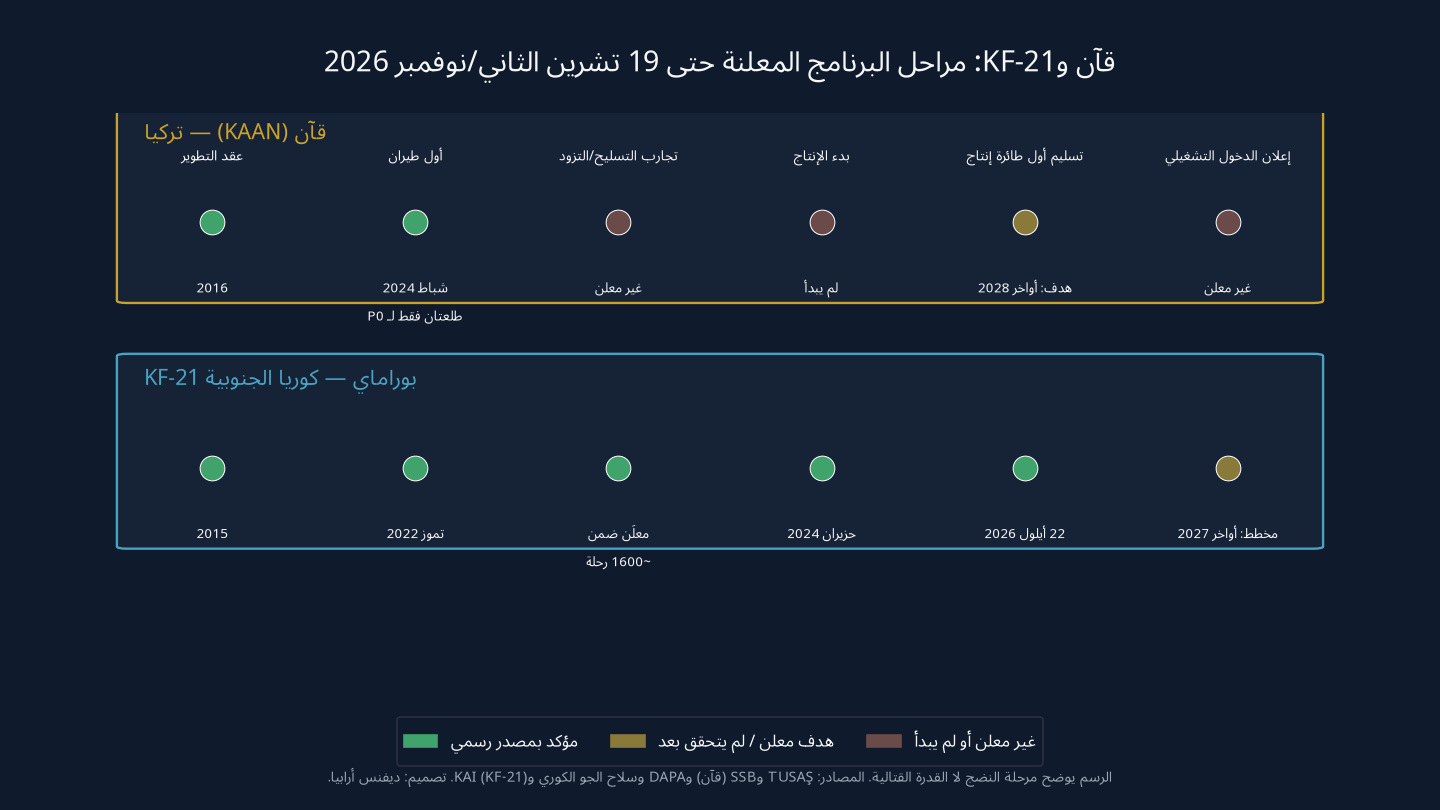
The KF-21 reached delivery of its first production aircraft to the Republic of Korea Air Force on 22 September 2026, after about 1,600 test flights and an official “combat suitability” ruling for the Block I batch in May. KAAN’s first prototype (P0), by contrast, flew only two sorties in 2024, and the first taxi test of the P1 prototype was announced in early August 2026, with no official announcement as of 19 November 2026 of a first flight by that prototype. TUSAŞ is targeting the start of deliveries to the Turkish Air Force in late 2028. Indonesia’s contract to buy 48 KAAN aircraft is signed, but it does not represent delivered aircraft, and Indonesia remains at the same time a development partner in the KF-21.
We have previously published a profile of KAAN: specifications, price and range (Arabic), a comparison of KAAN and Rafale (Arabic), and an explainer on the difference between fourth- and fifth-generation fighters (Arabic). This file does not repeat those general technical comparisons, nor does it ask “which is stronger”; instead it places both programmes on a single timeline: where has each actually got to, and what remains a declared goal?
The short answer
- Service stage: The KF-21 has entered the stage of production aircraft deliveries to the Republic of Korea Air Force (first aircraft on 22 September 2026). KAAN has not yet been delivered to any air force, and the declared target for delivery to Türkiye is late 2028.
- Testing: South Korea’s Defense Acquisition Program Administration (DAPA) announced about 1,600 test flights for the KF-21, including aerial refuelling and air-to-air weapons firing. For KAAN, TUSAŞ announced two sorties by the P0 prototype on 21 February and 6 May 2024, lasting 13 and 14 minutes at a speed of 230 knots.
- Production: Initial production of the KF-21 began in 2024. There is no official announcement of the start of KAAN series production.
- Contracts: In 2025 Indonesia signed a contract to buy 48 KAAN aircraft (produced in Türkiye). At the same time, it is a partner in KF-21 development following the amendment of the contribution agreement in June 2025. As of the reference date, no announced Arab purchase contract exists for either programme.
Scope of the comparison
What we include: the declared design stage, ground and flight testing, the start of production, delivery of production aircraft, an official combat suitability ruling or its equivalent, and contracts or protocols announced by official bodies. We take technical figures from the two manufacturers’ pages and brochures, noting that they are declared characteristics.
Out of scope: predictions of combat performance or the outcome of an engagement, comparing “generation” as a verdict on superiority, unit prices not officially announced, letters of interest or leaks about Arab orders, and any inventory whose delivery has not been announced. Nor do we count a memorandum of understanding or a cooperation protocol as a purchase order for a specific number, unless the official source states so.
Methodology: five criteria with declared weights
We distributed 100 points across five criteria that measure programme maturity, not “combat superiority”. We do not add the points up into a winner’s ranking; the assessment comes criterion by criterion in a later section. Each weight is justified by what can be publicly verified:
| Criterion | Weight | Why this weight? |
|---|---|---|
| Flight-test maturity | 30% | The number of prototypes that have flown and the nature of the announced tests are the most reliable public indicator of a programme’s move from prototype to testing |
| Production, delivery and entry into service | 25% | The move from prototype to a production aircraft delivered to an air force, separating delivery from a declaration of operational entry |
| Sensor and weapons verification | 20% | Separates what has passed a test or an official ruling from what remains a brochure item (internal bays, sustained supersonic speed, teaming with drones) |
| Confirmed contractual commitments | 15% | Domestic production contracts and signed export contracts, not statements of interest; a contract does not count as inventory |
| Propulsion and supply path | 10% | Officially declared thrust and the national engine path, if any, with the risks of dependence on a foreign supplier, without speculation |
KAAN: a first prototype that flew in 2024 and a second still in ground testing
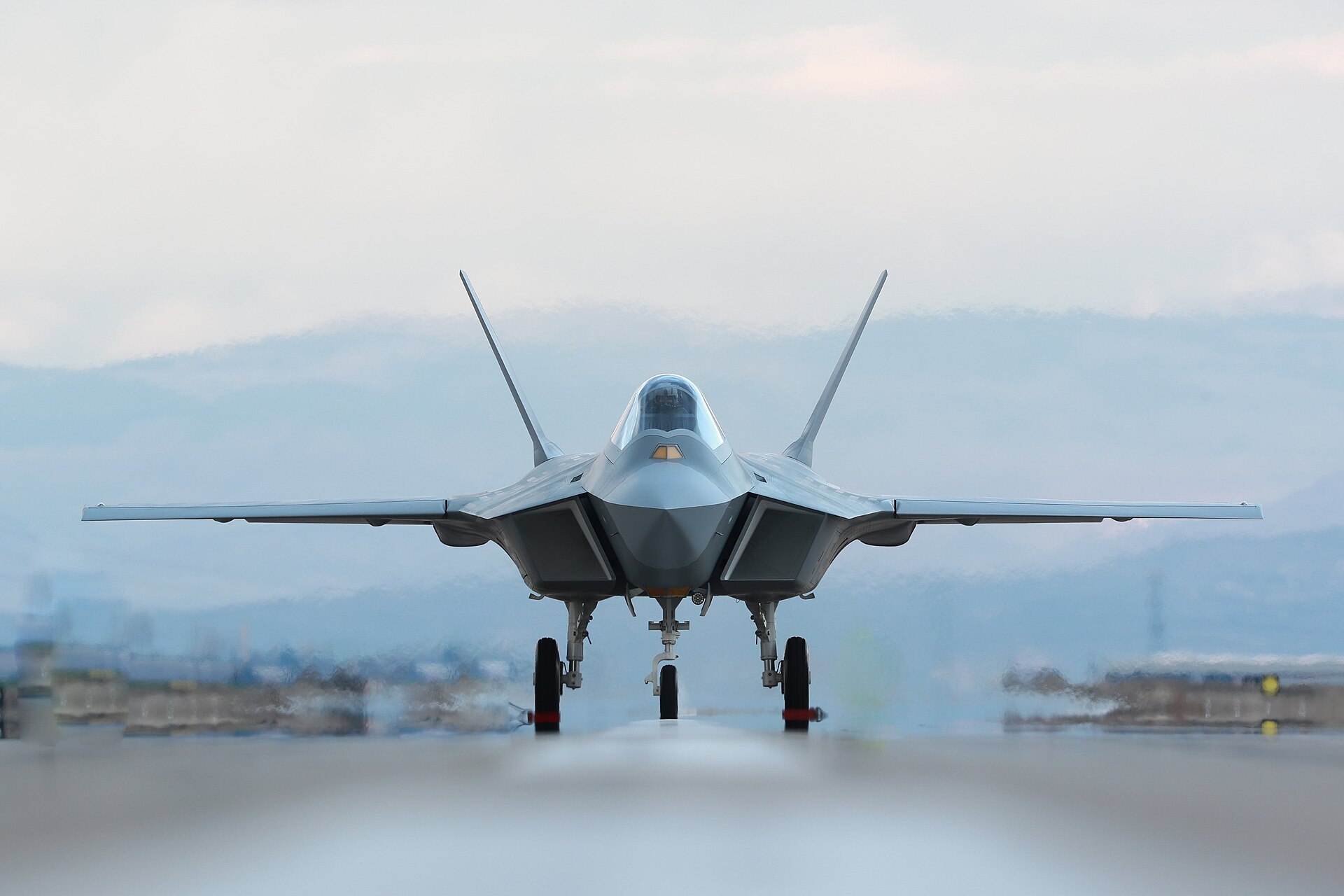
TUSAŞ leads the KAAN programme under an agreement with the Presidency of Defence Industries (SSB) signed on 5 August 2016, with the aim of designing an indigenous fighter that will gradually replace the F-16s in the Turkish Air Force from the 2030s. The company describes the aircraft as fifth-generation and lists design characteristics on the programme page including a low radar signature, internal weapons bays, sensor fusion and operation with other platforms.
After ground testing, TUSAŞ announced that the first prototype made its first flight on 21 February 2024, lasting 13 minutes and reaching an altitude of 8,000 feet and a speed of 230 knots. The second sortie took place on 6 May 2024, lasting 14 minutes at an altitude of 10,000 feet and the same speed. These two sorties are what the company’s official page confirms as of the reference date; they are early sorties that do not prove characteristics such as sustained supersonic flight or firing weapons from internal bays.
On 3 August 2026 SSB announced that the P1 prototype had completed its first taxi test. On 2 October 2026 the general manager of TUSAŞ, Mehmet Demiroğlu, told Anadolu Agency that P1 systems tests had been completed, that low-speed taxi tests had been carried out, that a high-speed taxi test would follow, and that the goal was to fly P1 before the end of 2026 barring delays, to be followed by P2. As of 19 November 2026 we found no official announcement from TUSAŞ or SSB that P1 had flown. Demiroğlu said the programme plans six development prototypes and that the target for starting deliveries to the Turkish Air Force remains late 2028.
On the contractual side, SSB announced on 12 June 2025, followed by TUSAŞ and the Indonesian Ministry of Defence at the IDEF exhibition in Istanbul on 26 July 2025, the signing of a contract to buy 48 KAAN aircraft to be produced in Türkiye, with cooperation in local manufacturing and training. The Turkish presidency described the agreement as a framework for exporting 48 aircraft built in Türkiye while drawing on Indonesia’s capabilities. This is a signed contract, not a delivery. The official sources we relied on did not publish a contract value or a detailed annual delivery schedule. Azerbaijan, for its part, signed a cooperation protocol on joint development and production in July 2023, which is a framework for work, not a purchase order for an announced number. As for talk of Saudi, Egyptian or Pakistani participation, as of the reference date it remains without a government announcement we can rely on; we therefore treat it as unconfirmed.
KF-21: from first flight in 2022 to delivery of the first production aircraft in 2026
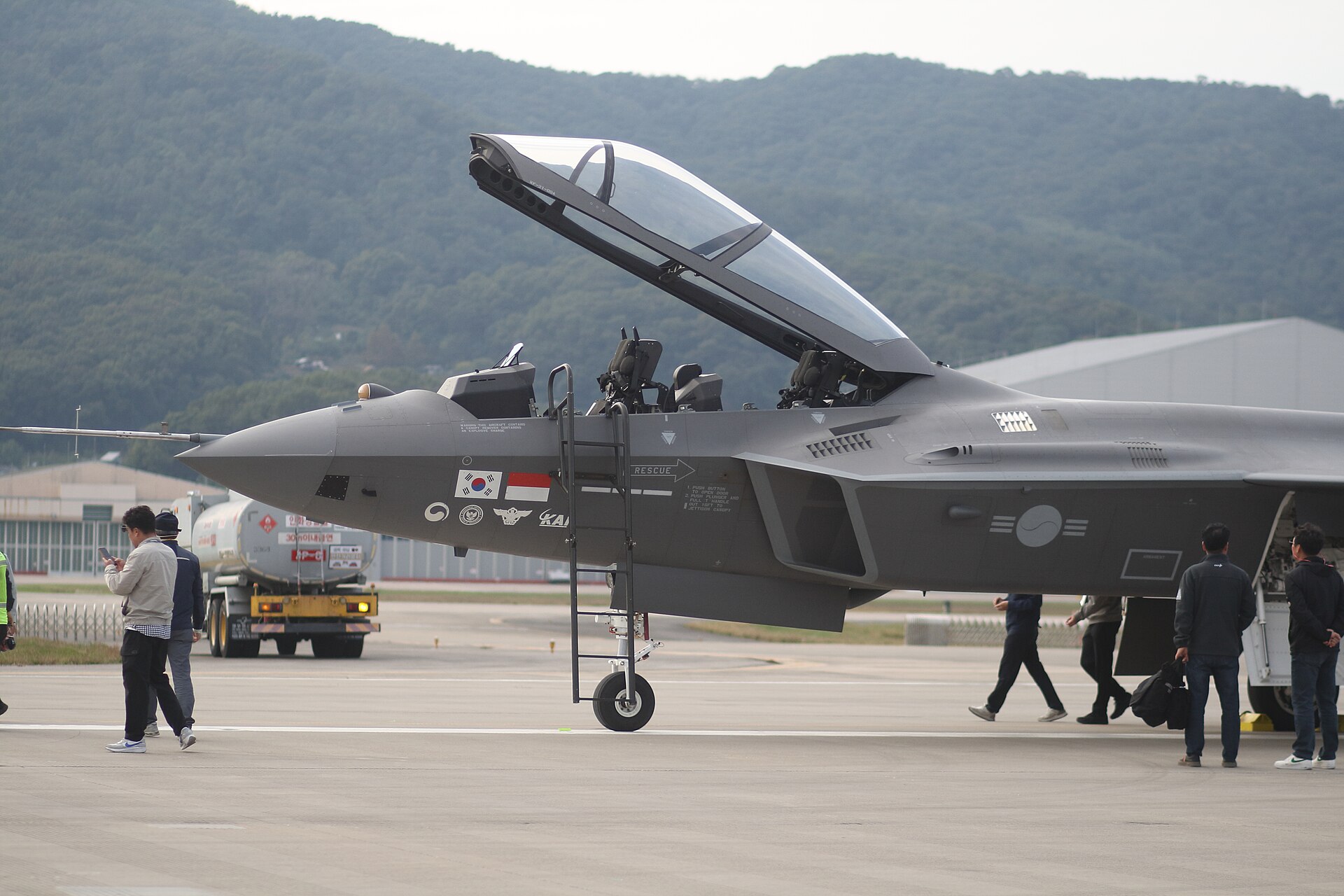
DAPA describes the KF-21 as a Korean 4.5-generation multirole fighter developed to replace ageing F-4 and F-5 aircraft. System development began in December 2015 in partnership with Indonesia. The first prototype was unveiled in 2021, and the first flight took place on 19 July 2022.
On 7 May 2026 DAPA announced that the programme had received a “combat suitability” ruling for the Block I batch (basic capabilities and air-to-air combat), after about 1,600 test flights and nearly 13,000 test conditions, including aerial refuelling and air-to-air weapons firing. Completion of system development was announced in June 2026. This ruling covers the first batch with air-to-air capabilities; longer-range air-to-ground capabilities are tied to later batches that are to be completed later.
Initial production had in practice begun in 2024: the Defense Acquisition Program Promotion Committee approved the plan in March, and initial contracts were signed on 25 June 2024 with KAI, Hanwha Aerospace and Hanwha Systems for airframes, engines and AESA radar, worth about 2.632 trillion Korean won for 2024–2027. The production kick-off meeting was held on 10 July 2024. The first production aircraft was rolled out in March 2026, and aircraft No. 001 was then delivered to the air force on 22 September 2026 from KAI’s plant in Sacheon and moved to Yecheon air base. On 1 June 2026 the 156th Squadron was re-formed as the first operating unit. The air force announced that it intends to declare combat formation in the second half of 2027; in other words, deliveries have begun, but full operational entry has not yet been declared.
Korean authorities plan to bring in more than 100 aircraft in stages through the early 2030s: initial batches focused on air-to-air until around 2028, followed by later batches with longer-range air-to-ground capabilities until around 2032. These are declared plans, not completed inventory.
The Indonesian partnership continues after the contribution crisis: on 11 June 2025 the Indonesian Ministry of Defence and DAPA signed an amendment to the project agreement setting Indonesia’s contribution at 600 billion won. On 1 November 2025 DAPA said the 2025 share had been paid and that preparation of the 2026 budget was under way. On 11 November 2026, at the 12th meeting of the defence industry cooperation committee in Jakarta, the continuation of the KF-21/IF-X programme and the delivery of prototype No. 5 to Indonesia were discussed, and PTDI and KAI signed memoranda of understanding to produce pylon components in the follow-on production phase. So Indonesia is a development partner in the KF-21 and, at the same time, a contracted buyer of 48 KAAN aircraft. This is an announced contractual reality, not a judgement on which programme will be operated first.
Technical table: what is declared and what is proven
The engineering figures below come from TUSAŞ’s official KAAN page and KAI’s official KF-21 brochure. They are declared characteristics, not independent measurements from operational service.
| Item | KAAN | KF-21 Boramae |
|---|---|---|
| Manufacturer / government body | TUSAŞ / SSB | KAI / DAPA |
| Official generation label | Fifth generation (TUSAŞ) | 4.5 generation (DAPA) |
| Development contract | 5 August 2016 | December 2015 |
| First flight | 21 February 2024 (P0) | 19 July 2022 |
| Flight tests announced as of the reference date | Two P0 sorties in 2024 (13 and 14 minutes, 230 knots). P1: taxi announced, first flight not announced | About 1,600 flights; aerial refuelling and air-to-air firing included in the tests |
| Series production | Start not announced | Initial contracts 2024; first production aircraft rolled out March 2026 |
| Delivery to an air force | None. Declared target: late 2028 for Türkiye | 22 September 2026 (aircraft 001) |
| Operational entry | Not announced | Planned for the second half of 2027 (not yet declared) |
| Length / wingspan / height | 20.3 m / 13.4 m / 5 m (TUSAŞ) | 16.9 m / 11.2 m / 4.7 m (KAI) |
| Maximum take-off weight | 34,750 kg | 25,600 kg |
| Declared thrust | 2×13,150 kgf (2×29,000 lb) | 44,000 lb total |
| Declared maximum speed | Mach 1.8 at 40,000 ft | Equivalent to about 2,200 km/h in the KAI brochure (around Mach 1.8) |
| Service ceiling / range / payload | Ceiling 16,764 m. Extended combat range described without a figure on the official page | Range 2,900 km; payload 7,700 kg (KAI) |
| Internal weapons bays | Declared design goal; not proven in the two published sorties | Weapons tested in development announced in the context of the flights; first batch air-to-air, longer-range air-to-ground capabilities for later batches |
| Confirmed export contract or partnership | Contract for 48 aircraft for Indonesia (2025, not delivered). Cooperation protocol with Azerbaijan (2023) with no purchase number | Domestic production contracts for the Republic of Korea Air Force. Amended development partnership with Indonesia (2025) still in place |
Strengths and weaknesses
KAAN — points drawn from official sources: a larger and heavier aircraft according to the declared figures, with declared design goals for fifth-generation characteristics (internal bays and low signature). A signed export contract for 48 aircraft gives the programme an early external commitment. SSB’s power systems project aims to develop a later national propulsion system.
KAAN — declared or missing limitations: the published flight tests are still at a very early stage (two short sorties in 2024). P1 has not been announced as having flown as of the reference date. No series production or delivery has been announced. The most prominent brochure characteristics (internal bays, sustained supersonic flight, full combat integration) have not yet been presented as completed tests in the official sources we reviewed. And the Indonesian contract, important as it is, does not move the aircraft from development into inventory.
KF-21 — points drawn from official sources: a long and announced test path, a combat suitability ruling for the Block I batch, and the start of production followed by delivery of the first production aircraft to a specific unit. The technical figures in the company brochure are clearer on range and payload. And the Indonesian partnership, despite the reset of the contribution, remains in place according to official documents as of November 2026.
KF-21 — declared or missing limitations: the official label is 4.5 generation, not fifth generation. The first batch is mainly for air-to-air; longer-range air-to-ground capabilities are deferred to a later batch. Full operational entry has not been declared and is planned for late 2027. The number of aircraft delivered after aircraft 001 as of the reference date is not detailed in the official statements we relied on, so we do not give a figure for current inventory.
Assessment criterion by criterion
Flight-test maturity (30%): the KF-21 leads here by a clear margin in what has been announced: about 1,600 flights versus two early sorties for KAAN. This is not a verdict on the quality of the design, but on the distance covered in testing.
Production, delivery and entry into service (25%): the KF-21 has completed the move into production and then delivery. KAAN has not reached this threshold, and its declared delivery target is late 2028. At the same time, the first KF-21 delivery does not mean the squadron has been declared combat-ready; that is the 2027 goal.
Sensor and weapons verification (20%): the KF-21 has an official Block I air-to-air suitability ruling after tests announced to have included refuelling and weapons. KAAN declares an indigenous radar, mission systems and internal bays as design goals, without an equivalent announced weapons-test package as of the reference date.
Confirmed contractual commitments (15%): the picture is mixed, not one-sided. Korea has active domestic production contracts and ongoing deliveries. Türkiye has a large signed export contract with Indonesia, but for a platform not yet delivered, plus the Azerbaijan protocol with no purchase quantity. Indonesia is present in both programmes in two different capacities: a development partner in the KF-21 and a buyer of KAAN. We do not turn this into “bias” towards one programme at the expense of the other, and we do not count any Arab order in the absence of an official announcement.
Propulsion and supply path (10%): both companies declare thrust figures (2×29,000 lb for KAAN and 44,000 lb in total for the KF-21). The initial Korean production contract covered engines with Hanwha Aerospace. On the Turkish side, SSB has a power systems project for the national fighter that is still in development. We do not specify the current engine model of either aircraft here because the TUSAŞ and KAI pages used in the table do not name it; we confine ourselves to declared thrust and the localisation path.
Conclusion and limits
If the question this file sets is asked — where has each programme got to today? — the answer from official sources is that the KF-21 is ahead of KAAN by two visible stages: closing a long test package with a suitability ruling for a first batch, and then delivering the first production aircraft. KAAN is still at the prototype stage: P0 flew twice in 2024, P1 has reached ground and taxi tests, and delivery is targeted for 2028. This is a ranking of maturity stages, not a declaration that one fighter is superior to the other in combat, nor a verdict that KAAN’s design goals cannot be achieved later.
The limits are clear. First, the technical figures are declared by the two companies and we have not checked them against independent measurement. Second, the number of KF-21s delivered after the first is not officially detailed in the sources we used. Third, KAAN’s Indonesian contract is contractually significant, but it does not change the fact that the aircraft has not been delivered. Fourth, there is not enough reliable data on an announced Arab order for either programme. Fifth, the generation label is each party’s official description, and KAAN’s distinguishing fifth-generation characteristics have not yet been presented as completed tests in the published sources.
Frequently asked questions
Which is better: KAAN or KF-21?
This file does not answer which is “better” in combat. What can be said from official sources as of 19 November 2026 is that the KF-21 is further along in testing, production and delivery, and that KAAN is still at the prototype stage with a delivery target in 2028.
Is KAAN fifth generation and the KF-21 4.5 generation?
That is each party’s description of its own programme: TUSAŞ describes KAAN as fifth generation, and DAPA describes the KF-21 as 4.5 generation. The label is not in itself proof that all the characteristics of the generation have been observed in completed tests.
Has KAAN entered service with the Turkish Air Force?
No. There is no announced delivery. The declared target for starting deliveries is late 2028.
Has the Republic of Korea Air Force received the KF-21?
Yes. Delivery of the first production aircraft (001) was announced on 22 September 2026 to the 156th Squadron at Yecheon air base. Full operational entry is planned for the second half of 2027 and has not yet been declared.
Has Indonesia signed up to both programmes?
Yes, in two different capacities. It is a development partner in the KF-21 following the amendment of the contribution agreement in June 2025, and in 2025 it signed a contract to buy 48 KAAN aircraft to be built in Türkiye. The second contract is not a delivery.
Have Arab countries ordered KAAN or the KF-21?
As of the reference date there is not enough reliable data on an announced Arab purchase contract for either programme. Azerbaijan’s 2023 protocol is a cooperation framework, not an order for an announced number.
Sources
- Turkish Aerospace (TUSAŞ) — official KAAN programme page, including the 5 August 2016 agreement, the sorties of 21 February and 6 May 2024 and the declared engineering figures — tusas.com.
- Presidency of Defence Industries of Türkiye (SSB) — KAAN national fighter development project page; the national fighter power systems project; the 3 August 2026 announcement of the first P1 taxi test; and the 12 June 2025 announcement of the agreement to export 48 aircraft to Indonesia, built in Türkiye — ssb.gov.tr, ssb.gov.tr and ssb.gov.tr.
- TUSAŞ — statement on the signing of the final contract for the sale of 48 KAAN aircraft to the Indonesian Ministry of Defence at IDEF in Istanbul, 26 July 2025 — tusas.com; and the Indonesian Ministry of Defence, 28 July 2025 — kemhan.go.id.
- Anadolu Agency — statement by TUSAŞ general manager Mehmet Demiroğlu on 2 October 2026 on the status of P1 and P2, the goal of flying before the end of 2026 and the late-2028 delivery target — aa.com.tr.
- South Korea’s Defense Acquisition Program Administration (DAPA) — KF-21 Block I combat suitability ruling on 7 May 2026; the start of initial production (March plan, 25 June contracts and 10 July 2024 meeting); and the joint statement with the air force on 23 September 2026 on the delivery of aircraft 001 on 22 September — dapa.go.kr, dapa.go.kr and dapa.go.kr.
- Yonhap — English coverage of the joint statement on 22 September 2026 — yna.co.kr.
- Korea Aerospace Industries (KAI) — official KF-21 brochure (dimensions, thrust, range, payload and maximum weight) — koreaaero.com.
- Indonesian Ministry of Defence — signing of the amendment to the KF-X/IF-X project agreement on 11 June 2025; DAPA — position statement on 1 November 2025 on setting the contribution at 600 billion won and payment of the 2025 share; and PTDI — memoranda of understanding with KAI on 11 November 2026 — kemhan.go.id and indonesian-aerospace.com.
- SSB — cooperation protocol with Azerbaijan on KAAN development and production, 30 July 2023 (a cooperation framework, not a purchase contract for a number) — ssb.gov.tr.