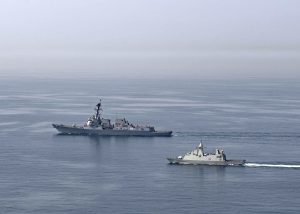
Warships Without Sailors: Inside the Autonomous Naval Race From Sea Hunter to Ghost Shark
Autonomous naval systems are often presented as a race to put robots where sailors used to stand. The more interesting question is what changes when a vessel is designed around the absence of a crew from the start, and what separates an impressive autonomous voyage from a genuinely useful naval capability.
Autonomy is not a single switch
Remote control and autonomy are related but not identical. A vessel can handle some navigation tasks on its own while people remain responsible for supervision, mission planning and other decisions. “Unmanned ship” does not mean there is no human organization behind it, and it says nothing about who controls any weapon aboard.
Sea Hunter: a platform for learning
Sea Hunter, with its narrow central hull and two outriggers, is one of the best-known examples. DARPA transferred the prototype to the Office of Naval Research in 2018, and the Navy later used it with other uncrewed prototypes in exercises and experimentation. Its value lies partly in exposing ordinary problems: long-term system behavior, human supervision and integration into wider operations.
Defiant removes the crew from the design
DARPA’s NOMARS project goes further. Its demonstrator, Defiant, was designed from the outset with no accommodation for people aboard, to test what that means for size, reliability, maintenance and endurance. Program updates describe extended sea trials, software testing for navigation and machinery control, and an at-sea replenishment demonstration that used water rather than fuel.
The race spreads across missions
Australia signed a five-year Ghost Shark contract in September 2025 covering delivery, maintenance and further development of large autonomous underwater vehicles, and in April 2026 its Navy described a new autonomous systems unit. Britain has tested an autonomous Pacific 24 boat in busy home waters, and Türkiye’s defense industry agency says the MARLIN unmanned surface vessel entered service in 2024. Countries are building institutions around the machines, not just the machines themselves.
The ocean is a maintenance test
The sea does not get easier because a ship has no crew. Machinery wears, sensors degrade and conditions change; the U.S. Navy has reported long-duration power-system demonstrations for exactly that reason. The likely outcome is not empty navies but a different fleet, with uncrewed platforms working alongside crewed ships under clear human responsibility.
This report accompanies the video above from DefenseandTech, Defence Arabia’s English-language partner channel, part of the Defense Vision series. Research checked on 7 November 2026; the full source list and footage credits are in the video description on YouTube.