Types of mortars and their calibres: 60 vs 81 vs 120 mm in range and weight
Mortars are usually classified by calibre into three categories: light at 60 mm, medium at 81 or 82 mm, and heavy at 120 mm. Calibre determines the weapon’s weight, its range and the level of the unit that uses it. According to US Army data, the maximum range of the 60 mm M224A1 mortar is about 3,490 metres, the 81 mm M252A1 about 5,844 metres, and the 120 mm M120A1 about 7,200 metres.
This guide explains the types of mortars, their calibres and the differences between them using official figures. For the definition of a mortar and how it basically works, see our article: What is a mortar? How it works and why it fires at a high angle (Arabic).
How are mortars classified?
The most common classification is based on barrel diameter (calibre). The larger the calibre, the greater the bomb’s power and range, and with it the weight of the system and its need for a larger crew or a vehicle. Mortars can also be classified by how they are transported and mounted:
- Man-portable mortar: carried by soldiers and mounted on a baseplate and bipod.
- Towed mortar: moved on a trailer behind a vehicle and lowered to the ground for firing.
- Vehicle-mounted mortar: installed inside an armoured vehicle and fired from it.
- Turreted mortar: housed in a remotely operated armoured turret.
Comparison table: light, medium and heavy mortars
| Item | M224A1 (60 mm) | M252A1 (81 mm) | M120A1 (120 mm) |
|---|---|---|---|
| Category | Light | Medium | Heavy |
| Weight in firing configuration | 37.9 lb (about 17 kg) | 74.9 lb (about 34 kg) | 317 lb (about 144 kg) |
| Minimum range | 70 metres | 83 metres | 200 metres |
| Maximum range | 3,490 metres | 5,844 metres | 7,200 metres |
| Maximum rate of fire | 30 rounds/min for 4 minutes | 30 rounds/min for 2 minutes | 16 rounds in the first minute |
| Sustained rate of fire | 20 rounds/min | 15 rounds/min | 4 rounds/min |
| Level of use (US Marine Corps) | Company | Battalion | — |
Source: US Army Project Manager Combat Ammunition Systems (PM CAS) and the US Marine Corps crew-served weapons manual. Conversions to kilograms are approximate.
Light mortar: 60 mm calibre
The light mortar is the company’s weapon. The US Marine Corps manual describes the M224A1 as a smoothbore, muzzle-loaded, high-angle-of-fire weapon. The weapons platoon of an infantry company has three of them, ready to meet the company commander’s immediate need for fire.
The M224A1 can be used conventionally with a baseplate and bipod, or in handheld mode weighing just 19.6 lb (about 9 kg), according to the US Army. The Army says the A1 version is 21% lighter than its predecessor while keeping the same range and rate of fire. Its ammunition includes high-explosive, white phosphorus smoke, and visible-light and infrared illumination rounds.
Medium mortar: 81 and 82 mm calibre
The medium mortar is the organic indirect-fire weapon of the infantry battalion commander. The US Marine Corps manual explains that the battalion’s 81 mm mortar platoon has two sections, each with four mortars, for a total of eight.
The M252A1 weighs 74.9 lb in firing configuration, about 13% lighter than the original M252, according to the US Army. The bomb’s range is set by the number of propellant charges attached to its tail: the assistant gunner removes charges according to the required distance before dropping the bomb into the muzzle. The US Army is working on an improved high-explosive round for this calibre to increase range and effectiveness.
NATO uses the 81 mm calibre, while armies with Soviet and Russian equipment adopted 82 mm. This is why several Arab armies operate both calibres, depending on their Western and Eastern sources of arms.
Heavy mortar: 120 mm calibre
In terms of firepower, the heavy mortar is closer to light artillery. The M120A1 weighs 317 lb in firing configuration, so it is moved on a trailer usually towed by a Humvee, according to the US Army. It fires up to 16 bombs in the first minute, then at a sustained rate of 4 bombs per minute.
A vehicle-mounted version, the M121, is installed in the M1064A3 armoured carrier and can fire across a 90-degree sector without being dismounted. The US Army equips these systems with digital fire-control computers such as the M150 and M151, which connect several mortars to fire-support networks and shorten the time needed to emplace, fire and displace.
Mortars in armoured turrets
A newer category places a 120 mm mortar inside a remotely operated armoured turret. One example is the NEMO system from Finland’s Patria. Patria says NEMO is a 120 mm mortar turret offering ballistic protection and both direct and indirect fire capability.
In 2010 the company announced a contract to supply 36 NEMO systems for LAV II vehicles produced by General Dynamics Land Systems – Canada under the US Foreign Military Sales programme. In the same statement, Patria noted that the UAE Navy had previously selected the system.
Guided mortar rounds
The mortar bomb is no longer only an area weapon. In 2011 the US Army delivered the first GPS-guided 120 mm mortar rounds (XM395) to its forces in Afghanistan under the Accelerated Precision Mortar Initiative (APMI). The requirement was for the round to land within a circular error of no more than 10 metres, according to the US Army. Such accuracy reduces the number of rounds needed to hit a target and lowers the risk of collateral casualties.
Mortars in Arab armies
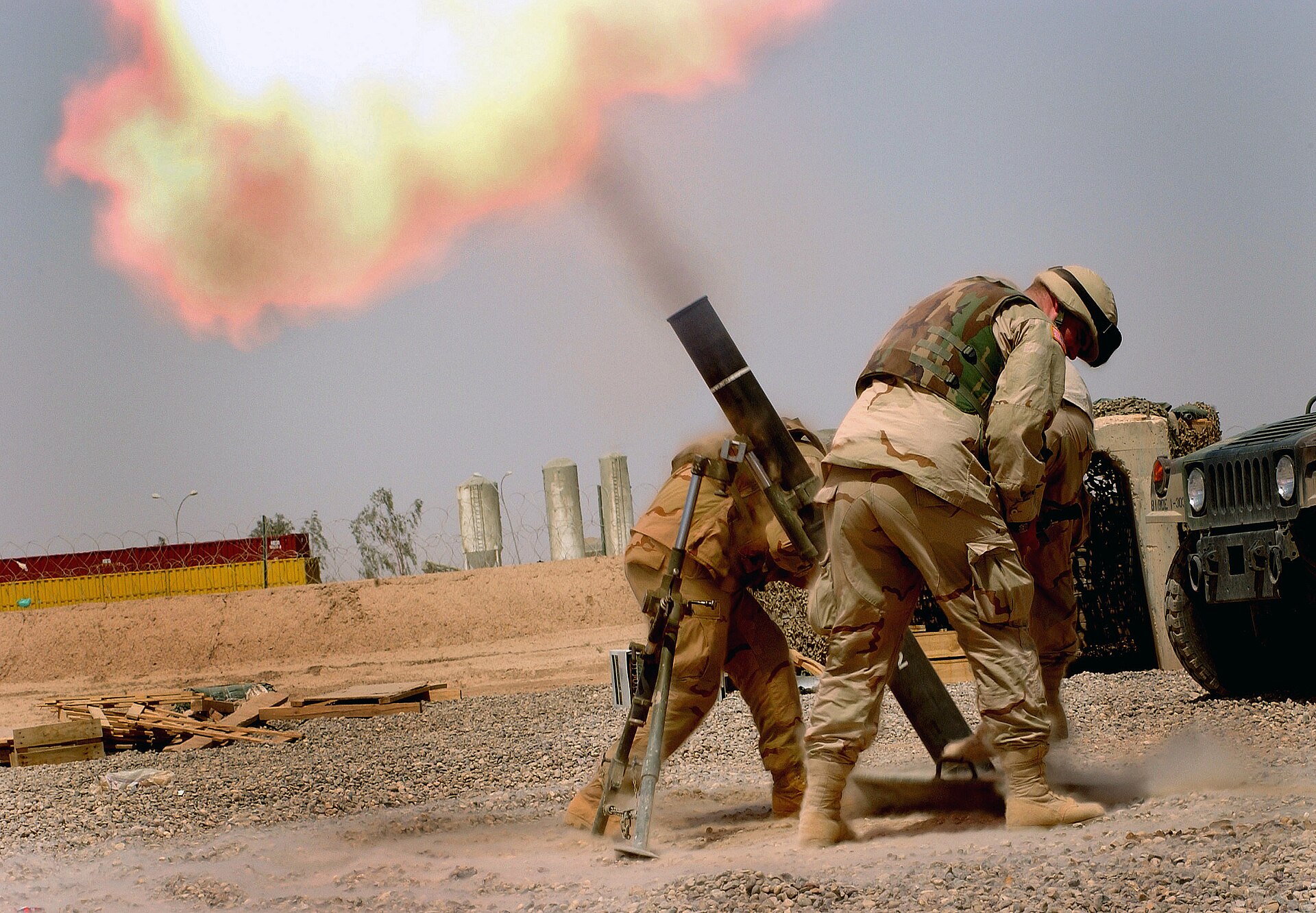
The mortar holds a firm place in Arab armies because it is cheap, easy to carry and effective in mountainous and urban terrain. One officially documented example is that the United States delivered 55 mortar systems to the Lebanese Army within 12 months, according to a speech by US Ambassador in Beirut Elizabeth Richard on 11 December 2015. The image in this article shows soldiers firing a 120 mm M120 mortar in Iraq.
For a comparison between mortars and other fire assets, see: What is a self-propelled howitzer? (Arabic) and What is a multiple rocket launcher (MLRS)? (Arabic)
How do armies choose a mortar calibre?
- Mobility: the light mortar accompanies infantry on foot, while the heavy one needs a vehicle.
- Range: the 120 mm calibre roughly doubles the range of the light mortar.
- Firepower: a heavier bomb has a greater effect, but the ammunition is heavier to transport.
- Responsiveness: the light mortar is directly in the hands of the company commander, so there is no wait for artillery support to be requested.
Frequently asked questions
What are the types of mortars?
Light (60 mm), medium (81 or 82 mm) and heavy (120 mm). There are also vehicle-mounted types and others housed in armoured turrets.
What is the range of a mortar?
According to the US Army: about 3.5 km for the 60 mm calibre, about 5.8 km for 81 mm, and 7.2 km for 120 mm.
What is the difference between 81 mm and 82 mm mortars?
The 81 mm calibre is a Western standard used by NATO, while 82 mm is a Soviet and Russian standard.
Are there guided mortar rounds?
Yes, such as the US XM395 120 mm GPS-guided round, which entered service in Afghanistan in 2011.
Main image: soldiers firing a 120 mm M120 mortar in Iraq. Source: SSgt Aaron D. Allmon II / US Air Force via Wikimedia Commons – public domain.
Sources
- US Army (PM CAS) – 60 mm M224A1 mortar
- US Army (PM CAS) – 81 mm M252A1 mortar
- US Army (PM CAS) – 120 mm M120A1 and M121 mortar systems
- US Army (CPE Ground) – M252A1 system
- US Marine Corps – Introduction to Crew-Served Weapons (The Basic School)
- US Army – first guided mortar rounds delivered in Afghanistan
- Patria – contract to supply 36 NEMO mortar systems (2010)
- US Embassy in Beirut – remarks by Ambassador Elizabeth Richard (11 December 2015)