Why does the same fighter jet cost different amounts in different countries?
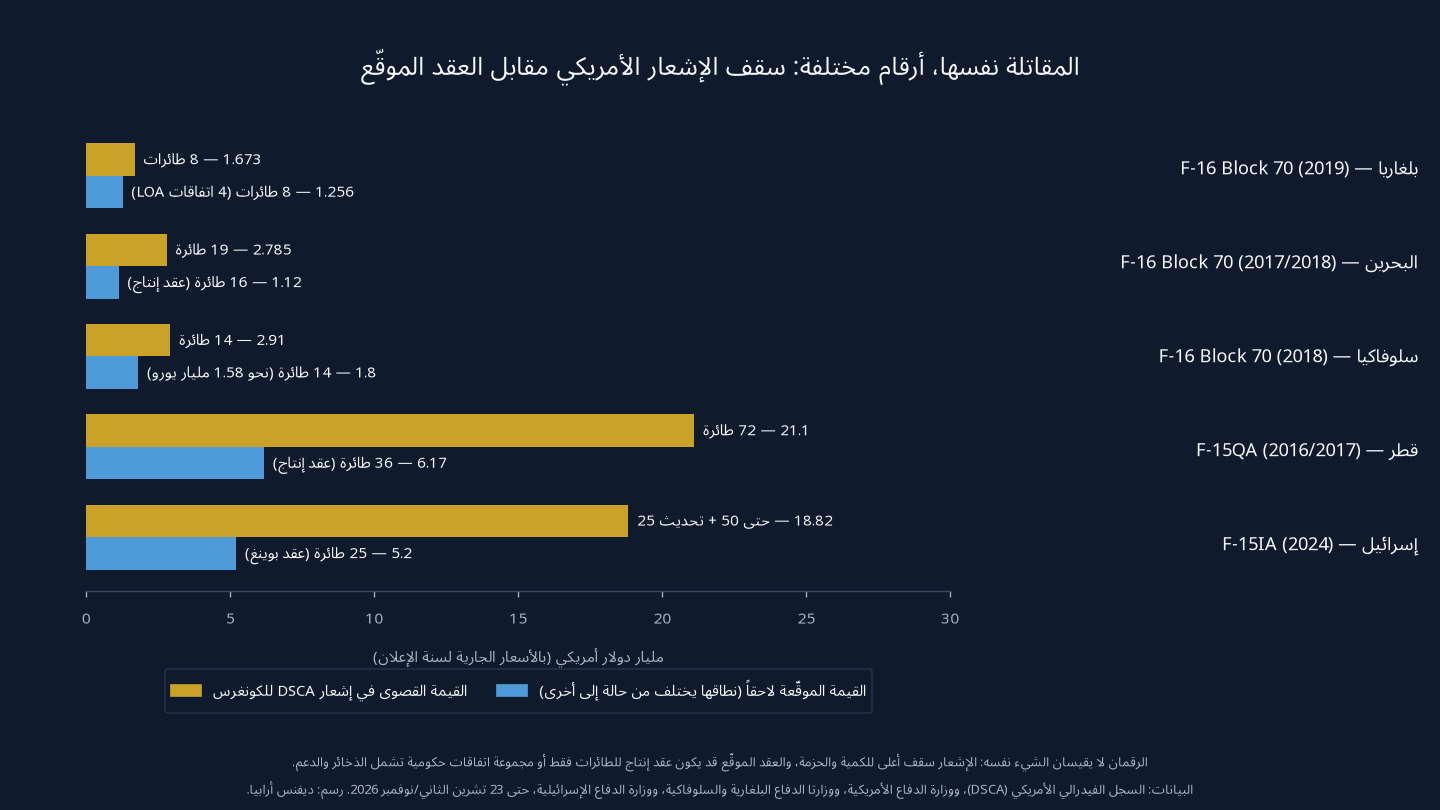
Editor’s assessment: This dossier explains why different figures appear for the price of the same fighter model in different countries’ deals, based on published government documents for three families: the F-16 Block 70/72, the modern F-15 and the Rafale. It does not determine the “real price” of any fighter, nor does it say that any country paid more or less than it should have, because the published documents do not disclose detailed price breakdowns. Source confidence level: High for US notifications and contracts announced by governments, medium for figures reported by the media from officials or leaked documents, and low where no party has announced the value. Note: The value of a US Defense Security Cooperation Agency (DSCA) notification is an estimated ceiling that covers weapons, training and support; it is not the price of a ready-to-fly aircraft.
Countries pay different amounts for the same fighter model because the figure announced in each deal covers a different package of aircraft, spare engines, munitions, training, maintenance and infrastructure, and because some figures are estimated ceilings while others are signed contracts, according to US and European government documents and defence ministry statements reviewed by Defence Arabia.
Anyone searching for the “price of the F-16” or the “price of the Rafale” finds widely varying figures for the same model. Bulgaria’s agreements for eight F-16 Block 70 fighters came to about $1.256 billion, while the production contract for 16 fighters of the same model for Bahrain amounted to $1.12 billion. The two figures do not measure the same thing.
Defence Arabia previously published an explainer on pricing terms titled What is the difference between unit price and deal price in arms deals? (Arabic). This dossier asks a different question: it does not define the terms, but compares real deals for the same fighter across different countries and identifies the factors that explain the difference in each case. Nor does it repeat the Rafale vs F-15EX comparison (Arabic), which compares two different models.
The short answer
- The announced figure is not the aircraft price: most circulating figures are the value of a package that includes aircraft, munitions, spare parts, training and support.
- The US notification is an upper ceiling: DSCA statements specify that the announced value is for the “highest estimated quantity and dollar value” and that the actual value “will be lower” depending on the signed agreements.
- A signed contract does not have a uniform scope: it may be a production contract for the aircraft only, as in Bahrain and Qatar, or a set of government agreements that includes munitions and missiles, as in Bulgaria.
- Quantity, configuration and financing: the value changes with the number of aircraft and options, with each country’s specific modifications, and with financing terms and the year of signature.
- The SIPRI indicator is not a price: the Stockholm International Peace Research Institute states that trend-indicator values (TIV) “do not represent sales prices”.
Scope of the dossier
The dossier covers deals for newly built fighters whose value was announced by a government body or the manufacturer, or reported by a media outlet citing an official body or document. It covers three families: Lockheed Martin’s F-16 Block 70/72, Boeing’s modern F-15 family (F-15QA and F-15IA) and Dassault Aviation’s Rafale. The cases span 2015 to 2024, and figures are in current prices of the year of announcement, without adjustment for inflation.
The dossier does not cover second-hand fighters, upgrade programmes or operating costs. Nor does it calculate a “price per aircraft” from any deal, because the published documents do not separate the cost of the airframe from the other items. The arithmetic division in the table only shows the scale of the difference.
Methodology: five factors with stated weights
The dossier measures five factors that explain why the announced figure differs for the same model. The weights set the importance of each factor in the overall explanation, based on the items disclosed in official documents. The weights are not added up into a final score for any country, because the dossier does not rank countries or assess the efficiency of their spending.
| Factor | Weight | What it measures | Reason for the weight |
|---|---|---|---|
| Package content | 30% | Weapons, spare engines and radars, training, simulators, facilities and logistics support | Appears in every US notification and in Dassault statements, and is the largest source of difference according to the published items |
| Type and stage of the figure | 25% | Notification ceiling, signed government agreement, production contract with the manufacturer, or figure taken from an unofficial document | Prevents comparing an estimated ceiling with an actual contract, the most common error in coverage |
| Quantity, options and reserve | 15% | Number of confirmed aircraft, options and amounts set aside for future requirements | Confirmed by official documents only in some cases, such as Slovakia |
| Configuration and specific integration | 15% | Sub-variant, integration of national weapons or systems, and buyer-specific modifications | Influential, but documents rarely state its cost separately |
| Financing, currency and industrial offset | 15% | Loans, Foreign Military Financing, exchange rates, year of signature and offset programmes | Changes the actual cost to the buyer, but its details are often unpublished |
The dossier grades the strength of evidence in three levels: a government document or manufacturer statement; then a figure reported by an international news agency citing an official; then a figure taken from an unofficial document. Every third-level figure is described as not officially confirmed.
Models and countries in the dossier
F-16 Block 70/72: five countries and five figures
The latest production variant of the F-16 family, with the APG-83 active electronically scanned array radar. The cases include Bahrain, Morocco and Jordan, as well as Bulgaria and Slovakia because their governments published the value of the signed agreements. For the difference between this model and the UAE’s Block 60 version, see the F-16 Block 60 vs Block 70/72 comparison (Arabic), and for background on the Jordanian deal see Why did Jordan choose the F-16 Block 70? (Arabic).
Modern F-15: Qatar and Israel
Qatar’s F-15QA and the F-15IA belong to the modern generation of the F-15, equipped with the APG-82 radar and F110-GE-129 engines. The two cases are the clearest example of the gap between the US notification ceiling and the first signed contract.
Rafale: the UAE, Egypt, Indonesia and India
The Rafale is sold through direct contracts with Dassault Aviation or government-to-government agreements, without a public notification comparable to the US system, so its figures rely on government statements or media reports. For the Arab context, see Egyptian Air Force (Arabic) and UAE armed forces’ sources of weaponry (Arabic).
Reference table: the same model, different figures
The table shows the announced figure in each case, its type and what it includes according to the source. The last column is an arithmetic division of the value by the number of aircraft; it is not an aircraft price.
| Country and year | Model and quantity | Announced figure | Type of figure | What it includes according to the source | Arithmetic division per aircraft | Source |
|---|---|---|---|---|---|---|
| Bahrain 2017 | 19 F-16V fighters | $2.785 billion (of which $2.095 billion for major defence equipment) | DSCA notification ceiling | 22 engines and 22 radars (3 spares of each), simulators, training, facilities, cybersecurity and logistics support | About $147 million | Federal Register, notification 16-60 |
| Bahrain 2018 | 16 F-16 Block 70 fighters | $1.12 billion | Production contract with Lockheed Martin | Aircraft production under Foreign Military Sales, without the other package items | About $70 million | US Department of Defense, 22 June 2018 |
| Morocco 2019 | 25 F-16C/D Block 72 fighters | $3.787 billion (of which $2.987 billion for major equipment) | DSCA notification ceiling | 29 engines, 40 AIM-120C-7 missiles, 60 GBU-39 bombs, 26 Sniper targeting pods, 6 DB-110 reconnaissance systems, training and support | About $151 million | Congressional Record, notification 19-09 |
| Jordan 2022 | 16 F-16 Block 70 fighters | $4.21 billion, raised to $4.27 billion in 2024 | DSCA notification ceiling with Foreign Military Financing | 21 engines and 21 radars, hundreds of JDAM guidance kits and fuzes, training and support | About $263 million | Congressional Record and Federal Register, notification 22-06 |
| Bulgaria 2019 | 8 F-16C/D Block 70/72 fighters | $1.673 billion | DSCA notification ceiling | 10 engines, 16 AIM-120C7 missiles, 24 AIM-9X missiles, guided bombs and support | About $209 million | Federal Register, notification 19-36 |
| Bulgaria 2019 | 8 F-16 Block 70 fighters | $1.256 billion | Four signed government agreements (LOA) | Aircraft and support, munitions, AIM-9X Block II missiles and MIDS-JTRS communication systems | About $157 million | Bulgarian Ministry of Defence via BTA |
| Slovakia 2018 | 14 F-16 Block 70/72 fighters | $2.91 billion | “Framework price” in the US notification | Includes an additional $1 billion for future requirements, according to the Slovak Ministry of Defence | Not suitable for division because of the reserve | Slovak Ministry of Defence |
| Slovakia 2018 | 14 F-16 Block 70/72 fighters | More than €1.6 billion according to the prime minister, and €1.58 billion according to the ministry as reported by AFP | Three signed government agreements (LOA) | Aircraft, munitions, two years of logistics support and training for 22 pilots and 160 technicians | About €113 million | Slovak Ministry of Defence; France 24/AFP |
| Qatar 2016 | 72 F-15QA fighters | $21.1 billion (of which $11.5 billion for major equipment) | DSCA notification ceiling | Aircraft, weapons package, training in the United States, support equipment and simulators | About $293 million | Federal Register, notification 16-58 |
| Qatar 2017 | 36 F-15QA fighters | $6.2 billion | Production contract with Boeing | Production of 36 aircraft; a separate contract for the support programme was estimated at about $1.1 billion | About $172 million | Al Jazeera English citing the US Department of Defense |
| Israel 2024 | Up to 50 F-15IA fighters and upgrade of 25 F-15I fighters | $18.82 billion | DSCA notification ceiling | New aircraft, upgrade kits for existing aircraft, 120 engines, 75 radars, facilities, training and warranties | Not suitable for division because it includes upgrades | DSCA (notification text) |
| Israel 2024 | 25 F-15IA fighters with an option for 25 more | $5.2 billion | Agreement signed with Boeing | 25 aircraft; deliveries begin in 2031 at a rate of 4 to 6 aircraft per year | About $208 million | Israeli Ministry of Defense |
| UAE 2021 | 80 Rafale F4 fighters | €16 billion, of which €2 billion for weapons and “associated elements” | Signed contract (value announced by the French Ministry of the Armed Forces) | Aircraft to the F4 standard (still in development at signing), weapons and associated elements | About €175 million for the non-weapons portion | France 24/AFP citing the French ministry |
| Egypt 2015 | 24 Rafale fighters as part of a package | €5.2 billion | Signed contract for a combined package | 24 Rafale fighters, a FREMM frigate and MBDA missiles | Not suitable for division because the package includes a frigate | Reuters |
| Egypt 2021 | 30 Rafale fighters | Not officially announced; estimated by Disclose at $4.5 billion | Figure taken from unofficial documents | Financed by a loan repayable over at least 10 years, according to the Egyptian Ministry of Defence | Unconfirmed | Al Jazeera citing AFP and Reuters |
| Indonesia 2022 | 42 Rafale fighters | $8.1 billion | Signed contract (value reported by Reuters from the French side) | Crew training, logistics support for several bases, a training centre with two full-mission simulators, and industrial return | About $193 million | Dassault Aviation; Reuters |
| India 2016 | 36 Rafale fighters | The value was not included in the government statement used here | Government-to-government agreement | Weapons, long-term maintenance support, simulators and 10 years of annual maintenance | Insufficient reliable data | Press Information Bureau of India (PIB) |
The table shows that the same model, the F-16 Block 70, gives an arithmetic division ranging from about $70 million to about $263 million. The reason is not that the aircraft price differs by that much, but that different items are included in the figure. The Bahraini figure is a production contract for the aircraft alone, while the Jordanian figure is a ceiling for a package that includes munitions, spare engines and radars, and support.
The five factors in official documents
1. The US notification is a ceiling, not an invoice
The US Defense Security Cooperation Agency closes its notifications with a standard statement. The F-15IA notification issued on 13 August 2024 reads: “The description and dollar value is for the highest estimated quantity and dollar value based on initial requirements. Actual dollar value will be lower depending on final requirements, budget authority, and signed sales agreement(s), if and when concluded.”
In Bulgaria, the notification was $1.673 billion and the signed agreements $1.256 billion. In Israel, the notification covered 50 new aircraft and the upgrade of 25 existing ones, while the first agreement was signed for twenty-five aircraft.
2. Reserve for future requirements
The Slovak Ministry of Defence explained that the framework price of $2.91 billion “already includes an additional $1 billion to meet the customer’s future requirements without the need to go through the approval procedure again”. It added that this practice is “normal and necessary” in Foreign Military Sales. Slovakia later signed three government agreements covering the aircraft, munitions, logistics support and training.
3. The contract type determines what is counted
The US Department of Defense announced on 22 June 2018 that Lockheed Martin had been awarded a $1,124,545,002 contract “for the production of 16 F-16 V Block 70 aircraft” for Bahrain. This is a production contract between the US government and the manufacturer, and it does not include everything listed in the 2017 notification, such as spare engines, facilities and training. Similarly, in December 2017 the department awarded Boeing a contract worth about $6.2 billion to produce 36 F-15QA fighters for Qatar, while a separate contract for the support programme was estimated at about $1.1 billion.
4. Weapons and combined packages
Some figures include weapons or even other platforms. The French Ministry of the Armed Forces announced that the contract for the UAE’s eighty fighters is worth €16 billion, of which €2 billion is for weapons and “associated elements”. Egypt’s first deal in 2015, worth €5.2 billion, included twenty-four Rafale fighters, a FREMM frigate and MBDA missiles. The price of the Egyptian fighter therefore cannot be derived from this figure.
5. Financing and industrial offset
The Egyptian Ministry of Defence announced in May 2021 that the deal for thirty fighters is financed by a loan repayable over at least 10 years, without announcing its value. Jordan’s deal is financed through the US Foreign Military Financing (FMF) programme, according to the notification. In Indonesia, Dassault Aviation said the contract includes a “significant industrial return” for local industry. These terms change the actual cost to the buyer, but their financial details have not been published in any of the three cases.
Why can’t the SIPRI indicator be used to calculate the price?
Some reports cite SIPRI arms transfer values as the “deal value”. The institute states in its methodology that “TIV figures do not represent sales prices for arms transfers”, and that they cannot be directly compared with gross domestic product, military expenditure or sales values. The institute gives an example: an F-15 Advanced Eagle fighter is valued at 75 million TIV, and a new Rafale at 55 million. These are units for measuring the volume of transferred capability, not dollars paid.
Strengths and weaknesses of each type of figure
| Type of figure | Strength | Weakness |
|---|---|---|
| DSCA notification | Public official document listing items and quantities | Upper ceiling that may include options, reserves and upgrades |
| Signed government agreement (LOA) | Closest figure to what the country commits to pay | May be spread across several agreements and amended later |
| Production contract with the manufacturer | Sets the cost of producing the aircraft | Does not include weapons, training and support contracted separately |
| Value announced by the selling country’s government | Comes from an official body | Rarely breaks down the items |
| Figure taken from an unofficial document | Fills a gap when governments are silent | Not officially confirmed |
| SIPRI indicator (TIV) | Consistent across countries and years | Not a monetary price, as stated by the institute |
Assessment by criteria: what explains the difference in each family?
| Factor (weight) | F-16 Block 70/72 | F-15QA and F-15IA | Rafale |
|---|---|---|---|
| Package content (30%) | High: notifications list spare engines and munitions | High: the Qatar notification includes weapons and training | High: the UAE weapons share and Egypt’s 2015 package |
| Type and stage of the figure (25%) | High: notification versus agreements or production contract | High: the notification exceeds the first contract by more than three times | Medium: no public notification; figures are contracts or reports |
| Quantity and options (15%) | Medium: Slovak $1 billion reserve; Bahrain 19 in the notification and 16 in the contract | High: 72 versus 36 in Qatar, and 50 versus 25 in Israel | Insufficient reliable data |
| Specific configuration (15%) | Low to medium: differences in pods and weapons | Medium: the Israeli Ministry of Defense cited integration of national systems | Medium: the UAE bought the F4 standard, still in development at signing |
| Financing and offset (15%) | Medium: Foreign Military Financing for Jordan and US support for Bulgaria | Unconfirmed | Medium: Egyptian loan and industrial return for Indonesia, with no published figures |
A “high” rating does not mean the country paid more, but that the factor explains a large part of the difference between the announced figures.
Conclusion and limitations
The price of the same fighter differs between countries because each country buys a different package, and because the announced figures are of different types. Two factors explain most of the documented differences: package content, and confusion between the notification ceiling and the signed agreement.
To read any news about a fighter deal, the dossier suggests four questions: Is the figure a notification, an agreement or a production contract? How many aircraft are confirmed and how many are options? Does it include weapons, training and support? And who announced the figure?
Limitations: Most Arab governments do not publish the value or terms of fighter contracts, so the comparison relies more on US and European documents than on Arab ones. Figures are in current prices, so 2015 and 2024 cannot be compared directly. The arithmetic division in the table does not represent the aircraft price. The dossier does not address operating costs, which are the subject of a separate dossier.
Frequently asked questions
How much does an F-16 Block 70 cost?
There is no single published price that applies to all countries. Announced values for deals involving this model range from a Bahraini production contract worth $1.12 billion for sixteen aircraft to a Jordanian notification ceiling of $4.21 billion for sixteen aircraft with munitions and support. The difference lies in the scope of the figure, not in the aircraft.
Is the DSCA notification value the deal price?
No. The agency states that the value is for the highest estimated quantity and dollar value, and that the actual value will be lower depending on the signed agreements. In Bulgaria, for example, the value fell from $1.673 billion in the notification to $1.256 billion in the agreements.
How much did the UAE’s Rafale fighters cost?
The French Ministry of the Armed Forces announced that the contract for 80 Rafale F4 fighters is worth €16 billion, of which €2 billion is for weapons and associated elements. The price of a single aircraft has not been published.
What is the price of Egypt’s Rafale deal?
The 2015 deal was worth about €5.2 billion for a package including 24 fighters, a FREMM frigate and missiles. Egypt did not announce the value of the 2021 deal for thirty fighters; Disclose estimated it at $4.5 billion, a figure that has not been officially confirmed.
Sources
- US Federal Register — DSCA notification 16-58 (Qatar, F-15QA), 28 November 2016 — federalregister.gov.
- US Federal Register — DSCA notification 16-60 (Bahrain, F-16V), 28 September 2017 — federalregister.gov.
- Congressional Record — DSCA notification 19-09 (Morocco, F-16 Block 72), 26 March 2019 — govinfo.gov.
- US Federal Register — DSCA notification 19-36 (Bulgaria, F-16 Block 70/72), 18 June 2019 — govinfo.gov.
- Congressional Record — DSCA notification 22-06 (Jordan, F-16 Block 70), 7 February 2022 — govinfo.gov; and the amendment report in the Federal Register, 6 August 2024 — govinfo.gov.
- US Defense Security Cooperation Agency — F-15IA and F-15I+ notification for Israel, 13 August 2024, as republished by ASDNews — asdnews.com.
- US Department of Defense — contracts of 22 June 2018 (F-16 Block 70 production contract for Bahrain) — defense.gov.
- Bulgarian Ministry of Defence via the Bulgarian News Agency BTA — signing of the F-16 Block 70 agreements, 11 July 2019 — bta.bg; and additional US funding, 2 September 2019 — bta.bg.
- Slovak Ministry of Defence — framework price of the US offer, 2018 — mosr.sk; and signing of the contracts, 12 December 2018 — mod.gov.sk.
- France 24 / AFP — Slovakia’s deal to buy 14 F-16 fighters, 12 December 2018 — france24.com.
- Israeli Ministry of Defense — acquisition of 25 F-15 fighters for $5.2 billion, 7 November 2024 — mod.gov.il.
- Al Jazeera English — Boeing contract to produce 36 F-15QA fighters for Qatar, citing the US Department of Defense, 23 December 2017 — aljazeera.com.
- France 24 / AFP — the UAE’s purchase of 80 Rafale fighters and the contract value according to the French Ministry of the Armed Forces, 3 December 2021 — france24.com.
- Reuters — Egypt signs €5.2 billion deal for fighters, a frigate and missiles, 16 February 2015 — reuters.com.
- Al Jazeera English (AFP and Reuters) — Egypt’s deal to buy 30 Rafale fighters, 4 May 2021 — aljazeera.com.
- Dassault Aviation — statement on Indonesia’s purchase of Rafale fighters, 10 February 2022 — dassault-aviation.com; and Reuters — deal value of $8.1 billion — reuters.com.
- Press Information Bureau of India (PIB) — agreement with France for the supply of Rafale fighters, 18 December 2017 — pib.gov.in.
- Stockholm International Peace Research Institute (SIPRI) — sources and methods of the arms transfers database — sipri.org.
Published: 23 November 2026. Data reference date: 23 November 2026. Figures are in current prices of the year of announcement and have not been adjusted for inflation or exchange rates.