The newest fighters in Arab armed forces: who operates 4.5- and fifth-generation jets?
Editor’s assessment: This dossier tracks 4.5- and fifth-generation fighters in Arab armed forces from a single angle: what has actually been delivered and entered service, and what is still a contract, a request or an unconfirmed report, as of 20 November 2026. The dossier does not rank air forces by strength, declare a winner or predict the outcome of any confrontation. The “generation” classification here is a descriptive technical classification based on characteristics announced by manufacturers, not a certification of combat performance. Source confidence level: high for contracts and deliveries officially announced by governments and companies, medium for ongoing delivery numbers based on open-source tracking, and low for the Algeria file owing to the absence of an official Algerian announcement. Caution: approval of a possible sale is not a contract, and a contract is not a delivered inventory.
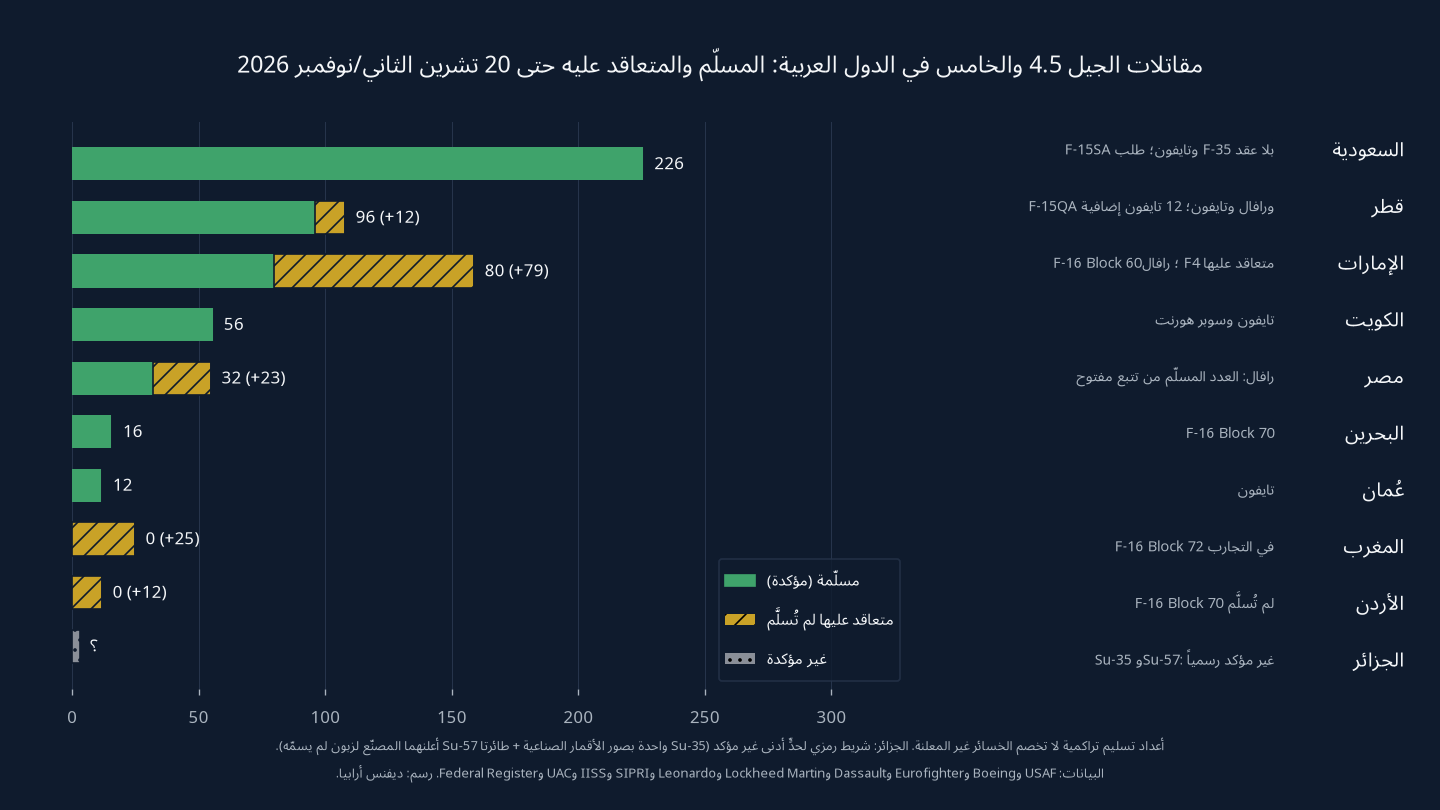
Seven Arab countries operate 4.5-generation fighters whose delivery has been confirmed by official or independent sources: Saudi Arabia, Qatar, the UAE, Kuwait, Egypt, Bahrain and Oman, according to a Defence Arabia review of data up to 20 November 2026. No Arab country operates the F-35. Satellite images indicate that Su-35 fighters have arrived in Algeria, while Russia has announced the delivery of two Su-57s to an unnamed “foreign customer”; Algeria has not officially confirmed either deal.
The site has previously published a ranking of Arab countries by number of fighters (Arabic), a dossier on the largest Arab air forces (Arabic) and a matrix of operators of the Rafale, F-15SA and Typhoon (Arabic). This dossier asks a different question: it does not count all fighters, nor is it limited to three types; instead, it classifies types by technical generation and then separates, for each country, what has been delivered from what is contracted, requested or unconfirmed. For a definition of the term, see the explainer on the difference between fourth- and fifth-generation fighters (Arabic).
Publication date: 21 November 2026. Data reference date: 20 November 2026.
The short answer
- Fifth generation: there is no F-35 in any Arab military. Saudi Arabia has requested 48 aircraft, and the US government has published a “possible sale” notification with an estimated value of $24.3 billion, but the Letter of Offer and Acceptance (LOA) had not been signed as of the reference date. The Su-57 file in Algeria remains a “delivery announced by the manufacturer to an unnamed customer”.
- Delivered 4.5 generation: F-15SA and Typhoon in Saudi Arabia; F-15QA, Rafale and Typhoon in Qatar; F-16E/F Block 60 in the UAE; Typhoon and F/A-18E/F Super Hornet in Kuwait; Rafale in Egypt; F-16 Block 70 in Bahrain; and Typhoon in Oman.
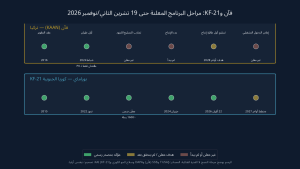
- Contracted but not delivered: 80 Rafale F4s for the UAE (first delivery announced for late 2026), 25 F-16 Block 72s for Morocco (first flight on 6 October 2026), 12 F-16 Block 70s for Jordan, the remainder of Egypt’s second Rafale batch, and 12 additional Typhoons for Qatar.
- Unconfirmed: Su-35 and Su-57 numbers in Algeria, any J-10C deal for Egypt, and the second Typhoon batch for Saudi Arabia.
Scope of the dossier
The dossier covers member states of the Arab League and is limited to fixed-wing fighters. It does not include armed trainers, helicopters or drones. It excludes types classified as fourth generation or “4+”, such as the Mirage 2000-9, F-16 Block 52, MiG-29M and Su-30MKA, while mentioning them where they explain a country’s position.
The numbers cited are announced cumulative delivery numbers, not current operational inventory. Losses in accidents or operations are not always announced, so the dossier does not deduct them. The dossier does not compare defence budgets, because methods of calculating spending differ between sources, and it does not divide the value of any deal by the number of aircraft, because packages include support, training and munitions in varying proportions.
Methodology: three criteria with declared weights
The dossier relies on three criteria to determine the position of each type in each country. The weights determine how strongly an item qualifies for the “delivered 4.5 or fifth generation” column; they are not used to rank countries.
| Criterion | Weight | What it measures | Reason for the weight |
|---|---|---|---|
| Technical classification of the type | 45% | An active electronically scanned array (AESA) radar or equivalent, integrated digital electronic warfare, and modern sensor fusion and data links. For the fifth generation: structural stealth, internal weapons bays and sensor fusion | It is the core of the dossier’s question and relies on specifications announced by the manufacturer or the government body |
| Programme stage | 35% | A seven-step ladder: report, request, approval of a possible sale, contract, production and testing, delivery, service | It prevents confusion between intent, contract and delivery, the most common error in coverage |
| Strength of evidence | 20% | An official announcement by the country, the manufacturer or the exporting government, then SIPRI and IISS data, then open-source tracking | It determines the confidence level, which is why “unconfirmed” is written when official evidence is absent |
The dossier counts a type as 4.5 generation if it is new production to a modern standard combining an AESA radar or a comparable modern radar with a digital electronic warfare suite. The Typhoon and Rafale are classified as 4.5 generation by design, noting that the radar standard differs between export batches. Russia describes the Su-35 as “4++” generation, and the dossier places it in the same category with this caveat.
Countries and systems: what has been delivered and what has not
Saudi Arabia: the largest Arab 4.5-generation fleet and an F-35 request without a contract
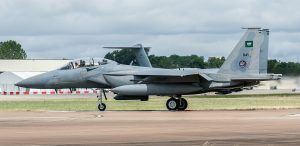
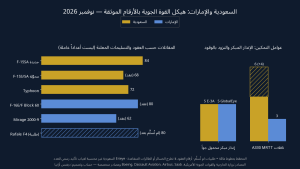
The Royal Saudi Air Force received the last of its new F-15SAs on 10 December 2020, under a deal worth about $29 billion concluded in 2010, according to the US Air Force Life Cycle Management Center. The deal comprises 84 new aircraft and an upgrade of the existing F-15S fleet to the same standard. The centre said the aircraft features “a digital electronic warfare system, fly-by-wire flight controls, an infrared search and track system and an active electronically scanned array radar”.
The Kingdom operates 72 Typhoon fighters, according to the Eurofighter consortium’s programme page. The second Typhoon batch remains a sales opportunity with no contract announced as of November 2026. On the F-35, a notice published in the US Federal Register on 20 November 2026 shows that the Kingdom “has requested to buy 48 F-35 aircraft” with 49 engines, at an estimated value of $24.3 billion. The notice concerns the “proposed issuance of a Letter of Offer”, meaning the deal has not become binding. Republican Senator Rand Paul of Kentucky introduced a joint resolution of disapproval of the sale on 24 September 2026, which was referred to the Senate Foreign Relations Committee. Details in the dossier Does Saudi Arabia have F-35 fighters? (Arabic).
Qatar: three Western 4.5-generation families
The Qatar Emiri Air Force operates three 4.5-generation families: the F-15QA, Rafale and Typhoon. The SIPRI database records that Qatar’s imports in 2021–2025 included 100 combat aircraft, 48 of them from the United States, 33 from the United Kingdom and 13 from France. Eurofighter says Qatar ordered 24 Typhoons, and Doha announced the purchase of 12 additional aircraft in December 2024. Qatar also operates 36 Rafales of the EQ and DQ variants, according to Defence Industry Europe.
Türkiye has been negotiating with Qatar since 2025 to buy second-hand Typhoons. Al-Monitor reported in October 2026 that Ankara considers the deal “on track”, without a signed contract being announced as of the reference date. The Qatari fleet therefore remains in the table at its delivered number, without any aircraft being deducted.
UAE: F-16 Block 60 in service and Rafale F4 on the verge of delivery
The UAE relies on 80 F-16E/F Block 60 fighters alongside the Mirage 2000-9. Northrop Grumman equipped this fleet with the AN/APG-80 electronically scanned radar and an integrated electronic warfare suite, according to a 2003 company statement. Abu Dhabi signed a contract for 80 Rafales to the F4 standard on 3 December 2021. Dassault presented the first Emirati aircraft on 29 January 2025, and it remained at the French test centre. In its half-year results presentation in July 2026, the company listed the item “preparation of the first deliveries to the UAE at the end of 2026”. SIPRI records that the UAE had 79 combat aircraft on order from France at the end of 2025. The UAE suspended its F-35 deal in 2021, and no aircraft has been delivered. For background: Why did the UAE choose the Rafale F4 instead of the F-35? (Arabic).
Kuwait: Typhoon with Captor-E radar and the Super Hornet
The last two aircraft of Kuwait’s Typhoon deal landed at Ali Al Salem Air Base on 6 November 2025, completing 28 aircraft (22 single-seat and 6 two-seat), according to EDR Magazine. The aircraft carry the Captor-E electronic radar, the Praetorian defensive aids suite and the PIRATE infrared search and track system. Kuwait has also received 28 F/A-18E/F Super Hornets from Boeing. SIPRI records 23 combat aircraft from Italy for Kuwait in 2021–2025; the difference is due to the last aircraft being delivered near the end of the period.
Egypt: Rafale between two batches and the Su-35 and J-10C files
Egypt ordered 24 Rafales in 2015 and 30 aircraft in 2021, and open tracking sources say total orders reached 55 aircraft including an attrition replacement. Militarnyi reported on 13 May 2026 that Egypt had received 32 of the 55 aircraft. This figure comes from open-source monitoring and has not been officially announced by Cairo or Dassault, so it is treated in the table as an estimate.
Egypt has not received the Su-35 fighters it contracted for in 2018. TWZ reported in April 2025, based on satellite images published by the International Institute for Strategic Studies (IISS), that aircraft from the Egyptian batch had appeared in Algerian Air Force markings. As for the J-10C, China denied in February 2025 that it had sold the fighter to Egypt, and there is no official announcement of a contract as of the reference date. The site publishes a separate dossier on what is confirmed and what is rumour in the J-10C file (Arabic).
Bahrain and Oman: two small 4.5-generation fleets
The Bahrain News Agency announced on 8 March 2024 the arrival of the first batch of F-16 Block 70 fighters at Isa Air Base. Aerospace Global News reported in April 2026 that all sixteen aircraft ordered had been delivered. Oman operates 12 Typhoon fighters according to Eurofighter, alongside fourth-generation F-16 Block 50s. Türkiye is also negotiating with Muscat for second-hand Typhoons, without an announced contract.
Algeria: Su-35 in satellite images and Su-57 without official naming
The core of the Algerian fleet consists of the Su-30MKA and MiG-29M/M2, types in the “4+” category. Satellite images dated 10 March 2025 showed a Su-35 in Algerian Air Force markings at Oum El Bouaghi base, according to TWZ citing the IISS. No official number of delivered aircraft is available.
On the Su-57, the director general of Russia’s United Aircraft Corporation (UAC), Vadim Badekha, said on 18 November 2025, according to Anadolu Agency: “The first two aircraft have been received by our foreign customer… and have begun combat duty.” Badekha did not name the customer. Defense News published an analysis in February 2026 of video footage near Oum El Bouaghi base that concluded the aircraft was likely a Su-57. Algeria’s Ministry of National Defence had not issued an official statement as of the reference date. The dossier therefore classifies this item as a “delivery announced by the manufacturer, customer identity not officially confirmed”, and does not describe Algeria as a confirmed fifth-generation operator.
Morocco and Jordan: F-16 Block 70/72 contracts before delivery
Lockheed Martin announced on 6 October 2026 the first flight of the first F-16 Block 72 for the Royal Moroccan Air Force in Greenville, South Carolina. Mike Shoemaker, vice president and general manager of Lockheed Martin’s Integrated Fighter Group, said the flight “reflects tangible progress in Morocco’s F-16 Block 72 programme”. The company did not give a delivery date. Jordan signed a contract for 12 F-16 Block 70 fighters in January 2023, and no aircraft had been delivered as of the reference date.
Other Arab countries
There is insufficient reliable data on whether Iraq, Libya, Syria, Sudan, Yemen, Tunisia, Lebanon, Mauritania or the remaining members possess 4.5- or fifth-generation fighters. Iraq operates fourth-generation F-16IQ Block 52 fighters.
Reference table: delivered and contracted by type
| Country | Type | Generation | Delivered | Contracted/requested, not delivered | Stage | Source |
|---|---|---|---|---|---|---|
| Saudi Arabia | F-15SA | 4.5 | 84 new + 70 upgraded | — | In service | USAF AFLCMC |
| Saudi Arabia | Eurofighter Typhoon | 4.5 | 72 | Second batch without a contract | In service | Eurofighter; FlightGlobal |
| Saudi Arabia | F-35A | 5 | 0 | 48 requested | Approval of possible sale, LOA not signed | Federal Register |
| Qatar | F-15QA | 4.5 | 48 US combat aircraft per SIPRI (2021–2025) | — | In service | SIPRI |
| Qatar | Rafale | 4.5 | 36 | — | In service | Defence Industry Europe |
| Qatar | Eurofighter Typhoon | 4.5 | 24 | 12 additional (2024 announcement) | In service / contracted | Eurofighter |
| UAE | F-16E/F Block 60 | 4.5 | 80 | — | In service | Northrop Grumman |
| UAE | Rafale F4 | 4.5 | 0 in the UAE | 80 (79 per SIPRI) | Production and testing; delivery announced for late 2026 | Dassault; SIPRI |
| Kuwait | Eurofighter Typhoon | 4.5 | 28 | — | In service | EDR / Leonardo |
| Kuwait | F/A-18E/F | 4.5 | 28 | — | In service | SIPRI |
| Egypt | Rafale | 4.5 | About 32 (open-source estimate) | About 23 | Delivery ongoing | Militarnyi; Dassault |
| Egypt | Su-35 / J-10C | 4++ / 4.5 | 0 | Unconfirmed | Not delivered / unconfirmed | TWZ; Anadolu |
| Bahrain | F-16 Block 70 | 4.5 | 16 | — | In service | BNA; AGN |
| Oman | Eurofighter Typhoon | 4.5 | 12 | — | In service | Eurofighter |
| Algeria | Su-35 | 4++ | Unconfirmed (at least 1 in images) | Not announced | Delivery not officially announced | IISS via TWZ |
| Algeria | Su-57 | 5 | 2 to an unnamed customer | Not announced | Not officially confirmed | UAC via Anadolu |
| Morocco | F-16 Block 72 | 4.5 | 0 | 25 | Flight testing | Lockheed Martin |
| Jordan | F-16 Block 70 | 4.5 | 0 | 12 | Contract | Breaking Defense |
Strengths and weaknesses of acquisition patterns
This section does not assess the aircraft in combat terms; it describes what the acquisition patterns visible in the data allow and the burdens they impose.
- Diversification between suppliers (Qatar, Kuwait, Saudi Arabia): reduces dependence on a single supplier and provides negotiating leverage. On the other hand, it raises the cost of maintenance, training and supply chains, because each family needs its own support infrastructure. Kuwait’s experience illustrates this burden: Leonardo set up a local support company dedicated to the Typhoon fleet.
- Reliance on the modern F-16 family (UAE, Bahrain, Morocco, Jordan): eases the transition from older versions of the same type and reduces conversion costs. However, US export restrictions and end-use conditions remain a decisive factor in armament and modernisation.
- The Russian route (Algeria): allows access to types that Western countries do not offer on the same terms. But it is associated with low transparency on numbers and deliveries, and with the impact of sanctions on supply chains, as shown by the faltering Egyptian Su-35 deal.
- The European route (Egypt, UAE): provides wider latitude in diversifying armament. But it is tied to crowded production schedules at Dassault, which reported 208 Rafales remaining to be delivered as of 30 June 2026.
Criterion-by-criterion assessment
Criterion one, technical classification (45%): the types delivered in the seven countries meet the 4.5-generation requirements as announced by the manufacturers. The clearest official data concern the F-15SA, whose radar and electronic warfare suite are explicitly cited by the US Air Force, and Kuwait’s Typhoons equipped with the Captor-E radar. No unified official data are available on the radar standard of all the older Gulf Typhoon batches.
Criterion two, programme stage (35%): seven countries are at the “service” stage. The UAE (Rafale) and Egypt (remainder of the second batch) are at the “production and delivery” stage. Morocco is at “flight testing”. Jordan is at the “contract” stage. Saudi Arabia is at the “approval of a possible sale” stage for the F-35 file. Algeria is at the “delivery not officially announced” stage.
Criterion three, strength of evidence (20%): the Saudi, Kuwaiti, Bahraini, Moroccan and Emirati files are supported by government documents or company statements. Egypt’s ongoing delivery numbers rely on open-source monitoring. The Algeria file has the weakest evidence, because the Russian manufacturer did not name the customer and the Algerian government has not issued a statement.
Data conflicts between sources
- Kuwait: SIPRI records 23 Typhoons delivered in 2021–2025, while EDR reports the completion of 28 aircraft on 6 November 2025. The difference is due to the timing of recording and SIPRI’s counting method.
- UAE: SIPRI records 79 Rafales on order because one aircraft was contractually accepted in France in 2025. That aircraft has not reached the UAE according to available sources.
- Egypt: total orders vary between 54 aircraft under the two contracts and 55 when an attrition replacement is counted. Delivered numbers vary according to the date of monitoring.
- Qatar: the additional Typhoon deal is described variously as a “purchase announcement” and a “contract”, and no delivery schedule has been published for it.
Conclusion and limitations
Delivered 4.5-generation fighters in the Arab world are concentrated in the six Gulf states and Egypt. The UAE, Morocco, Jordan and Egypt are awaiting contracted deliveries that will change the figures in the coming years. As of 20 November 2026 there is no officially confirmed Arab operator of a fifth-generation fighter. The Saudi F-35 request has not turned into a contract, and the Su-57 file in Algeria rests on a statement by a manufacturer that did not name the customer and on video monitoring.
Limitations of the dossier: the numbers are cumulative deliveries, not operational inventory. The dossier does not measure readiness, flight hours, available armament or training, which determine actual capability more than the type itself. The dossier will be updated when an official announcement of Rafale delivery to the UAE is made, when the Letter of Offer for the Saudi F-35 deal is signed, or when an official Algerian statement is issued.
Frequently asked questions
Does any Arab country have F-35 fighters?
No. Saudi Arabia has requested 48 aircraft and a possible-sale notice has been published in the US Federal Register, but the Letter of Offer and Acceptance had not been signed as of 20 November 2026. The UAE suspended its F-35 negotiations in 2021.
Has Algeria received Su-57 fighters?
Russia’s United Aircraft Corporation announced the delivery of two aircraft to an unnamed foreign customer, and video footage was recorded in Algeria. The Algerian government has not officially confirmed the deal, so the item remains officially unconfirmed.
What is the difference between the 4.5 and fifth generations?
4.5-generation fighters are conventionally designed aircraft upgraded with electronic radars, digital electronic warfare and sensor fusion. The fifth generation adds structural stealth, internal weapons bays and the fusion of sensors into a single system.
Has the UAE received Rafale aircraft?
As of the reference date, no official sources confirm the arrival of the Rafale in the UAE. Dassault says it is preparing the first deliveries for the end of 2026.
Has Egypt obtained the Su-35 or J-10C?
Egypt has not received the Su-35, and satellite images indicate that aircraft from the Egyptian batch were transferred to Algeria. China denied in 2025 that it had sold the J-10C to Egypt, and no contract has been announced.
Sources
- SIPRI — “Trends in International Arms Transfers, 2025”, March 2026 (imports by Qatar, Kuwait and Saudi Arabia, and UAE orders from France) — sipri.org.
- US Federal Register — arms sales notification for Saudi Arabia (48 F-35s), 20 November 2026 — federalregister.gov; and Congress.gov — S.J.Res.217 — congress.gov.
- US Air Force (AFLCMC) — delivery of the final F-15SA to Saudi Arabia, 11 December 2020 — af.mil.
- Eurofighter — programme page and export orders — eurofighter.com.
- Dassault Aviation — presentation of the first Emirati Rafale, 29 January 2025, and the H1 2026 results presentation — dassault-aviation.com and the presentation (PDF).
- Lockheed Martin — first flight of Morocco’s first F-16 Block 72, 6 October 2026 — lockheedmartin.com.
- Bahrain News Agency — arrival of the first batch of F-16 Block 70s, 8 March 2024 — bna.bh; and Aerospace Global News, April 2026 — aerospaceglobalnews.com.
- EDR Magazine — Leonardo Aviation Services and Kuwait’s Typhoon programme, 6 February 2026 — edrmagazine.eu.
- The War Zone (TWZ) — Su-35s in Algeria based on IISS imagery, 9 April 2025 — twz.com.
- Anadolu Agency (Russian) — UAC director general’s statement on Su-57 delivery, 18 November 2025 — aa.com.tr; and Defense News, 10 February 2026 — defensenews.com.
- Militarnyi — Rafale batch delivery to Egypt and total delivered, 13 May 2026 — militarnyi.com.
- Anadolu Agency (English) — China denies selling J-10s to Egypt, 2025 — aa.com.tr.
- Breaking Defense — Jordan’s contract for 12 F-16 Block 70s, January 2023 — breakingdefense.com.
- Northrop Grumman — delivery of the first AN/APG-80 radar for the UAE’s F-16 Block 60 fleet (80 aircraft), 20 August 2003 — northropgrumman.com.
- Defence Industry Europe — Qatar confirms purchase of 12 additional Typhoons, 9 December 2024 — defence-industry.eu.
- FlightGlobal — prospects for a second Saudi Typhoon batch, February 2026 — flightglobal.com; and Al-Monitor — Qatar’s Typhoon deal for Türkiye, October 2026 — al-monitor.com.