What is an armoured brigade? How is it formed from tanks, mechanised infantry and artillery?
An armoured brigade is the military formation that combines tank battalions with mechanised infantry, artillery and logistic support in a single combat unit, commanded by a brigadier or major general and usually numbering between three thousand and five thousand soldiers. Its purpose is simple: to ensure that the tank does not move alone on the battlefield, but is protected and supported by other weapons that compensate for its weaknesses.
Without this formation, tanks are vulnerable to infantry anti-tank missiles, and without tanks, mechanised infantry loses its ability to break through fortified enemy lines. This is why the armoured brigade is described as the basic “combined arms unit” of modern land forces.
How is an armoured brigade formed?
The armoured brigade is built around the principle of “combined arms”, meaning that it includes not only tanks but a mix of the following units:
- Tank battalions: usually two to three battalions, each with about 40 to 58 main battle tanks; they are the striking force that breaks enemy lines and destroys its armour.
- One or two mechanised infantry battalions: they carry their soldiers in armoured vehicles such as armoured personnel carriers and infantry fighting vehicles (Arabic), and their task is to clear urban and fortified areas that a tank alone cannot enter safely.
- Field artillery battalion: provides long-range fire support before and during the attack.
- Combat engineer company: clears minefields and obstacles and builds military bridges.
- Support, signals and logistics units: provide fuel, ammunition, maintenance and communications between all these elements.
What are its basic components?
Besides the combat battalions, the brigade needs elements that enable it to operate independently for days or weeks: field repair and recovery vehicles to return disabled tanks to service, a fuel and ammunition transport convoy that follows the brigade’s movements, and a field command-and-control post that coordinates between the battalions over protected communications networks. There is also often an active protection system on the brigade’s tanks (Arabic) to intercept anti-tank missiles before they hit the hull.
What is the difference between a brigade, a division, a regiment and a battalion?
Many readers confuse levels of military organisation because their names seem similar. The following table shows the difference from smallest to largest:
| Unit | Approximate strength | Number of tanks (if any) | Commanded by |
|---|---|---|---|
| Platoon | 30–50 soldiers | 3–4 tanks | Lieutenant |
| Company | 100–150 soldiers | 10–17 tanks | Captain |
| Battalion | 500–900 soldiers | 40–58 tanks | Lieutenant colonel or colonel |
| Regiment | May equal an enlarged battalion or several battalions of one type | Varies by army | Colonel |
| Brigade (armoured) | 3,000–5,000 soldiers | 2–3 tank battalions + mechanised infantry and support | Brigadier |
| Division | 10,000–20,000 soldiers (2–4 brigades) | Several armoured or infantry brigades | Major general |
The essential difference is that a battalion contains a single type of weapon (tanks only or infantry only), while a brigade brings different types together so that it can fight on its own. A division, in turn, is simply several brigades under a single command to carry out wider-scale operations.
What are the advantages of an armoured brigade?
Its main advantage is that it gives land forces a unit capable of fighting, manoeuvring and defending itself at the same time, without having to wait for support from other formations. If the tank battalions come under anti-tank fire, the mechanised infantry steps in to secure the perimeter; if the advance needs preparatory fire, the brigade’s own artillery provides it. This internal integration reduces response time and gives the commander flexibility to choose the method of attack or defence according to the terrain.
What are its limitations?
The armoured brigade is relatively heavy to move: the fuel and ammunition convoys it needs every day are large, and moving it over long distances or through mountainous and narrow urban terrain is harder than moving light units. Its heavy reliance on tanks also makes it a favoured target for kamikaze drones and precision-guided munitions, as clearly shown in recent conflicts in which unmanned aircraft were used against advancing armoured columns.
What an armoured brigade is not
An armoured brigade is not simply a group of tanks gathered together; that is described as a “tank battalion” or a “task-organised armoured formation”, not a brigade in the full sense. Nor should it be confused with an “armoured division”, which is a larger formation comprising several armoured and infantry brigades under a single command. Finally, brigade size is not strictly fixed across all armies; some countries use the term “brigade” for formations closer to the size of a reinforced regiment, while others give them firepower closer to that of a small division.
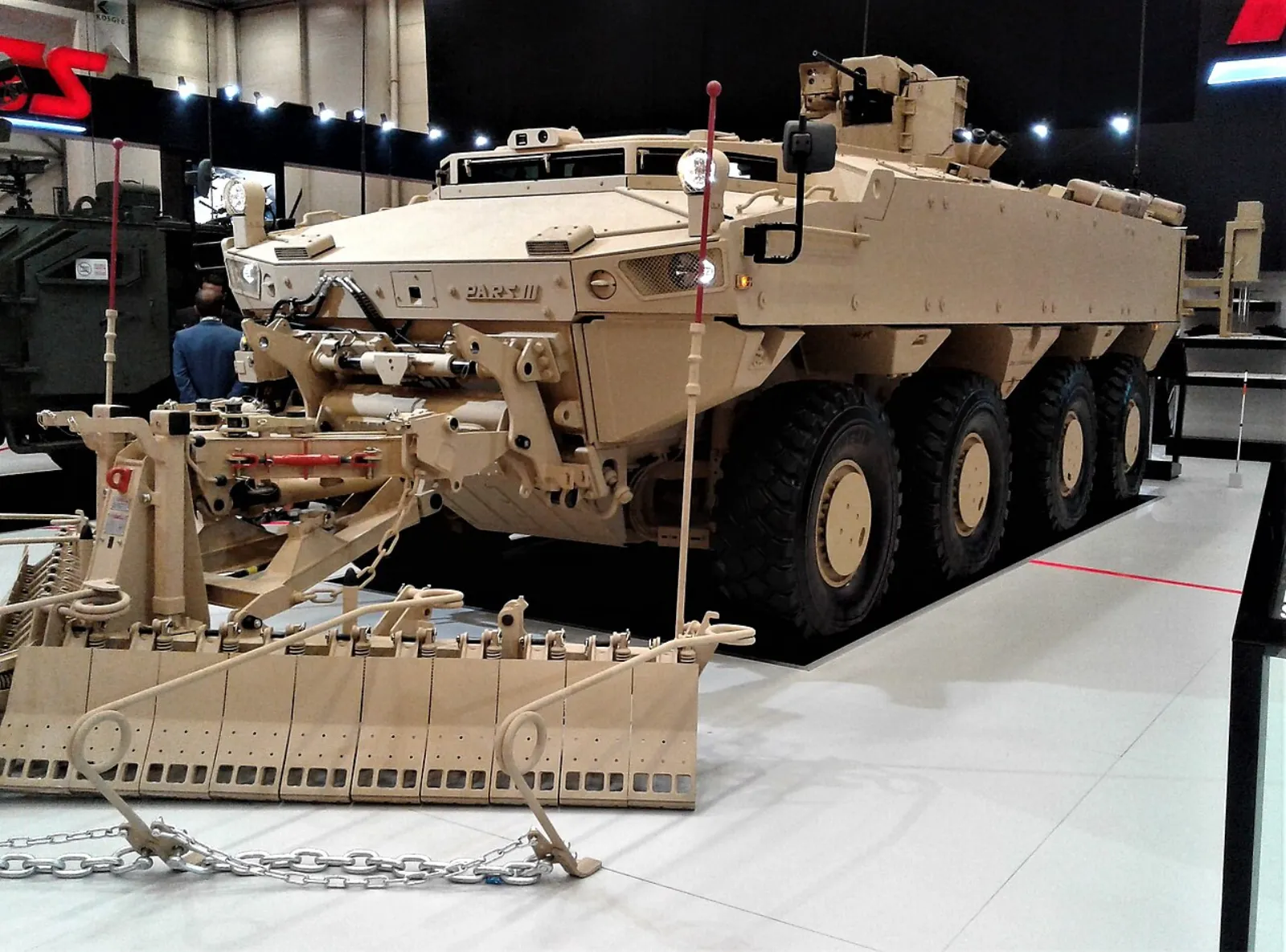
Real examples from Arab and world armies
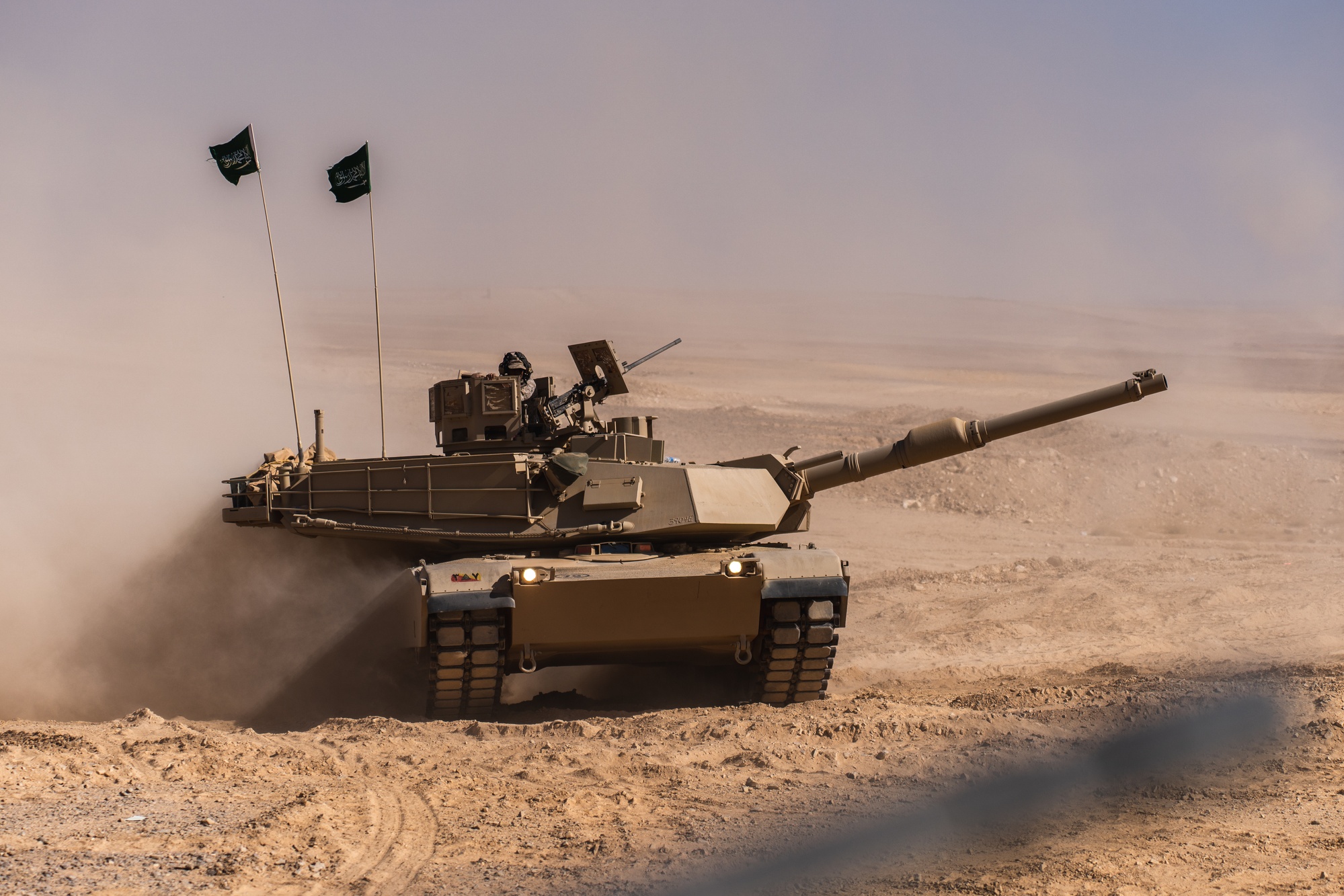
The Saudi Land Forces (Arabic) rely on armoured brigades equipped with M1A2S Abrams tanks alongside mechanised infantry vehicles, while the Egyptian forces (Arabic) include armoured brigades within their field divisions equipped with M1A1 tanks produced locally under US licence. Algeria also maintains armoured brigades with tanks of different generations, as noted in our coverage of the diversity of Algerian tanks (Arabic). Internationally, the United States uses the Armored Brigade Combat Team model, which combines Abrams battalions, Bradley vehicles and self-propelled artillery in a single integrated formation very close to the classic armoured brigade structure.
Examples from the Turkish and Arab defence industries
The Turkish defence industry supplies key elements for the mechanised infantry battalions within modern armoured brigades, most notably the family of Otokar ARMA II eight-wheeled vehicles (Arabic) and FNSS tracked vehicles from the ACV and Kaplan medium families, which are used as more mobile alternatives to traditional personnel carriers. For a technical profile of this class of vehicles, see the file published by Envanter Medya (Turkish) on the FNSS armoured vehicle family. On the Arab side, companies such as Egypt’s Arab Organization for Industrialization and the UAE’s NIMR produce wheeled armoured vehicles that equip the mechanised infantry battalions of brigades in several Arab and African armies.
Why does this concept matter?
Understanding the structure of an armoured brigade helps readers interpret military news more accurately: when the “deployment of an armoured brigade” to a given area is announced, it does not simply mean moving tanks, but the movement of a complete combat system capable of attacking, defending and sustaining itself for days. This distinction also matters when comparing the capabilities of regional armies, since counting tanks is not enough to assess real strength; one must look at the number of integrated armoured brigades and their logistical readiness.
- US Army (army.mil) – structure of divisions and brigade combat teams
- US Congressional Research Service (CRS) – reports on land forces and their formations
- NATO – combined arms military organisation concepts
- Stockholm International Peace Research Institute (SIPRI)
- Official website of Turkish company FNSS