Gulf maritime security 2026: the Strait of Hormuz, the IMSC coalition and the numbers
Maritime security in the Gulf rests on protecting the passage of oil and gas tankers and merchant ships through the Strait of Hormuz, the waterways of the Arabian Gulf and the Gulf of Oman, with more than one security framework operating at the same time. According to the US Energy Information Administration, oil flows through the Strait of Hormuz averaged 20 million barrels per day in 2024, equivalent to about 20% of global petroleum liquids consumption, and about one-fifth of global liquefied natural gas trade also passed through it, mostly from Qatar. Since July 2019, the International Maritime Security Construct (IMSC) and its operational arm, Coalition Task Force Sentinel (CTF Sentinel), both headquartered in Bahrain, have monitored merchant shipping around the Strait of Hormuz and Bab el-Mandeb, alongside the US Fifth Fleet and the Combined Maritime Forces.
Quick facts
| Main waterway | The Strait of Hormuz, between Oman and Iran, links the Arabian Gulf with the Gulf of Oman and the Arabian Sea |
|---|---|
| Oil volume (2024) | An average of 20 million barrels per day, about 20% of global petroleum liquids consumption and more than a quarter of seaborne oil trade |
| Liquefied natural gas | About one-fifth of global trade passed through the strait in 2024, mostly from Qatar |
| IMSC | Established in July 2019, headquartered in Bahrain, with CTF Sentinel as its operational arm |
| Members (February 2024) | 12 countries according to US Naval Forces Central Command: Albania, Bahrain, Estonia, Jordan, Latvia, Lithuania, Romania, Saudi Arabia, Seychelles, the UAE, the United Kingdom and the United States |
Why is the Strait of Hormuz a critical chokepoint?
A US Energy Information Administration report published on 16 June 2025 explains that the strait is deep and wide enough for the world’s largest oil tankers to transit, and that most of the volumes passing through it have no practical alternative route out of the region if the waterway is closed. In the first quarter of 2025, flows remained close to the 2024 average. Saudi crude oil and condensate exports accounted for 38% of crude oil flows through the strait in 2024, at 5.5 million barrels per day.
In 2024, 84% of the crude oil and condensate and 83% of the liquefied natural gas that passed through the strait went to Asian markets, with China, India, Japan and South Korea together accounting for 69% of crude oil and condensate flows. The United States imported about 0.5 million barrels per day through the strait in 2024, about 7% of its crude oil and condensate imports and 2% of its petroleum liquids consumption.
On Oman’s position on the southern shore of the strait, see also: How strong is the Omani army? (Arabic).
Are there alternatives to bypass the strait?
The US administration estimates that about 2.6 million barrels per day of unused capacity in Saudi and Emirati pipelines could be used to bypass the strait in the event of a disruption. The main pipelines are:
- Saudi East-West Pipeline: operated by Aramco with a capacity of 5 million barrels per day from the Abqaiq facilities to Yanbu on the Red Sea; its capacity was temporarily raised to 7 million barrels per day in 2019 by converting some natural gas liquids lines. In 2024, oil flows through it increased to avoid shipping disruption around Bab el-Mandeb.
- UAE pipeline to Fujairah: with a capacity of 1.8 million barrels per day from onshore fields to the port of Fujairah on the Gulf of Oman. Greater use of it in daily operations has reduced the spare capacity available for additional diversion.
- Iran’s Goreh-Jask pipeline: its effective capacity is about 300,000 barrels per day, but exports through it were below 70,000 barrels per day in summer 2024, and loadings stopped after September 2024, according to the US administration.
Between 2022 and 2024, crude oil and condensate volumes through the strait fell by 1.6 million barrels per day, partly offset by a 0.5 million barrels per day rise in oil products, amid OPEC+ cuts, increased domestic refining and the overland diversion of some Saudi exports towards the Red Sea after the disruption at Bab el-Mandeb. For the Bab el-Mandeb context: The Bab el-Mandeb Strait: military importance and freedom of navigation (Arabic).
What is the IMSC and how does it relate to the Fifth Fleet?
The International Maritime Security Construct was established in July 2019 after growing threats to the freedom of navigation of merchant ships in international waters in the Middle East, and its operational arm, CTF Sentinel, was set up four months later. Both the coalition and the task force are headquartered in Bahrain, at the US Naval Support Activity. According to a US Naval Forces Central Command statement of 20 February 2024, the coalition comprises 12 countries and monitors shipping activity around the Strait of Hormuz and Bab el-Mandeb, with the aim of deterring threats and reassuring mariners in the region.
The IMSC does not replace the two other frameworks based in Bahrain:
| Framework | Nature | Stated focus |
|---|---|---|
| US Fifth Fleet / Naval Forces Central Command | US operational command | US Navy operations in its area, and hosting the headquarters of partnerships |
| Combined Maritime Forces (CMF) | Multinational naval partnership with broader membership | Broader maritime security, including counter-piracy and counter-smuggling |
| IMSC / CTF Sentinel | Coalition established in 2019 | Monitoring merchant shipping in the Strait of Hormuz and Bab el-Mandeb |
Jordan joined in August 2023 to become the twelfth member, according to a Naval Forces Central Command statement of 1 September 2023, while Seychelles had joined in October 2022. Australia was a founding member and ended its contribution on 29 December 2020, according to the coalition’s open documentation; the list used here is the February 2024 list issued by the US command. On the Fifth Fleet in Bahrain: US Fifth Fleet: headquarters in Bahrain and area of operations (Arabic).
It is important to distinguish between IMSC membership and the broader Gulf presence: the official 2024 list includes Bahrain, Saudi Arabia and the UAE among the Gulf Cooperation Council states, and does not list Kuwait, Qatar or Oman among the twelve members as of that date. This does not rule out their participation in other frameworks such as the Combined Maritime Forces or bilateral arrangements.
What does this mean in practice for energy security?
No independent body announced a complete “closure” of the strait in the data above for 2024 and early 2025; however, the US administration notes that disruption to transit, even temporarily, could raise shipping costs and prices, because the alternatives cannot absorb the full flow. For this reason, the strait is monitored through a mix of US presence, multiple coalitions and regional partnerships, rather than through a single mechanism.
Frequently asked questions
How much oil passes through the Strait of Hormuz?
20 million barrels per day on average in 2024, according to the US Energy Information Administration, or about one-fifth of global petroleum liquids consumption.
What is the IMSC?
An international coalition established in July 2019 and headquartered in Bahrain, with CTF Sentinel as its operational arm, to monitor merchant shipping around the Strait of Hormuz and Bab el-Mandeb.
How many countries are in the IMSC?
12 countries according to a US Naval Forces Central Command statement in February 2024, after Jordan joined in 2023.
Can the East-West Pipeline replace the strait?
No. The pipeline’s capacity is 5 million barrels per day (temporarily raised to 7 million in 2019), while flows through the strait reached 20 million barrels per day in 2024. Washington estimates that only about 2.6 million barrels per day of spare capacity in Saudi and Emirati pipelines might be available for bypassing the strait in a disruption.
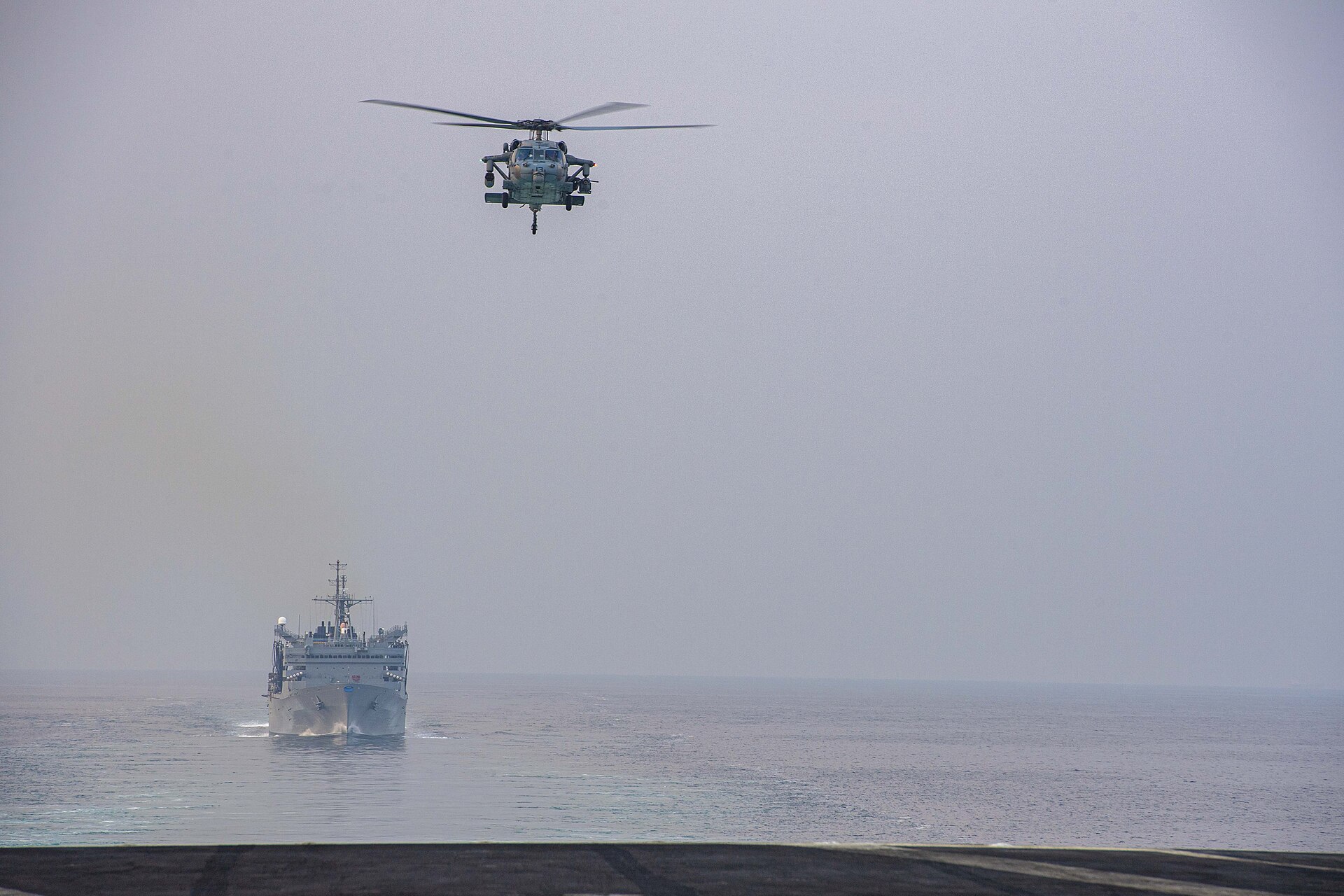
Featured image: the Eisenhower carrier strike group transits the Strait of Hormuz. Source: Petty Officer 3rd Class Janae Chambers / US Navy via Wikimedia Commons – public domain.