HAWK missile (MIM-23 HAWK): range, specifications and Arab operators
The HAWK missile (MIM-23 HAWK) is a US medium-range air defence system designed by Raytheon to intercept aircraft at low and medium altitudes. The system entered service in 1960 and received successive upgrades, the latest being Phase III in the early 1990s. The improved MIM-23B version has a range of about 40 km. Several Arab countries operate it today, including Kuwait, Bahrain, Jordan and the UAE.
What is the HAWK missile?
The history office of the US Army’s Redstone Arsenal describes HAWK as a medium-range guided surface-to-air missile providing defensive coverage against aircraft flying at low and medium altitudes. The document describes it as a mobile, all-weather, day-and-night system that resists electronic jamming.
In official US terminology, the name HAWK stands for “Homing All the Way Killer”, as stated in a 2022 notification by the US Defense Security Cooperation Agency (DSCA). The system’s prime contractor is Raytheon, which is now part of RTX.
History of the system and its development phases
The US Army began studies for the system in 1952 and in 1954 awarded development contracts to Raytheon for the missile and to Northrop for the launcher, radars and fire-control system, according to Designation-Systems. The system achieved initial operational capability with the US Army in August 1959 and entered field service in 1960, according to the US Army. It was used by many countries inside and outside NATO, and the missile was licence-built in Western Europe and Japan. Upgrades then followed as below:
| Stage | Date | Key additions |
|---|---|---|
| Basic HAWK (MIM-23A) | Entered service 1960 | Medium-range surface-to-air missile against low- and medium-altitude aircraft |
| Improved HAWK (I-HAWK / MIM-23B) | Early 1970s | Larger 74 kg warhead, new rocket motor and improved guidance |
| Product Improvement Programme – Phase I | 1979 | Improved acquisition radar and digital upgrade of the search radar |
| Phase II | 1983–1986 | Modern electronics for the illuminator radar and an electro-optical tracking system |
| Phase III | Development from 1983; US service from 1989 | New computers and software, the AN/MPQ-62 radar, and simultaneous engagement of multiple low-altitude targets (LASHE) |
Sources: US Army (Redstone) and Designation-Systems, a site specialising in US military designations.
LASHE technology allows the system to counter saturation attacks by intercepting several low-altitude targets simultaneously, according to Designation-Systems.
HAWK missile range and specifications
HAWK relies on semi-active radar homing: the battery’s radar illuminates the target and the missile follows the waves reflected from it until impact. Designation-Systems states that the MIM-23B’s engagement envelope extends from 1.5 to 40 km at high altitude and from 2.5 to 20 km at low altitude. The minimum engagement altitude is about 60 metres.
A HAWK battery consists of several elements, most notably:
- Search and acquisition radar: detects air targets at long distances.
- Continuous-wave radar: specialised in detecting low-flying targets.
- Illuminator radar: illuminates the target so that the missile homes in on it through semi-active guidance.
- Launchers: carry the missiles and fire them at the target.
How much does a HAWK missile cost?
The Redstone Arsenal history office published cost figures for the system: $250,000 per missile, $15 million per firing unit and $30 million per battery. The document does not state the year of these prices, so they should be treated as historical figures that do not reflect today’s upgrade or support costs.
The HAWK missile in wars
The US Army states that HAWK’s first combat use was in 1967 during the Six-Day War. Although US batteries were deployed in Vietnam and the Gulf, US soldiers never fired the missile in combat.
In the Gulf, HAWK had a direct Arab role. According to the US Army, Kuwaiti air defence units equipped with HAWK missiles shot down about 22 Iraqi aircraft and one combat helicopter during the invasion on 2 August 1990. It added that Iraqi forces later seized HAWK missiles in Kuwait, posing a potential threat to coalition forces. For details of the system in Kuwait, see: How many HAWK air defence systems does Kuwait have? (Arabic)
Arab countries operating the HAWK missile
The US Army says about 20 allied countries, including countries in Southwest Asia, have received the HAWK system. Arab countries whose operation of the system is confirmed by official sources include:
- Kuwait: used it in combat in 1990, according to the US Army.
- Bahrain and Jordan: took part as “HAWK partner nations” in the 31st annual sustainment review of the system, held by the US Army’s HAWK project office from 8 to 12 June 2026.
- UAE: on 3 February 2022 the US State Department approved a possible $65 million sale of spare parts supporting the UAE’s HAWK, Patriot and THAAD systems.
Open references list other Arab countries such as Saudi Arabia, Egypt and Morocco among operators of versions of the system, but we found no recent official source confirming their current status.
Is HAWK still relevant today?
The US Army maintains an international support programme for the system. The US Army Aviation and Missile Command (AMCOM) said the June 2026 review discussed with partner nations Bahrain, Japan, Jordan, Spain and Ukraine, as well as Romania, how to address component obsolescence and improve missile reliability. It also discussed upgrading command, control and communications, and converting launchers from analogue to digital.
The command quoted Bahraini Major Abdullah Al-Buainain as saying that direct updates from the project office were “extremely helpful”. This review indicates that HAWK remains part of Arab air defence networks, despite the arrival of newer systems such as Patriot and NASAMS.
To compare HAWK with modern systems, see: Top 10 air defence systems in the world 2026 (Arabic). For man-portable short-range air defence, see: The Stinger missile (FIM-92 Stinger) (Arabic).
Frequently asked questions
What is the HAWK missile?
A US medium-range surface-to-air missile from Raytheon that entered service in 1960 and intercepts aircraft at low and medium altitudes.
What is the range of the HAWK missile?
The MIM-23B’s engagement envelope extends from 1.5 to 40 km at high altitude and from 2.5 to 20 km at low altitude.
Which Arab countries have the HAWK missile?
Official US sources confirm that Kuwait, Bahrain, Jordan and the UAE operate the system.
What does the name HAWK mean?
“Homing All the Way Killer”, according to the designation given in a 2022 DSCA notification.
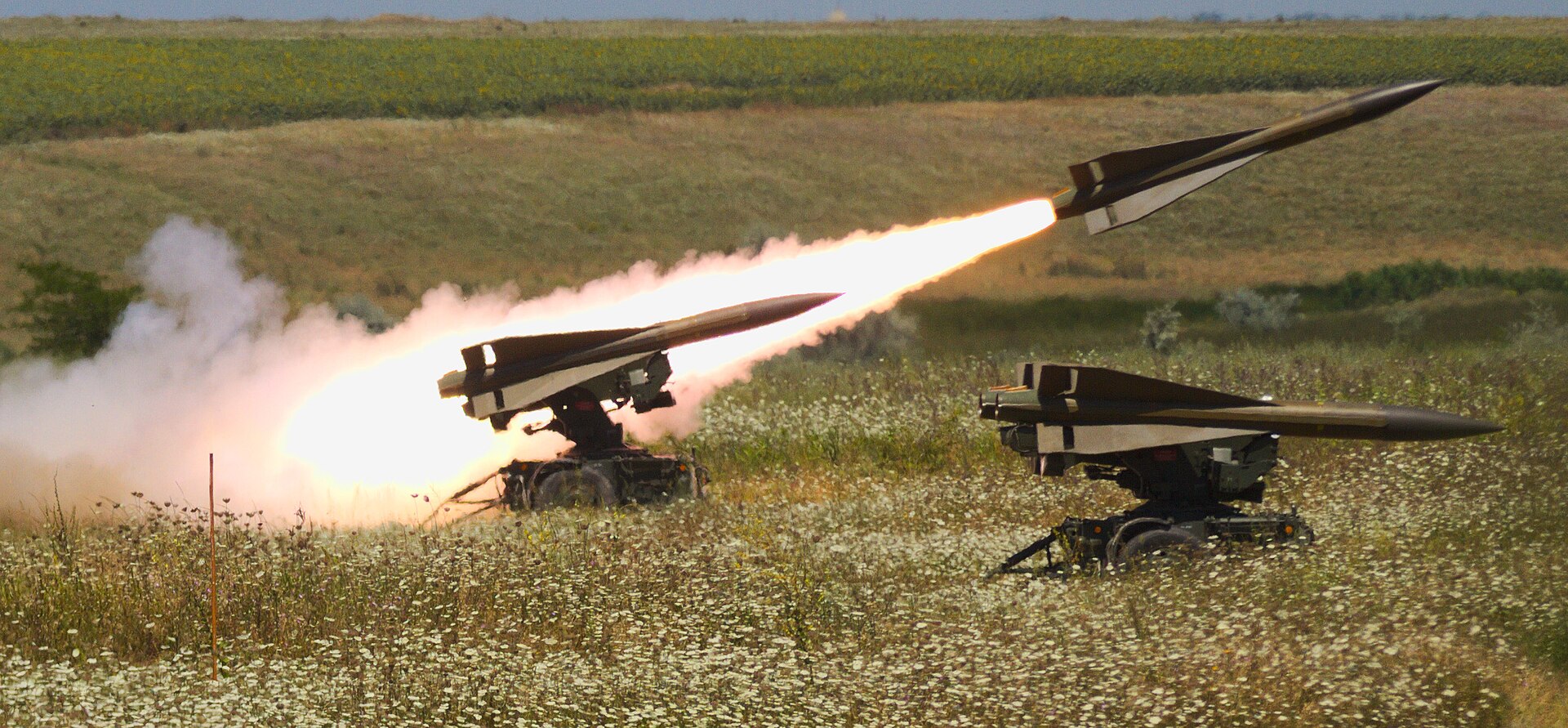
Main image: a Romanian MIM-23 HAWK missile is fired from Capu Midia Training Area. Source: US Army (Pfc. Nicholas Vidro) via Wikimedia Commons – public domain.
Sources
- US Army – Redstone Arsenal: history of the HAWK system
- US Army Aviation and Missile Command (DVIDS) – 31st annual HAWK review (June 2026)
- US Defense Security Cooperation Agency (DSCA) – notification of HAWK, PATRIOT and THAAD support sale to the UAE (3 February 2022)
- Designation-Systems – Raytheon MIM-23 Hawk