The ATACMS missile: specifications, 300 km range, variants and launch platforms
ATACMS (Army Tactical Missile System) is a US single-stage, solid-fuel short-range ballistic missile that entered service in 1986. Its range is 165 km in the Block 1 version and 300 km in the extended-range Block 1A, according to the CSIS Missile Threat project database, and it carries a single warhead of 160 to 560 kg or hundreds of submunitions. It is launched from the HIMARS and M270 MLRS rocket launchers and is produced by Lockheed Martin.
Specifications (CSIS)
| Class | Short-range ballistic missile (SRBM) |
|---|---|
| Length | 3.98 m |
| Diameter | 0.61 m |
| Launch weight | 1,673 kg (Block 1), 1,321 kg (Block 1A) |
| Payload | Single warhead of 160–560 kg |
| Warhead types | High explosive, blast-fragmentation, or 300–950 submunitions |
| Propulsion | Solid fuel, single stage |
| Range | 165 km (Block 1), 300 km (Block 1A) |
| In service | Since 1986 |
Main variants
- Block 1: the standard version with M74 submunitions against dispersed targets deep in enemy territory.
- Block 1A: an extended-range version reaching 300 km with GPS-aided guidance.
- Unitary-warhead versions: for hardened and point targets.
Launch platforms
The HIMARS launcher carries one ATACMS missile, while the M270 carries two. Read more: HIMARS: specifications, price and operators and MLRS rocket launchers (Arabic).
The successor: PrSM
The US Army is developing the Precision Strike Missile (PrSM) to replace ATACMS, with a longer range and the ability to carry two missiles in the same pod.
Development history
ATACMS traces its roots to the experimental Assault Breaker programme of 1978, which developed the concept of a ground-launched guided missile carrying submunitions. The programme formally began in 1983 as JTACMS, merging two US Army and Air Force projects; testing of the Block 1 version was completed in December 1989, and the missile was first used in combat in the 1991 Gulf War. It was originally designed to succeed the MGM-52 Lance missile in the tactical support role for ground forces, and according to CSIS the US Army had ordered a total of 1,647 missiles by 1997.
Comparison of the main variants
| Variant | Range | Warhead | Guidance | Status |
|---|---|---|---|---|
| Block 1 (MGM-140A) | 165 km | 560 kg containing 950 M74 submunitions | Inertial | Gradual withdrawal began around 2009 |
| Block 1A | Up to 300 km (minimum range 100 km) | 160 kg containing 300 submunitions | Inertial + GPS | Entered service in 1998 |
| Block 1A Unitary | About 270 km | Unitary warhead of 213 kg (from Harpoon) or 247 kg (from SLAM-ER) | Inertial + GPS | About 280 missiles according to CSIS |
| Block 2 | 140 km | BAT anti-armour munitions | — | Cancelled in October 2002 |
Source: CSIS Missile Threat database. CSIS estimates the probable accuracy of the unitary version at 10 to 50 m (CEP), an estimate rather than an official figure.
The M74 submunition: how does it work?
The Block 1 version carries M74 anti-personnel and anti-materiel submunitions, each a 6 cm sphere weighing 0.59 kg encased in a tungsten fragmentation wall with incendiary pellets. The release altitude determines the area of effect: a wide spread with light damage or a small area with dense damage. These munitions are suited to airfields, air-defence sites, launch platforms and command centres, but are ineffective against heavy armour. For this reason, since the service-life extension programme that began in September 2016, the US Army has moved to replace cluster warheads with unitary warheads.
ATACMS in Arab countries
According to CSIS, the Block 1 version was exported to a number of US allies, including two Arab states, Bahrain and the UAE, as well as Greece, South Korea, Taiwan and Türkiye. CSIS referred to a $174 million contract awarded to Lockheed Martin in 2015 to supply ATACMS missiles to the US Army and the UAE. No precise official figures for the two countries’ missile stocks are available in open sources, so we avoid citing undocumented numbers.
| Operator (according to CSIS) | Variant cited |
|---|---|
| United States | All variants |
| Bahrain, UAE | Block 1 (export) |
| Greece, South Korea, Taiwan, Türkiye | Block 1 (export) |
Platform loads: one missile versus six rockets
According to CSIS, the modified M270 launcher replaces its two standard rocket pods (12 rockets of 227 mm calibre) with two ATACMS missiles, while the lighter HIMARS carries a single pod containing one ATACMS missile instead of six GMLRS rockets. This means that loading ATACMS is a trade-off between a single long-range deep strike and a salvo of shorter-range rockets. For this reason these missiles are usually reserved for high-value targets in depth, such as air-defence sites, command centres and airfields.
Other variants and the replacement path
- Block 3 (TACMS-Penetrator): a Block 1A version fitted with a Mk 4 re-entry vehicle and a high-explosive penetrating warhead, with a range of 250 km according to CSIS.
- Modernisation programme: a ten-year service-life extension programme began in September 2016, including the replacement of cluster warheads with unitary warheads.
- Replacement: the US Army announced plans to replace ATACMS with long-range precision strike missiles under the LRPF programme, which produced the PrSM.
Editorial note: maximum range varies with the warhead type; the Block 1A cluster version reaches 300 km and the unitary version about 270 km, so attention should be paid to the variant in question when comparing figures in circulation.
Frequently asked questions
What is the range of the ATACMS missile?
165 km for the Block 1 version and 300 km for the Block 1A version.
What is ATACMS launched from?
From the HIMARS (one missile) and M270 (two missiles) launchers.
Who makes ATACMS?
The US company Lockheed Martin.
Do any Arab countries have ATACMS missiles?
Yes. CSIS lists Bahrain and the UAE among the countries to which the Block 1 version was exported.
What is the difference between ATACMS Block 1 and Block 1A?
Block 1 has a range of 165 km with a 560 kg cluster warhead and inertial guidance, while Block 1A has a range of up to 300 km with a lighter warhead and GPS-aided guidance.
Why were ATACMS cluster warheads replaced?
Under the service-life extension programme that began in 2016, it was decided to replace the submunition warheads with unitary warheads that reduce collateral damage and suit point and hardened targets.
How many ATACMS missiles does an M270 launcher carry?
Two, compared with one on the HIMARS launcher.
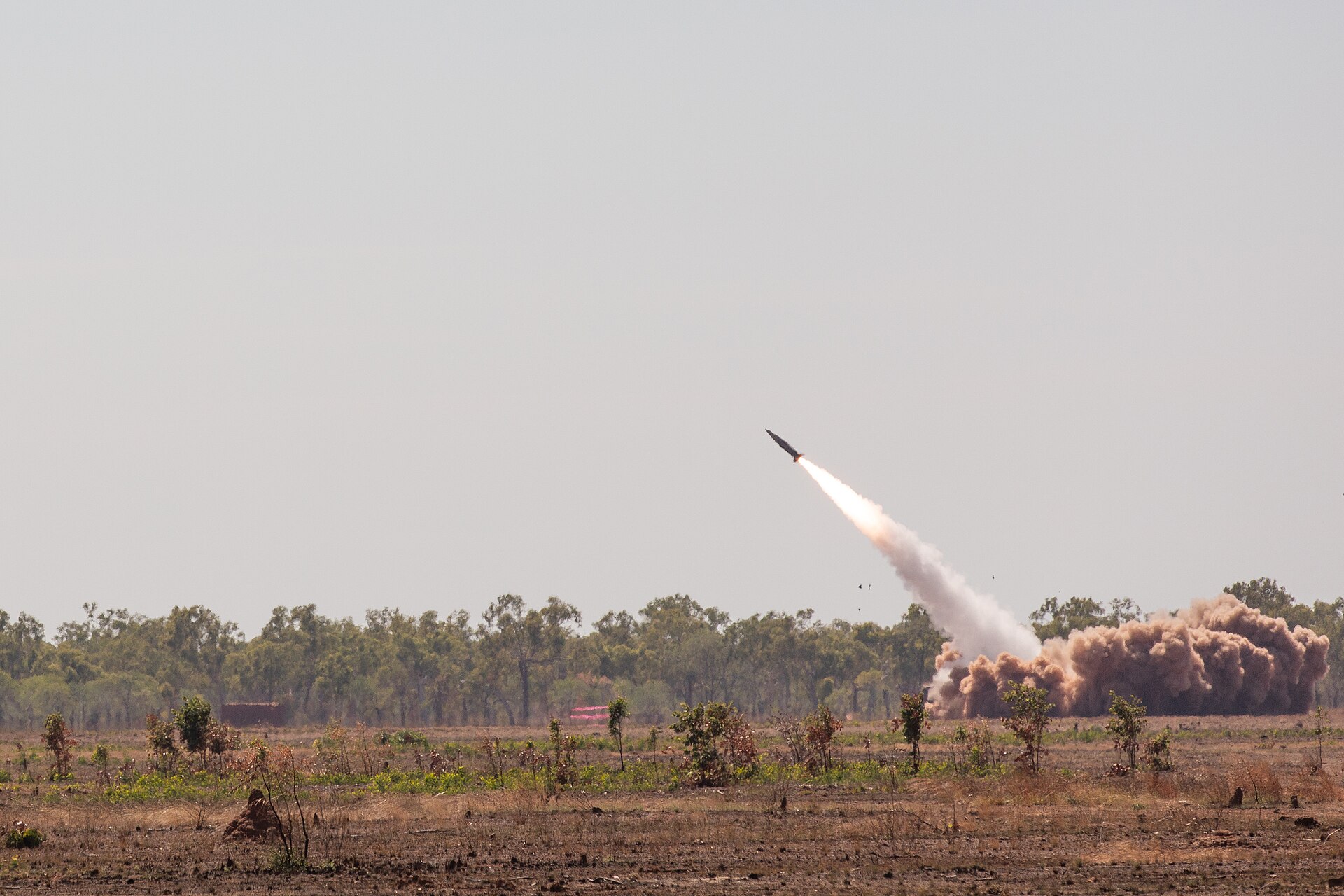
Main image: launch of an ATACMS missile from a US field artillery launcher during an exercise in Australia. Source: Sgt. 1st Class Andrew Dickson / US Army via Wikimedia Commons – public domain.