Saqr 1: KACST armed MALE drone from Saudi Arabia
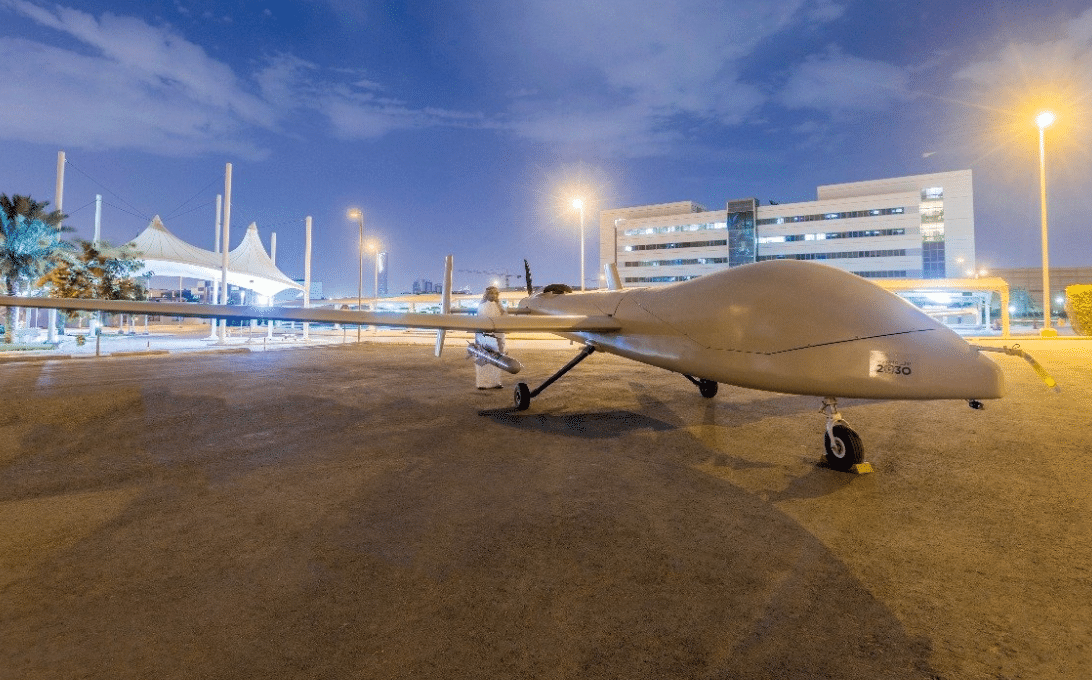
Photo: Quwa (quwa.org)
 Saudi ArabiaArmed MALE unmanned aerial vehiclePrototype
Armed medium-altitude long-endurance UAV unveiled by KACST in 2017
Saqr 1 is an armed medium-altitude long-endurance (MALE) unmanned aircraft developed by King Abdulaziz City for Science and Technology (KACST), Saudi Arabia's national science agency. Presented in 2017 as the Kingdom's first indigenous armed drone, it remained a prototype, and its design origin is disputed.
What is Saqr 1? Overview and development history
KACST president Prince Turki bin Saud bin Mohammed unveiled Saqr 1 in Riyadh in May 2017. He presented it as Saudi Arabia's first indigenous armed drone. The programme involved KACST's National Aeronautical Technology Centre. According to KACST, the aircraft was designed and manufactured by Saudi personnel, with technology transfer from international partners for rocket techniques and sensor systems.
Two months earlier, in March 2017, KACST had signed a co-production agreement with China Aerospace Science and Technology Corporation (CASC). KACST said Saqr development predated that agreement by up to four years. At the unveiling it also referred to a second-generation Saqr 1B, and a third-generation Saqr 1C was reported to have been unveiled in 2020.
The official account is contested. Oryx assessed in 2022 that the Saqr design traces back to South Africa's Denel Bateleur and that it was developed with US-based UAVOS since at least 2012. That attribution conflicts with the official description of Saqr as an all-Saudi aircraft.
Saqr 1 design, weapons and performance
The airframe is built from carbon-fibre and glass composite and powered by a Rotax 914 engine. Maximum take-off weight is 1,400 kg and payload is 250 kg. With a Ka-band satellite link, range reaches 2,500 km. The aircraft typically operates at about 20,000 ft. Endurance was given as up to 24 hours at the 2017 unveiling, while Oryx cites up to 48 hours for later versions.
Take-off and landing are automatic, and an emergency parachute is fitted. Sensors include day and night cameras, radar and electronic warfare systems. Two hardpoints carry weapons, which can engage targets at up to 10 km with a stated accuracy of under 1.5 m. The weapons shown were Chinese-origin AR-1 laser-guided air-to-ground missiles and FT-9 guided bombs.
Saqr 1 programme status
The first-generation system consisted of two aircraft and a ground control room. A third-generation set of four aircraft was planned for completion in 2018. According to Oryx's 2022 assessment, Saqr 1 never entered service, and the follow-on Saqr 2 and Saqr 4 did not reach production. No operator is confirmed.
The programme nonetheless matters as an early sign of Saudi ambitions in armed drones. It was unveiled the same year that Saudi Arabian Military Industries was founded and the General Authority for Military Industries was set up, at the start of the Kingdom's push to localise defence production.
Other Saudi UAV programmes, including Sky Guard, Haboob and Samoom, are being pursued by PSDSRC, SAMI and Intra Defense Technologies.
Saqr 1 specifications: range, endurance, payload and weapons
| Range | 2,500 km (Ka-band satellite link) |
|---|---|
| Endurance | Up to 24 h |
| Average operating altitude | 20,000 ft |
| Payload | 250 kg |
| Maximum take-off weight | 1,400 kg |
| Engine | Rotax 914 |
| Hardpoints | 2 |
| Weapon engagement range | Up to 10 km |
| Stated weapon accuracy | < 1.5 m |
| Structure | Carbon-fibre and glass composite |
| Launch / recovery | Automatic take-off and landing; emergency parachute |
| Sensors | Day/night cameras, radar, electronic warfare systems |
Saqr 1 variants: Saqr 1B and Saqr 1C
How did Saqr 1 come to be? Development and industrial background
KACST president Prince Turki bin Saud bin Mohammed unveiled Saqr 1 in Riyadh in May 2017 as Saudi Arabia's first indigenous armed drone. KACST said the aircraft was designed and manufactured by Saudi personnel, with technology transfer from international partners for rocket techniques and sensor systems.
Two months before the unveiling, in March 2017, KACST signed a co-production agreement with China Aerospace Science and Technology Corporation (CASC). KACST said development of Saqr predated that agreement by up to four years. At the unveiling it also referred to a second-generation Saqr 1B, and a third-generation Saqr 1C was reported unveiled in 2020.
Where is Saqr 1 produced? Manufacturer, partners and local content
The Saqr programme involved KACST's National Aeronautical Technology Centre. KACST is Saudi Arabia's national science and technology agency, founded in 1977.
Partnership claims are contested. Oryx assessed in 2022 that the Saqr design traces to the South African Denel Bateleur and was developed with US-based UAVOS since at least 2012, which conflicts with the official all-Saudi description. The weapons shown were Chinese-origin AR-1 laser-guided air-to-ground missiles and FT-9 guided bombs, so the programme combined Saudi work with foreign components.
Who has ordered or tested Saqr 1? Status and service record
No operator is confirmed and the programme is listed as a prototype. According to Oryx's 2022 assessment, Saqr 1 never entered service, and the follow-on Saqr 2 and Saqr 4 did not reach production.
The first-generation system consisted of two aircraft and a ground control room. A third-generation set of four aircraft had been planned for completion in 2018. The aircraft carries two hardpoints that can engage targets at up to 10 km with a stated accuracy of under 1.5 m, but the sources reviewed contain no record of operational use.
Why Saqr 1 matters for Saudi Arabia's defence industry
Saqr 1 was unveiled in the year Saudi Arabian Military Industries was founded (May 2017) and the General Authority for Military Industries was set up (August 2017), at the start of the Kingdom's push to localise defence production. Localisation of military spending reached 19.35% at the end of 2023, up from 4% in 2018.
Later Saudi UAV programmes, including Sky Guard, Haboob and Samoom, are being pursued by PSDSRC, SAMI and Intra Defense Technologies. Saqr 1 is therefore best read as an early marker of ambition, not as a production system.
Saqr 1 timeline: key dates from the CASC agreement to Saqr 1C
- March 2017KACST signs a co-production agreement with CASC.
- May 2017KACST unveils Saqr 1 in Riyadh as Saudi Arabia's first indigenous armed drone.
- May 2017SAMI is founded as a wholly owned company of the Public Investment Fund.
- August 2017The General Authority for Military Industries (GAMI) is established.
- 2018A third-generation set of four aircraft is planned for completion.
- 2020The third-generation Saqr 1C is reported unveiled.
- 2022Oryx assesses that Saqr 1 never entered service and that Saqr 2 and Saqr 4 did not reach production.
About KACST: who developed Saqr 1
King Abdulaziz City for Science and Technology (KACST), founded in 1977, is Saudi Arabia's national science and technology agency. The Saqr programme involved its National Aeronautical Technology Centre. In March 2017 KACST signed a co-production agreement with China Aerospace Science and Technology Corporation, and KACST said Saqr development predated that agreement by up to four years. Oryx has disputed the all-Saudi origin of the design.
KACST Saqr 1 FAQ: origin, weapons and status
What is the Saqr 1?
Saqr 1 is an armed MALE unmanned aircraft unveiled by Saudi Arabia's KACST in May 2017 and presented as the Kingdom's first indigenous armed drone.
Is the Saqr 1 an indigenous Saudi design?
KACST says it was designed and built by Saudi personnel. Oryx assessed in 2022 that it traces to the Denel Bateleur and was developed with US-based UAVOS, an attribution that conflicts with the official claim.
What weapons does the Saqr 1 carry?
It was shown with Chinese-origin AR-1 laser-guided missiles and FT-9 guided bombs on two hardpoints.
What is the range of the Saqr 1?
Range is 2,500 km using a Ka-band satellite link, with up to 24 hours of endurance quoted at the 2017 unveiling.
Is the Saqr 1 in service?
According to Oryx (2022), Saqr 1 never entered service and the follow-on Saqr 2 and Saqr 4 did not reach production.
Who developed the Saqr 1?
King Abdulaziz City for Science and Technology (KACST), through its National Aeronautical Technology Centre.
When was Saqr 1 unveiled?
KACST unveiled Saqr 1 in Riyadh in May 2017, presenting it as Saudi Arabia's first indigenous armed drone.
What are Saqr 1B and Saqr 1C?
Saqr 1B is the second-generation version referred to by KACST at the 2017 unveiling, and Saqr 1C is the third-generation version reported unveiled in 2020.
Did China help build Saqr 1?
In March 2017 KACST signed a co-production agreement with CASC. KACST said Saqr development began up to four years earlier, and the weapons shown were Chinese-origin AR-1 missiles and FT-9 bombs.
Is Saqr 1 based on the Denel Bateleur?
Oryx assessed in 2022 that the Saqr design traces to the South African Denel Bateleur and was developed with US-based UAVOS since at least 2012. KACST describes it as all-Saudi.
What engine does Saqr 1 use?
Saqr 1 is powered by a Rotax 914 engine and has a composite carbon-fibre and glass airframe.
How much can Saqr 1 carry?
Saqr 1 has a payload of 250 kg and a maximum take-off weight of 1,400 kg, with two hardpoints for weapons.
How long can Saqr 1 fly?
Endurance was given as up to 24 hours at the 2017 unveiling, while Oryx cites up to 48 hours for later versions.
Did Saqr 2 and Saqr 4 enter production?
According to Oryx (2022), the follow-on Saqr 2 and Saqr 4 did not reach production, and Saqr 1 never entered service.
Sources and further reading
- arabnews.com/saudi-arabia/king-abdulaziz-city-for-science-and-technology-unveils-strategic-drone-program-saqr-1-1098376
- quwa.org/2017/05/15/saudi-arabia-unveils-saqr-1-armed-drone
- shephardmedia.com/news/defence-notes/saudi-arabia-unveils-first-indigenous-armed-drone-
- oryxspioenkop.com/2022/09/vision-2030-saudi-arabia-pushes-ahead.html
Related products
 Prototype Saudi Arabia · Tactical unmanned aircraftSky GuardPrince Sultan Defense Studies and Research Center (PSDSRC) / SAMI Advanced Electronics
 In development Saudi Arabia · Armed MALE unmanned aircraftSamoomIntra Defense Technologies
 In service Saudi Arabia · Armed tactical UAVHaboobIntra Defense Technologies (with SAMI Advanced Electronics)
 Prototype Saudi Arabia · Wheeled armoured vehicleHEETSAMI Land (Saudi Arabian Military Industries)