WESCAM MX: Canadian sensor turrets for surveillance and targeting, models and users
WESCAM MX is a family of electro-optical and infrared (EO/IR) sensor turrets produced by L3Harris in Canada. The turrets are mounted under aircraft, helicopters and drones and are used for reconnaissance, surveillance, target designation and laser guidance of weapons. The company says its systems are installed on more than 260 platform types worldwide. In the Arab world, the proposed sale of Bell helicopters to Iraq, which Washington notified to Congress on 31 August 2026, included WESCAM MX-15HDI sensors.
What is WESCAM MX?
L3Harris describes the WESCAM MX series as multi-sensor, multi-spectral surveillance and targeting systems that support intelligence, surveillance, reconnaissance and target acquisition missions from air, land and maritime platforms. The turrets combine high-definition daylight cameras, thermal cameras and low-light cameras, as well as laser rangefinders and, in some versions, laser designators.
The company says the MX family uses electronics, cabling, software and operator interfaces common across its models. This allows air forces to swap turrets between fleets and train operators on a single system.
WESCAM MX models and sizes
The number in each model’s name indicates the turret’s approximate size class in inches. The letter D added to a model (such as MX-15D) adds laser target designation for guiding munitions.
| Model | Use specified by the company |
|---|---|
| MX-8 / MX-8D | Very lightweight digital system for small aircraft and tactical reconnaissance |
| MX-10 / MX-10D | Low-altitude tactical reconnaissance and search and rescue |
| MX-15 / MX-15D | Covert medium-altitude reconnaissance and search and rescue |
| MX-20 / MX-20D | Long-range persistent reconnaissance at high altitude |
| MX-25 / MX-25D | Long-endurance missions at very high altitude |
Source: L3Harris official website.
WESCAM MX-10
The MX-10 turret weighs about 38 lb (approximately 17 kg) and is less than 14 inches tall, according to L3Harris. It supports up to six sensors simultaneously and uses four-axis stabilisation. The company notes that the MX-10 benefits from technologies of the larger MX-15 and MX-20 models.
WESCAM MX-15
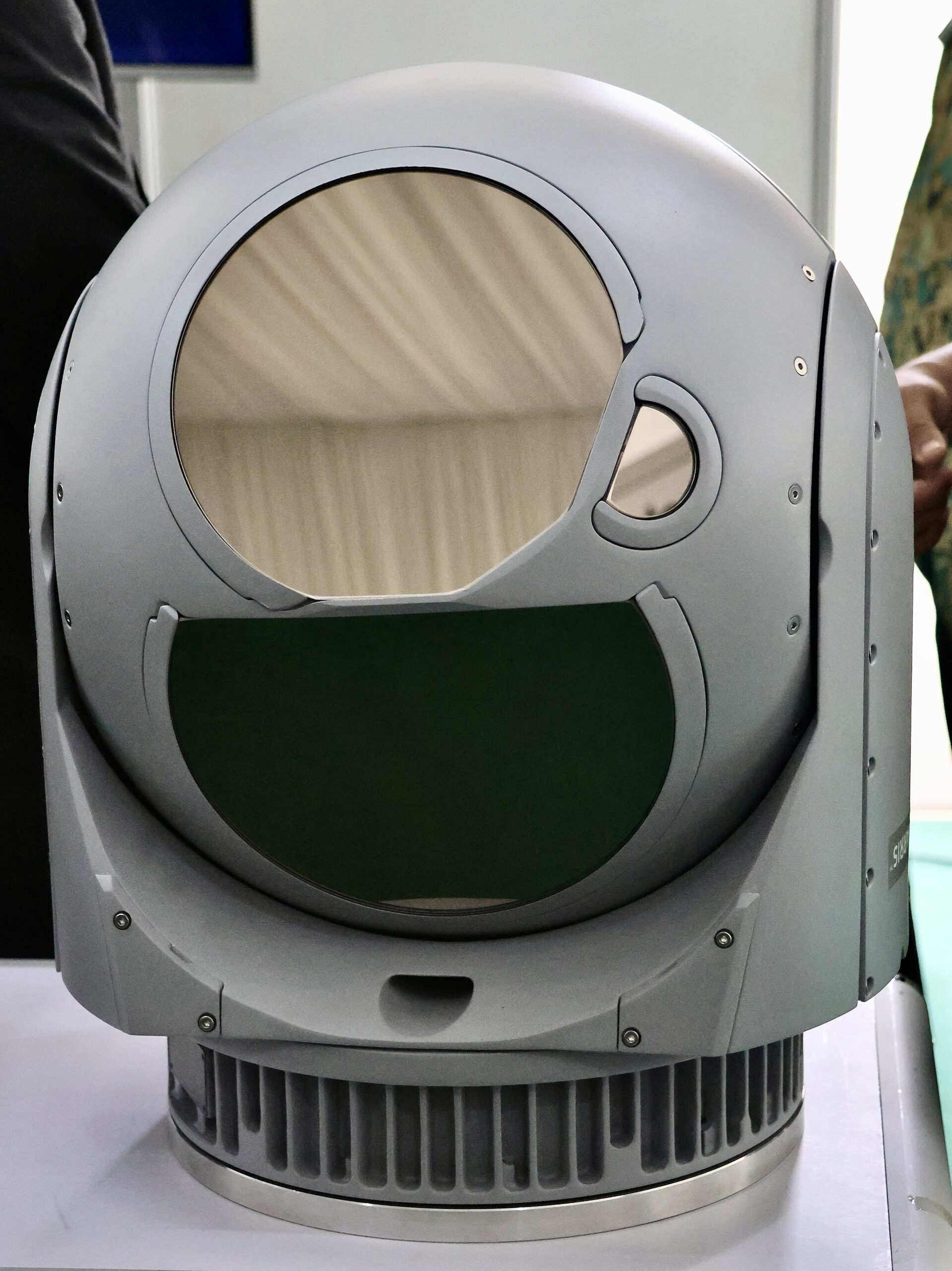
The MX-15 is the most widely used model in the medium-altitude class. The official specification sheet states that it supports seven sensor payloads simultaneously, including thermal, daylight and low-light cameras and a short-wave infrared (SWIR) camera, all in high definition. The turret includes an eye-safe laser rangefinder and multiple laser illuminator options.
The MX-15 uses four-axis stabilisation with an internal vibration isolator and is less than 19 inches tall. It contains an inertial measurement unit mounted on the optical bench for precise target geolocation. It also supports a moving target indicator and an advanced video tracker.
WESCAM MX-20 and MX-25
The two models are designed for high altitude and long range and use a five-axis gimbal. Specification sheets state that the MX-20 supports up to eight sensor payloads and the MX-25 up to seven.
How does a sensor turret work?
According to the company, WESCAM design focuses on three factors that determine the maximum target recognition range: image resolution, magnification and stabilisation. The steadier the turret is despite aircraft vibration, the more the image can be magnified and the farther away a target can be recognised. In laser-designating versions, the operator points the laser beam at the target so that laser-guided bombs and missiles can follow it. For details, see: How does laser guidance work? (Arabic)
WESCAM in the Arab world
Iraq: Bell helicopters with MX-15HDI sensors
On 19 October 2026 the US Defense Security Cooperation Agency (DSCA) published in the US Federal Register the text of a notification of a possible $800 million sale to Iraq. The package includes Bell 412EPX and Bell 407M helicopters, GAU-19 three-barrel machine guns, M260 2.75-inch rocket launchers and L-3 WESCAM MX-15HDI electro-optical and infrared sensors. The notification stated that the report was delivered to Congress on 31 August 2026 and that funding would come from Iraqi national funds. For background on the deal, see: Why is Iraq seeking to replace Russian Mi-17 helicopters with Bell models? (Arabic)
Service centres in Saudi Arabia and the UAE
L3Harris lists Saudi Arabia and the UAE among the locations of authorised service centres for WESCAM MX systems, alongside countries in North America, Europe, Asia and Australia. The company says these centres aim to reduce repair times and increase operational readiness.
Libya and the Turkish drone case
The WESCAM name became associated with Turkey’s Bayraktar TB2 drones. In autumn 2020 Canada suspended export permits for military equipment to Turkey to investigate the use of Canadian technology in the Nagorno-Karabakh conflict. On 12 April 2021 Canadian Foreign Minister Marc Garneau announced the cancellation of these permits after the review found “credible evidence” that Canadian technology had been used there.
The final report of the Canadian review also addressed Libya. It said there was credible evidence that Turkey had supplied drones to Libya’s Government of National Accord, but the evidence was insufficient to confirm that those drones were equipped with Canadian sensors, although the report considered it likely. To read about the drone’s role in Libya, see: What did the Bayraktar TB2 do in Libya? (Arabic) and Bayraktar TB2: specifications and Arab operators (Arabic).
Why do these turrets matter to Arab armies?
- Border surveillance: they enable persistent day-and-night reconnaissance over desert borders and long coastlines.
- Air support: they enable helicopters and drones to designate targets and guide munitions precisely.
- Export restrictions: the Turkish experience shows that sensitive Western components may be subject to political restrictions, an important factor when choosing platforms.
Frequently asked questions
What is WESCAM MX?
A series of electro-optical and thermal sensor turrets from Canada-based L3Harris, used for surveillance, reconnaissance and target designation.
What is the difference between the MX-15 and MX-15D?
The letter D adds laser target designation for guiding munitions, in addition to surveillance capabilities.
How much does the WESCAM MX-10 turret weigh?
About 38 lb (approximately 17 kg), according to L3Harris.
Do Arab countries use WESCAM systems?
The proposed US helicopter sale to Iraq includes MX-15HDI sensors, and the company has authorised service centres in Saudi Arabia and the UAE.
Main image: a WESCAM MX-15 sensor turret on display in Brunei in 2024. Source: Pangalau via Wikimedia Commons – CC BY-SA 4.0 licence.
Sources
- L3Harris – WESCAM MX-Series
- L3Harris – WESCAM MX-10
- L3Harris – WESCAM MX-15 specification sheet
- L3Harris – authorised service centres for WESCAM MX systems (2025)
- US Federal Register (DSCA) – notification of Bell helicopter sale to Iraq, 19 October 2026
- Global Affairs Canada – statement on cancellation of export permits to Turkey (12 April 2021)
- Global Affairs Canada – final report of the review of export permits to Turkey