Trident II D5 Missile: Range, Specifications and the Submarines That Carry It
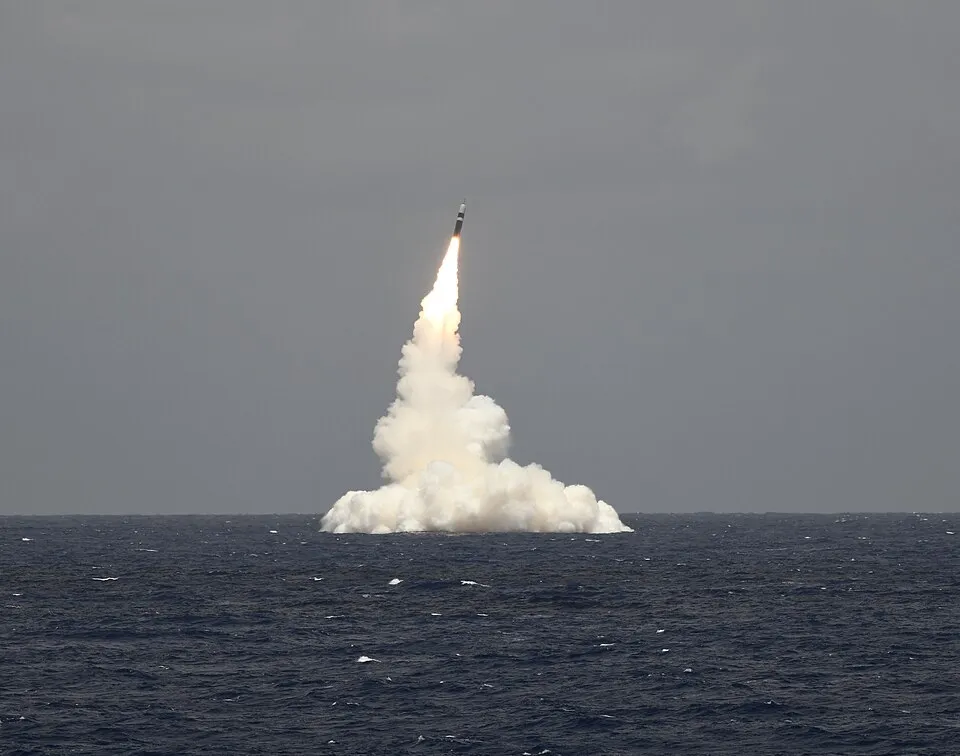
Beneath the ocean surface, in submarines whose positions are unknown, lies the strongest guarantee of American and British nuclear deterrence: the Trident II D5 missile. It is a submarine-launched ballistic missile that carries multiple nuclear warheads over a distance of more than 7,000 kilometres. This guide explains the official specifications of Trident, how it is launched from underwater, the submarines that carry it, and why it is regarded as the “most survivable leg” of the nuclear triad.
What is the Trident II D5 missile?
According to the US Navy, the Trident II strategic weapon system consists of the Trident II D5 submarine-launched ballistic missile (SLBM), the reentry body system, and the support systems aboard the submarine. The missile is a three-stage, solid-fuel weapon with inertial guidance, and it carries several warheads of the W76 or W88 types.
How is Trident launched from underwater?
The US Navy explains that the missile is pushed out of the launch tube by expanding gas pressure inside the tube, without igniting its motor underwater. When it breaks the surface of the water, the propulsion phase begins, and the first, second and third stage motors ignite in sequence. After the third stage separates, the missile deploys its warheads, each of which can be directed at an independent target (MIRV technology).
Official specifications of the Trident II D5
| Item | Value |
|---|---|
| Mission | Strategic nuclear deterrence |
| Contractor | Lockheed (now Lockheed Martin) |
| Deployment began | 1990 |
| Propulsion | 3 solid-fuel stages |
| Length | 13.41 metres |
| Diameter | 2.11 metres |
| Weight | 58,500 kg |
| Range | 4,000 nautical miles (about 7,360 km according to the Navy) |
| Guidance | Inertial |
| Warhead | Nuclear, multiple independently targetable reentry vehicles (MIRV) |
| Unit cost | USD 30.9 million |
Submarines that carry Trident
- US Ohio-class submarines: each submarine carries 20 D5 missiles, according to the US Navy.
- British Vanguard-class submarines: they carry 16 missiles, under the Polaris Sales Agreement between the two countries.
- The future: the new US Columbia-class and British Dreadnought-class submarines will carry the upgraded D5 missiles in the early part of their service.
For the difference between nuclear attack submarines and strategic missile submarines, see our guide on the nuclear submarine.
From Polaris to D5LE
American submarine-launched ballistic missiles began in 1956 with the Polaris A1 programme, then evolved through five generations: Polaris A2 and A3, then Poseidon C3, then Trident I C4, and finally Trident II D5. Each generation increased range, payload and accuracy. The designed service life of Trident II was about 25 years, but the Navy extended it through the Life Extension programme (D5LE), whose missiles entered service in early 2017 and will remain until the end of the service life of the Ohio and Vanguard submarines.
Why is Trident the “most survivable leg”?
The US Navy describes submarine-launched missiles as the most survivable leg of the nuclear triad, because they provide an assured “second strike” capability. Land-based missiles sit in silos whose locations are known, and bombers sit at bases that can be targeted, whereas a submarine hidden in the depths of the ocean is very hard to find. This means that any adversary considering a first nuclear strike knows that the response will inevitably come from the sea.
What is the relevance to the Arab region?
No Arab country possesses nuclear weapons or submarine-launched ballistic missiles. However, understanding the logic of naval deterrence helps the Arab reader interpret major strategic balances, discussions of nuclear proliferation in the Middle East, and the reasons major powers keep their submarines in the oceans surrounding the region.
Frequently asked questions about Trident
What is the range of the Trident II missile?
4,000 nautical miles, or about 7,360 kilometres according to the US Navy.
How many missiles does an Ohio-class submarine carry?
20 Trident II D5 missiles.
Who uses Trident?
The United States and the United Kingdom.
When did Trident II enter service?
In 1990.
Summary
The Trident II D5 has been the backbone of American and British naval nuclear deterrence since 1990, and it will remain so for decades to come after its service life extension. Its value lies not only in its destructive power, but in the fact that it is almost impossible to neutralise before launch, which is the essence of deterrence.