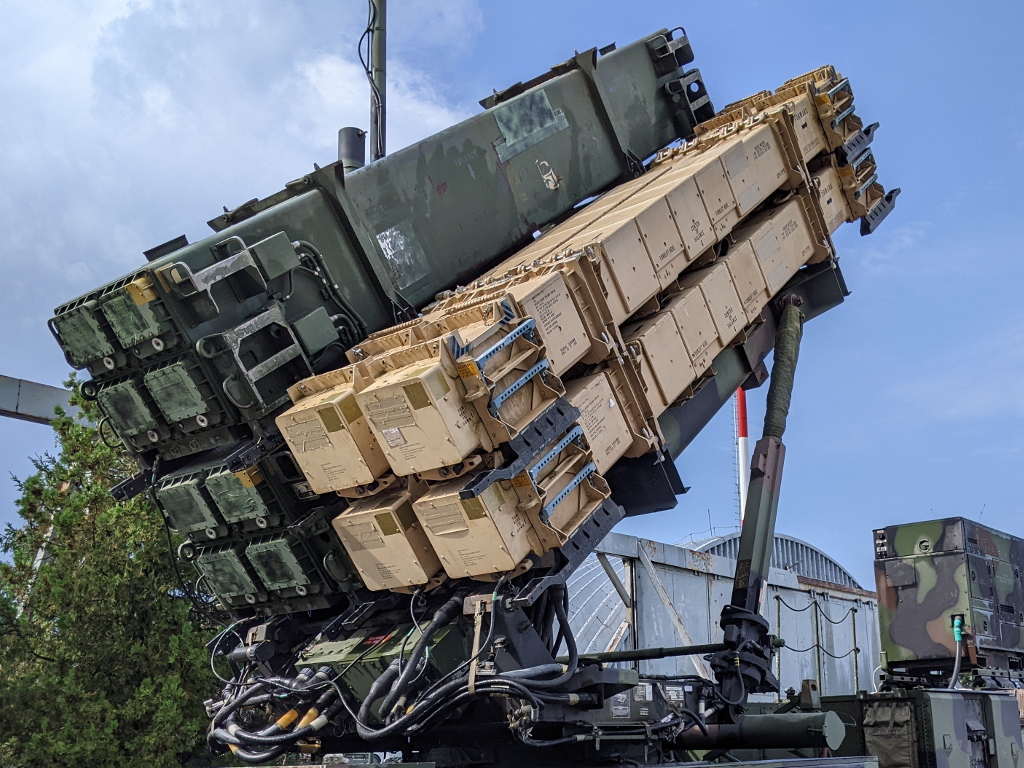
Patriot PAC-3 MSE missiles for Saudi Arabia
 Saudi Arabia ←
 United States
Deal progress
Current status: Sale approved — latest milestone in 2026. Not every deal goes through every stage; a government sale approval, for example, applies only in some supplier countries.
Deal details
The deal covers Patriot PAC-3 MSE missiles for Saudi Arabia, supplied by the United States; Lockheed Martin is listed as the manufacturer. It is classed under air defence. The announced quantity is 730 missiles, and the value is put at $9.0 billion (DSCA estimate).
The supplier government approved the sale in 2026. Approval is not a signed contract, and the quantity and value may change once one is concluded.
Details: Notified by the Defense Security Cooperation Agency in January 2026.
What is the Patriot PAC-3 MSE interceptor?
The PAC-3 MSE is an interceptor missile built by Lockheed Martin and the latest generation of munition fired by the Patriot air and missile defence system. MSE stands for Missile Segment Enhancement, and it is a direct development of the PAC-3 CRI that preceded it into service.
Its main job is to defeat tactical ballistic missiles, cruise missiles and hostile aircraft in the lower tier of air defence. It operates within a Patriot battery alongside the radar and fire control centre, and can be tied into the Integrated Battle Command System (IBCS) adopted by the US Army. Lockheed says 17 countries have chosen the PAC-3 family, that it has built more than 2,500 MSE missiles alone, and that it plans to triple annual output.
How it works and what sets it apart
The missile does not carry a fragmentation warhead in the conventional sense. It relies on hit-to-kill, destroying the target by striking it directly, an approach that works well against ballistic warheads that are hard to neutralise with fragments. In the terminal phase it is guided by an active Ka-band radar seeker.
The biggest change from the previous version is a dual-pulse solid rocket motor that fires in two stages, giving the missile an extra kick in the endgame of the intercept and extending the range and altitude it can cover. It also has larger control fins and improved actuators that make it more agile against fast targets. Lockheed Martin signed the first production contract in 2014, and the US Army declared initial operational capability in 2016. In a 2018 test the missile made the longest-range intercept in the history of the PAC-3 family up to that point. It is built at the company’s plant in Camden, Arkansas, with some 400 suppliers in 37 US states and five countries. The MSE and CRI together have logged more than 90 successful flight tests, and the missile has been integrated with THAAD launchers as part of efforts to link the layers of US missile defence.
Key specifications
| Role | Intercepting tactical ballistic missiles, cruise missiles and aircraft |
|---|---|
| Manufacturer | Lockheed Martin (United States) |
| Parent system | Patriot |
| Kill mechanism | Direct impact (hit-to-kill) |
| Propulsion | Dual-pulse solid rocket motor |
| Terminal guidance | Active Ka-band radar seeker |
| Initial operational capability | 2016 (US Army) |
| Countries that chose PAC-3 | 17 |