Saudi Arabia’s Cheongung-II (KM-SAM) air defence deal
 Saudi Arabia ←
 South Korea
Deal progress
Current status: Contract signed — latest milestone in 2024. Not every deal goes through every stage; a government sale approval, for example, applies only in some supplier countries.
Deal details
The deal covers the Cheongung-II (KM-SAM) air defence system for Saudi Arabia, supplied by South Korea; LIG Nex1 is listed as the manufacturer. It is classed under air defence. The quantity has not been disclosed, and the value is put at $3.2 billion.
The two sides have signed a final contract. The most recent major milestone came in 2024, and completion of deliveries has not yet been announced.
Details: Contract announced in February 2024.
What is the Cheongung-II (KM-SAM Block II)?
Cheongung-II, also known as KM-SAM Block II or M-SAM II, is a South Korean medium-range air defence system able to intercept aircraft and ballistic missiles. Development began in 2012 under the lead of Korea’s Agency for Defense Development (ADD), with LIG Nex1 as prime contractor and systems integrator, Hanwha building the launchers and transporter-loaders, and Hanwha Systems producing the multifunction radar. Open sources differ on the maximum intercept altitude, putting it at between 15 and 20 km.
The system extends Cheongung-I, which entered service in 2016, adding the ability to engage ballistic missiles in the terminal phase of their flight. The first new batteries were fielded with the Korean military in 2023, and they operate in a layered defence network alongside Patriot and the higher-altitude L-SAM. Work is under way on a Block III version, expected to reach operational capability around 2034 with greater intercept range and altitude.
How it works and what sets it apart
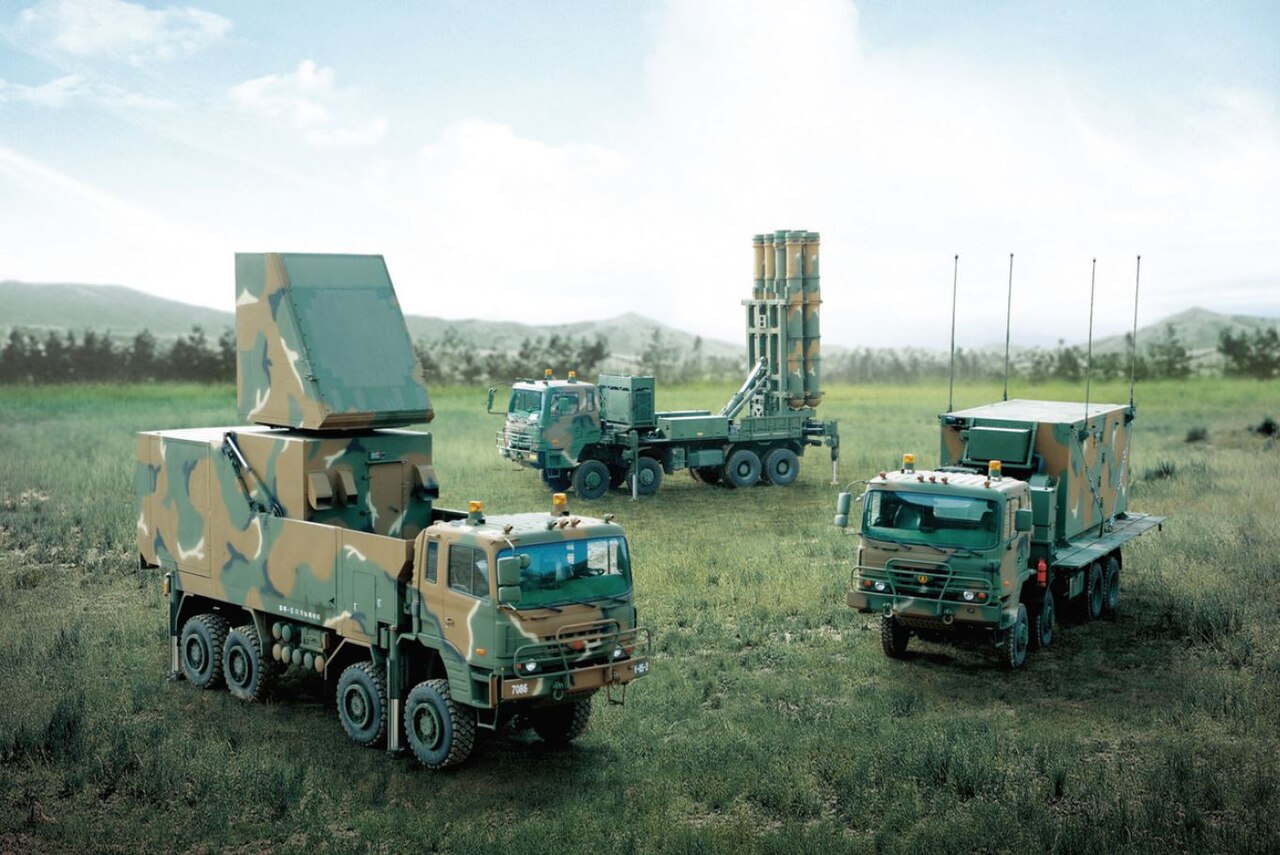
A battery consists of a truck-mounted X-band 3D active electronically scanned array (AESA) radar, a command vehicle and four vertical launchers with eight cells each, for 32 ready-to-fire missiles. The radar detects targets at about 100 km and tracks up to 40 at once, steering its beam electronically with no mechanical rotation, which makes it harder to jam. The missile is launched vertically, its active radar seeker takes over in the terminal phase, and its range reaches about 40 km. Hanwha Systems says the radar combines detection, tracking, identification, anti-jamming and data-link functions. Outside Korea, the UAE signed for the system in January 2022 in its first export deal, followed by Saudi Arabia.
Key specifications
| Role | Medium-range air and missile defence |
|---|---|
| Prime contractor | LIG Nex1 |
| Radar | X-band multifunction AESA (Hanwha Systems) |
| Radar range | About 100 km, tracking 40 targets at once |
| Missile range | About 40 km |
| Terminal guidance | Active radar |
| Battery composition | 4 launchers × 8 missiles |
| Development began | 2012 |
| First new batteries fielded | 2023 |
Related news
 Saudi Arabia vs UAE: comparing air power by numbers and criteria
 The War You Can’t See: How GPS Jamming and Spoofing Threaten Aviation, Shipping and Timing
 Coalition destroys 60 Houthi targets in four Yemeni governorates and intercepts two cruise missiles heading for Riyadh
 How does laser guidance work? Laser-guided bombs and missiles