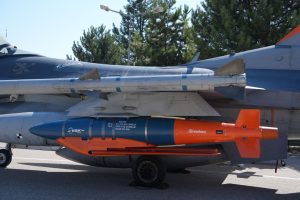
IRIS-T missiles for Saudi Arabia’s Eurofighters

 Saudi Arabia ←
 Germany
Deal progress
Current status: Sale approved — latest milestone in 2024. Not every deal goes through every stage; a government sale approval, for example, applies only in some supplier countries.
Deal details
Saudi Arabia is acquiring IRIS-T air-to-air missiles for its Eurofighter jets from Germany, with Diehl Defence named as the manufacturer. It is classed under munitions and missiles. The announced quantity is 150 missiles, and no value has been disclosed.
The supplier government approved the sale in 2024. Approval is not a signed contract, and the quantity and value may change once one is concluded.
Details: German government export approval granted in January 2024.
What is the IRIS-T air-to-air missile?
IRIS-T is a short-range infrared-guided air-to-air missile developed and produced under the lead of Germany’s Diehl Defence, in a programme involving six European countries: Germany, Greece, Italy, Norway, Spain and Sweden. It was designed to replace the American AIM-9 Sidewinder in those nations’ fleets while keeping compatibility with its mounting interfaces, which makes it easy to integrate on aircraft that already carried the Sidewinder.
It entered service in December 2005 and is now integrated on the Eurofighter Typhoon, Tornado, Gripen, F-16 and F/A-18, and in 2024 it was test-fired from South Korea’s KF-21 fighter. Users outside the partner nations include Austria, South Africa, Saudi Arabia and Thailand. The missile later became the core of the IRIS-T SL ground-based air defence family, which has spread more widely than the air-launched version itself.
How it works and what sets it apart
The missile uses an imaging infrared seeker that sees the target as a full thermal picture rather than a single hot spot, making it better at telling an aircraft apart from decoy flares. The pilot can lock the target before launch, or fire first and let the missile acquire the target in flight, a useful option when it is cued through the pilot’s helmet against targets at sharp off-boresight angles.
The standout design feature is thrust vectoring by metal vanes in the motor exhaust, which lets the missile turn hard as soon as it leaves the aircraft, to the point that it can engage targets behind the launch aircraft. It flies at more than Mach 3 and has an estimated range of about 25 km, a relatively high figure for a dogfight missile. Its 127 mm diameter matches that of the Sidewinder, which made it easy to use existing launchers on the aircraft. In Germany, Diehl has signed framework contracts with the defence procurement agency to supply missiles from the family over several years, amid rising demand for both the air-launched and ground-based versions.
Key specifications
| Role | Close-in and short-range air combat |
|---|---|
| Manufacturer | Diehl Defence (Germany) |
| Entered service | December 2005 |
| Length | 2.94 m |
| Diameter | 127 mm |
| Weight | 89 kg |
| Range | About 25 km |
| Speed | More than Mach 3 |
| Guidance | Imaging infrared seeker with thrust vectoring |