Saudi Arabia’s F-35 Lightning II fighter deal
 Saudi Arabia ←
 United States
Deal progress
Current status: Sale approved — latest milestone in 2026. Not every deal goes through every stage; a government sale approval, for example, applies only in some supplier countries.
Deal details
Saudi Arabia is acquiring F-35 Lightning II fighters from the United States, with Lockheed Martin / Pratt & Whitney named as the manufacturer. It is classed under fighter aircraft. The announced quantity is 48 aircraft + 49 F135 engines, and the value is put at $24.3 billion (US State Department estimate).
The supplier government approved the sale in 2026. Approval is not a signed contract, and the quantity and value may change once one is concluded.
Details: Approved on 17 September 2026, subject to congressional review; no contract announced yet.
What is the F-35 Lightning II?
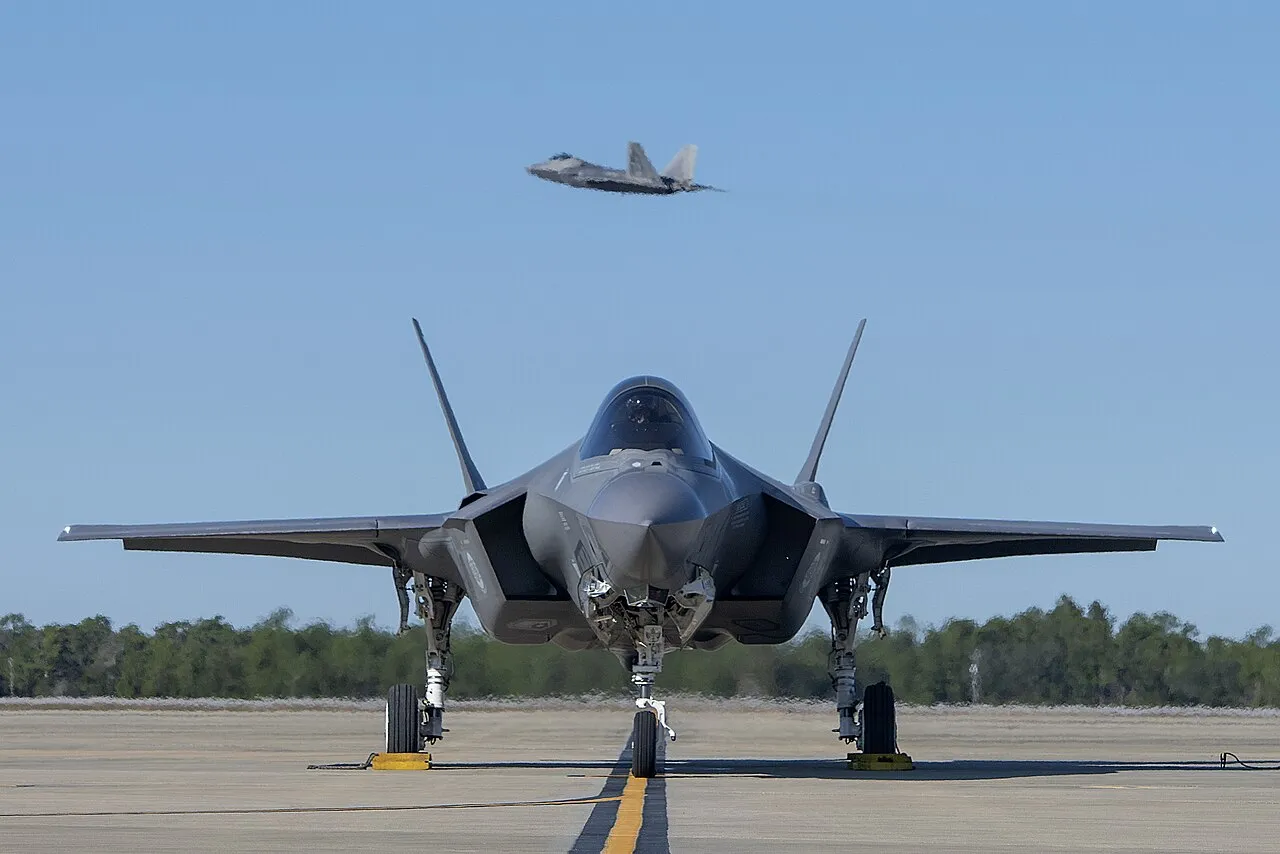
The F-35 Lightning II is a fifth-generation multirole stealth fighter built by a Lockheed Martin-led team that includes Northrop Grumman and BAE Systems. It grew out of the Joint Strike Fighter (JSF) competition, which Lockheed won in 2001, and the first aircraft flew in December 2006. It is the most expensive programme in the history of the US Department of Defense, with development, production and support stretching over decades.
The jet comes in three variants that share most of their systems: the F-35A for conventional take-off and landing from runways, the most widely fielded version and the one flown by air forces; the F-35B, a short take-off and vertical landing model for the US Marine Corps and smaller ships; and the carrier-based F-35C with its larger wing. The US Air Force declared initial operational capability for the A model in August 2016, and the global fleet has passed one million flight hours. Operators and customers include the UK, Italy, the Netherlands, Norway, Denmark, Australia, Japan, South Korea, Israel, Poland and Germany.
How it works and what sets it apart
The aircraft is built around a very low radar signature, achieved through airframe shaping, absorbent coatings and internal weapons bays. Its real operational value, though, lies in sensor fusion: the AN/APG-81 active electronically scanned array radar, an electro-optical targeting system built into the nose, and six infrared cameras around the airframe that let the pilot see in every direction through the helmet. The central computer merges this data into a single tactical picture and shares it over datalinks with friendly aircraft and units, which is why Lockheed pitches the F-35 as a command node in the air battle rather than simply a fighter. In stealth configuration it carries AIM-120 air-to-air missiles and guided bombs such as JDAM and GBU-39 internally, and extra stores can be hung under the wings when low observability is not the priority.
Key specifications
| Role | Multirole stealth fighter |
|---|---|
| Manufacturer | Lockheed Martin (United States) |
| First flight | 15 December 2006 |
| Crew | 1 pilot |
| Engine | Pratt & Whitney F135, about 191 kN (43,000 lb) of thrust |
| Maximum speed | Mach 1.6 |
| Range on internal fuel (F-35A) | More than 2,200 km |
| Service ceiling | 15,240 m (50,000 ft) |
| Gun (F-35A) | GAU-22/A four-barrel 25 mm |