The Stinger missile (FIM-92 Stinger): specifications, how it works and operators
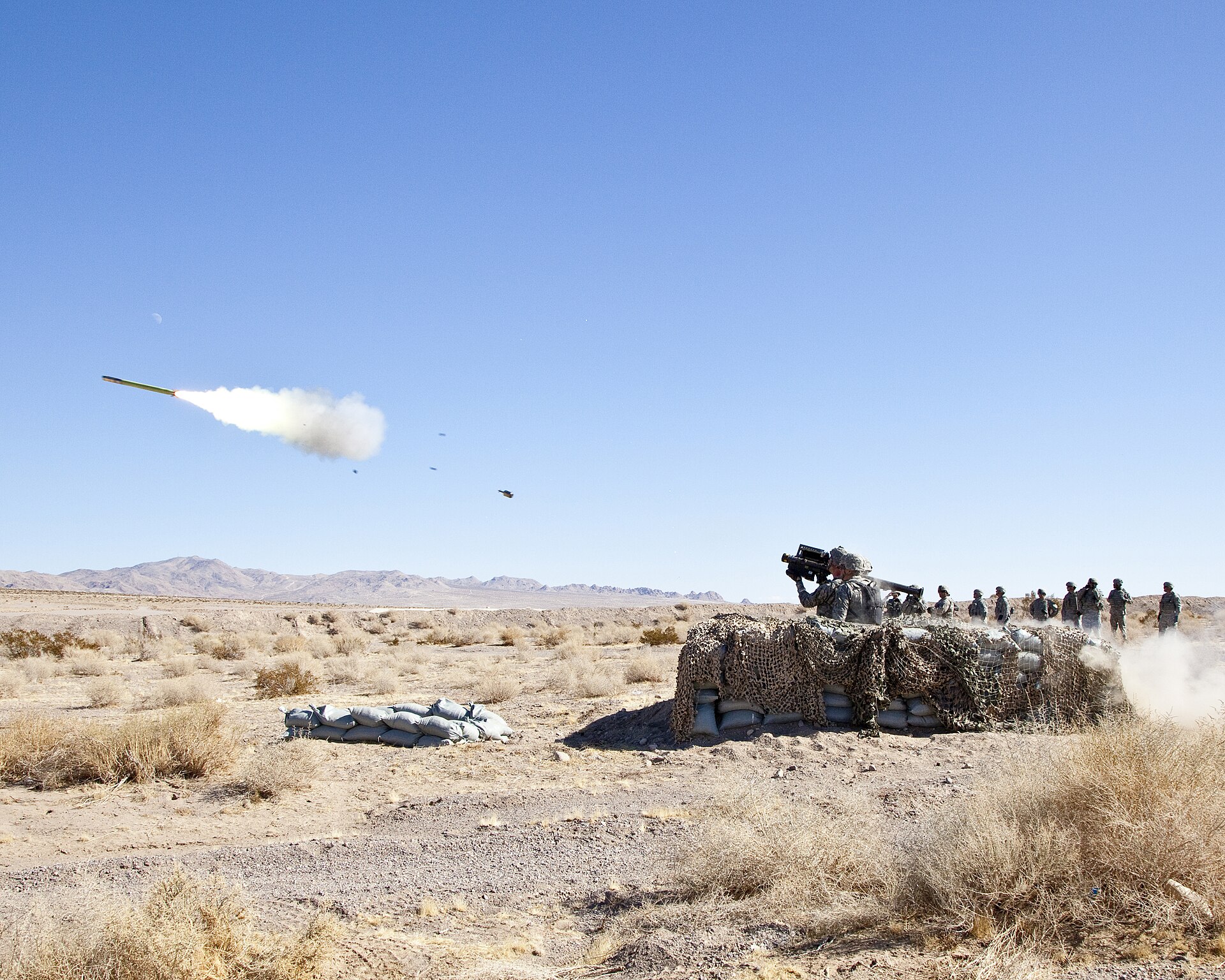
The Stinger (FIM-92 Stinger) is a light US man-portable surface-to-air missile (MANPADS) that entered service in the early 1980s and is currently produced by RTX (Raytheon). It uses an infrared seeker that tracks the target’s heat on a “fire-and-forget” principle, with an effective range of about 4.8 km and a speed exceeding Mach 2 according to open sources. It is used against helicopters, low-flying aircraft and drones, and is also mounted on platforms such as Avenger and M-SHORAD.
Approximate specifications
| Category | Man-portable air-defence missile (MANPADS) |
|---|---|
| Guidance | Infrared seeker (with an ultraviolet channel in later versions) |
| Effective range | About 4.8 km (open-source estimates) |
| Speed | More than Mach 2 |
| Missile weight | About 10 kg (about 15 kg with the launch tube) |
| Entry into service | Early 1980s |
| Manufacturer | RTX (Raytheon) |
How does it work?
- The gunner acquires the target visually and points the launcher at it.
- He activates the heat seeker until he hears the “lock-on” tone on the target.
- The missile is launched by a small ejection motor that carries it clear of the gunner, after which the main motor ignites.
- The missile tracks the target autonomously with no need for further guidance.
Stinger and countering drones
The spread of drones has revived interest in man-portable missiles, but the relatively high cost of a Stinger compared with a cheap drone poses a difficult equation, pushing armies to combine it with guns, lasers and electronic warfare systems. Read more: Short-range air defence (SHORAD), Counter-drone lasers and DragonFire (Arabic).
Stinger in Egypt: a 720-missile deal for Avenger systems
On 24 September 2024 the US Defense Security Cooperation Agency (DSCA) notified Congress of a possible sale to Egypt of 720 Stinger missiles intended exclusively for the vehicle-mounted Avenger systems already in Egyptian service, plus 20 Production Verification Flight Test (PVFT) rounds. The notification was later published in the US Federal Register on 18 November 2025.
| Item | Details (per the DSCA notification / Federal Register) |
|---|---|
| Quantity | 720 Stinger missiles + 20 PVFT test rounds |
| Use | Exclusively on vehicle-mounted Avenger systems |
| Version cited | Stinger-RMP Block I (reprogrammable microprocessor) |
| Estimated value | $740 million ($720 million in major defence equipment and $20 million in other items) |
| Funding | Foreign Military Financing (FMF) |
| Prime contractor | RTX Corporation, Tucson, Arizona |
| Offsets | No known offset agreements |
Note: a congressional notification means approval of a possible sale; it does not mean a contract has been signed or deliveries have begun. No official statements on contract signature or delivery have been announced so far.
The US document justifies the sale as improving Egypt’s ability to meet current and future threats and strengthening interoperability with US forces. More on Egyptian air-defence systems: Short-range air defence (SHORAD) in Arab armies (Arabic).
The coming replacement: the NGSRI programme
In September 2023 the US Army awarded RTX and Lockheed Martin contracts for the competitive development of a Stinger replacement under the Next-Generation Short-Range Interceptor (NGSRI) programme. Brig. Gen. Frank Lozano, Program Executive Officer for Missiles and Space, told Defense News that the plan would take five years to reach low-rate production and is divided into two phases:
- The first two years: each company develops its missile and produces a very small quantity, followed by a comparative fly-off.
- The second phase: improvements in specific areas, a round of prototypes and a second comparative test, followed by the selection of a single supplier for production.
| Requirement | What it means (according to Lozano) |
|---|---|
| Compatibility | Must fit the SVUL launcher on the M-SHORAD turret and the shoulder-fired configuration |
| Speed | Shorter time to target with an advanced rocket motor |
| Jamming resistance | Counter-countermeasures against the electronic warfare that has appeared on aircraft |
| Drones | An advanced seeker, because drones do not emit a large heat signature like aircraft and helicopters |
The last requirement explains the current Stinger’s limits against small drones: its heat seeker was designed mainly for aircraft and helicopters with a clear heat signature. For comparison with other man-portable missiles and short-range layer systems, see: Counter-drone lasers (Arabic).
Platforms that launch the Stinger
The US document on the Egypt deal describes the Stinger-RMP Block I as a lightweight, self-contained air-defence system that ground forces can deploy rapidly, and says its seeker and guidance system enable it to detect, track and engage a target with a single shot. Its use is not limited to the individual gunner:
- Shoulder-fired configuration: the missile’s original use with infantry units.
- Avenger system: a vehicle-mounted Stinger launcher, the exclusive use of the missiles in the Egypt deal.
- Interim M-SHORAD system: deployed by the US Army on Stryker vehicles in Europe to protect manoeuvring formations; a platoon of the 5th Battalion, 4th Air Defense Artillery Regiment was equipped with it, according to Defense News.
This means the same missile can appear in three different forms, so when reading any deal one should check which platform is intended, not just the number of missiles.
Stinger between order, delivery and service
| Status | Documented example |
|---|---|
| In service | US Army (man-portable configuration and on the interim M-SHORAD system) |
| Possible sale approved | Egypt: 720 missiles for Avenger (notification of 24 September 2024) |
| In development (replacement) | NGSRI: competing prototypes from RTX and Lockheed Martin since September 2023 |
Production restarted after the Ukraine war
The war in Ukraine exposed the pressure of demand on this missile. On 25 May 2022 US Army Contracting Command issued a contract action to Raytheon with a ceiling of $624.6 million to procure Stinger missiles and gripstocks for the Army and Marine Corps, along with test equipment to increase production capacity. The company announced that the contract covers production of 1,300 missiles and funds work to address obsolescence of key components and accelerate production, to replace about 1,400 missiles the United States sent to Ukraine.
| Item | Details (per the US Army and Raytheon) |
|---|---|
| Contract action date | 25 May 2022 |
| Maximum value | $624.6 million |
| Announced quantity | 1,300 missiles |
| Purpose | Replenishing stocks, addressing component obsolescence and accelerating production |
Frequently asked questions
What is the range of the Stinger missile?
An effective range of about 4.8 km, according to open sources.
How is the Stinger guided?
By an infrared seeker that autonomously tracks the target’s heat after launch.
Who makes the Stinger?
The US company RTX (Raytheon).
Has Egypt bought Stinger missiles?
In September 2024 the US State Department approved a possible sale of 720 missiles for Avenger systems at an estimated value of $740 million; no contract signature or delivery has been officially announced.
What will replace the Stinger?
The US NGSRI programme, in which RTX and Lockheed Martin have been competing since September 2023.
Is the Stinger effective against drones?
It is used against them, but for its replacement the US Army is requiring a more advanced seeker because drones emit a weak heat signature.
Main image: launch of an FIM-92 Stinger missile during US Army training in 2012. Source: Casey Slusser / US Army via Wikimedia Commons – public domain.
Sources
- U.S. DoD (A&S) – Army Awards Contracts to Accelerate Javelin and Stinger Production (31 May 2022)
- Raytheon – $624 million for Stinger missile production (27 May 2022)
- Federal Register – Arms Sales Notification: Egypt–Stinger Missiles (Transmittal 22-41)
- Defense News – US Army pursues faster, more survivable Stinger missile replacement (9 October 2023)
- RTX Raytheon – Stinger Missile
- U.S. Army