Morocco Mobilises MAD 22bn for Defence Industry, Names DIFAA Agency
Morocco has put a headline figure and an institution behind its plan to build a domestic defence industry. At a ceremony chaired by King Mohammed VI at the Royal Palace in Rabat on 25 November 2026, officials said public partners had mobilised nearly MAD 22 billion (about US$2.2 billion), signed two framework agreements and named the future strategic agency DIFAA. The step came one week after the Morocco Offer roadmap was presented to the monarch.
Two agreements: public money, then banks and business
The first framework agreement covers financing for the roadmap. According to the official account carried by Hespress, its signatories include the ministers of interior, economy and finance, and industry and trade, the minister delegate for national defence administration, the Moroccan Investment and Export Development Agency (AMDIE), the state-owned Deposit and Management Fund (CDG), the Hassan II Fund for Economic and Social Development and Mohammed VI Polytechnic University.
The second agreement mobilises the private and financial sectors. It brings in the central bank, Bank Al-Maghrib, the banking association GPBM, the employers’ confederation CGEM, the capital market authority AMMC, the Casablanca Stock Exchange and the private equity association AMIC. Crown Prince Moulay El Hassan attended with the King.
From MAD 4 billion to MAD 22 billion
AMDIE Director General Ali Seddiki, whom the King has tasked with preparing the operational rollout, told the ceremony that mobilisation by public partners had secured nearly MAD 22 billion for the programme. On 18 November, the Hassan II Fund had been instructed to contribute MAD 4 billion. Moroccan outlet Le360 reports that this first tranche accounts for a little over 18% of the new total.
Seddiki said the aim was a sovereign, efficient, innovative and competitive national industrial and technological base for defence and security.
What DIFAA will do
DIFAA stands for Defense Industry Facilitation and Acceleration Agency; in Arabic, “difaa” means defence. The agency is to promote investment, manage support schemes, structure the national industrial base and track commitments made by public and private stakeholders. Its stated levers are industrial offsets, public procurement, industrial land, skills and innovation.
Priority fields are drones and autonomous systems, land and naval systems, defence electronics, cyber defence and artificial intelligence. For foreign suppliers, offsets are likely to matter most: they link procurement contracts to local manufacturing, subcontracting or transfer of know-how.
The 2035 targets
- Industrial players based in Morocco to cover 40% of the needs of the Royal Armed Forces and security agencies.
- Annual sector revenue of at least MAD 50 billion at maturity.
- More than 65% of that revenue from exports, which implies upwards of MAD 32.5 billion a year at the minimum revenue target.
- At least 50,000 direct and indirect jobs by 2035.
The arithmetic shows an export-led model: roughly two-thirds of the planned business would have to be won abroad. The 40% goal also refers to manufacturers established in Morocco rather than exclusively to Moroccan-owned firms, which leaves room for plants set up with foreign partners.
Arab localisation context
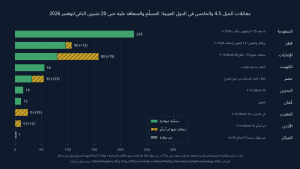
Morocco joins other Arab states that treat defence production as industrial policy. Saudi Arabia’s General Authority for Military Industries aims to localise more than 50% of military spending by 2030 and reported a rate of 24.89% at the end of 2024. The two targets are not directly comparable: Morocco’s measures coverage of armed forces and security needs by 2035, while the Saudi figure measures the local share of military spending by 2030.
Still to be disclosed
The published accounts of the ceremony do not break down the MAD 22 billion by partner or year. No date has been given for DIFAA’s legal creation, and no new private investors or industrial projects were named, as The Rio Times also notes. The sector already has a legal framework in Law 10-20 on defence and security equipment, weapons and ammunition.
Sources
- Hespress (Arabic): King chairs signing of two defence industry agreements
- Hespress FR: signature of two framework agreements
- Le360: MAD 22 billion, two agreements and a dedicated agency
- Yabiladi: signing of nearly 22 billion dirhams in deals
- The Rio Times: Morocco’s King Backs a Home Arms Industry
- GAMI: localisation of military spending reaches 24.89%