What Is a Cluster Munition and How Does It Work?
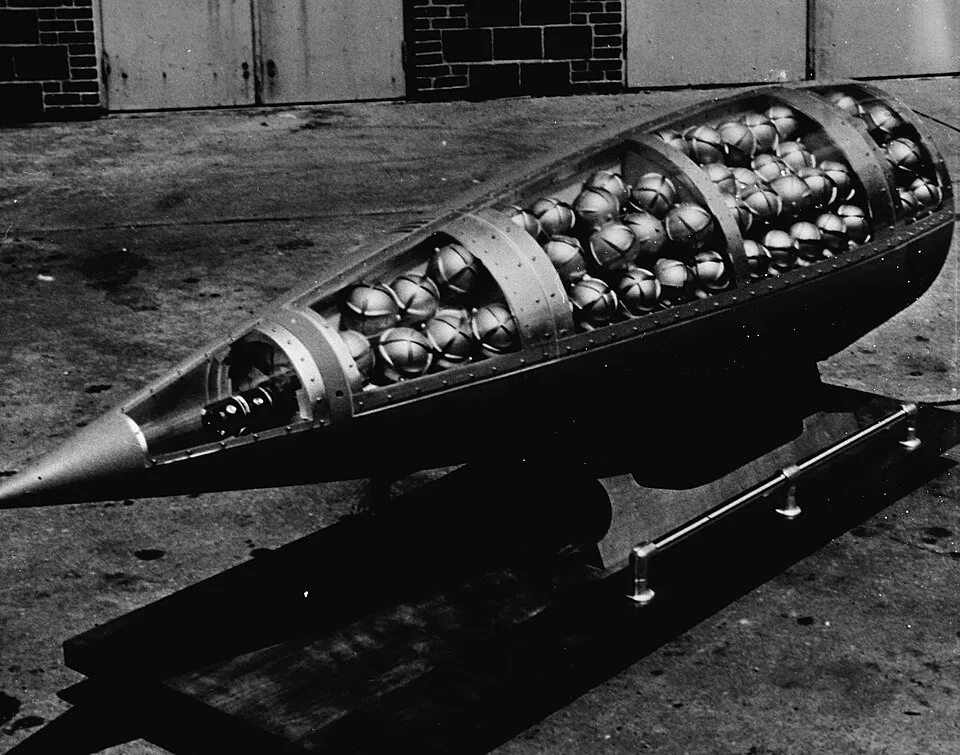
When an ordinary artillery shell or a conventional aerial bomb detonates, there is a single explosion at a single point. A cluster munition is different: it is a weapon – a bomb dropped from an aircraft, a rocket warhead, or an artillery shell – designed to open in the air at a set height and release from inside it dozens or hundreds of small explosive items, known as submunitions, which spread over a wide area of ground at once instead of striking a single point.
The purpose of this design is simple: some military targets are not a single point but a whole area, such as a formation of tanks halted in the open, a convoy of vehicles on a road, or an airfield full of scattered aircraft. A single precise munition hits only one point, whereas a cluster munition covers the whole patch.
Source: US Army (photographer Christina Ann Horne) via Wikimedia Commons (Public domain)
How does a cluster munition work?
Every cluster munition consists of an outer body (a dispenser) that carries a number of submunitions, plus a fuze or opening mechanism that determines when and why the outer body empties its payload. After launch or release, the mechanism – using a timer, air-pressure measurement or a command from a proximity fuze – opens the dispenser in the air at a pre-calculated height, so the submunitions scatter and each falls along its own path toward the ground.
Each submunition has its own independent fuze, and often fins or ribbons that stabilise its direction of fall and slow it slightly. On hitting the ground or a hard target, each submunition detonates individually. The result is that an entire area – possibly extending for hundreds of metres – receives dozens of small, almost simultaneous explosions instead of one large explosion at a single point.
Older generations of submunitions are not guided at all; they fall and explode on impact. Some newer generations, such as the “smart” submunitions of the American CBU-97 system, carry infrared sensors that detect the engine heat of an armoured vehicle before firing an explosively formed penetrator at it from a short distance, rather than relying on statistical probability alone.
What are its components?
- Outer body (dispenser): an aerial bomb, the warhead of a tactical or artillery rocket, or the body of a conventional artillery shell, which carries the submunitions and protects them until the moment of opening.
- Opening and dispensing mechanism: a time or barometric fuze (which measures air pressure to determine altitude) or a control device that opens the dispenser or blows off its cover at the calculated point on the trajectory.
- Submunitions: dozens or hundreds of small explosive items, which may be anti-personnel (fragmentation), anti-armour (shaped charge), dual-purpose combining both, or incendiary in some older models.
- Descent stabilisers: small fins or fabric ribbons that slow the fall of the submunition and give it a more stable orientation toward the target.
- Fuze of each submunition: a separate detonation mechanism for each item, usually armed moments after separation from the main dispenser. This is the link where a portion fail to function, turning the submunition into unexploded ordnance.
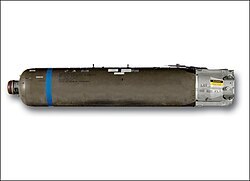
Source: US Air Force via Wikimedia Commons (Public domain)
What types of cluster munitions exist?
Cluster munitions are usually classified by the means that carries them to the target:
- Aerial bombs: dropped by aircraft and opening during their fall, such as the American CBU series or the Russian/Soviet RBK.
- Artillery shells: often known by the abbreviation DPICM (Dual-Purpose Improved Conventional Munition), fired from 155 mm howitzers or similar guns, with each shell carrying dozens of small submunitions.
- Rocket warheads: carried by long-range rocket artillery, such as the M26 rocket historically used with the HIMARS and M270 systems, or the 9M55K rocket of the Russian Smerch system.
They are also classified by the nature of the submunition itself: “unsmart” munitions that fall and explode on impact alone without any guidance, and “smart” munitions with limited guidance that use sensors to choose the moment of detonation more precisely against a particular armoured target, which in theory reduces the proportion of munitions that fail or strike unintended targets.
| System | Type | Delivery means | Submunitions | Manufacturing country |
|---|---|---|---|---|
| CBU-87 (Combined Effects Munition) | Dual-purpose aerial bomb | Aircraft | About 202 BLU-97 submunitions | United States |
| CBU-97 (Sensor Fuzed Weapon) | “Smart” anti-armour aerial bomb | Aircraft | 10 BLU-108 submunitions, each releasing 4 sensor-equipped projectiles | United States |
| M26 rocket (for the older MLRS and HIMARS systems) | Dual-purpose rocket warhead | 227 mm rocket launcher | About 644 M77 submunitions | United States |
| RBK-500 (in its various versions) | Multi-purpose aerial bomb | Aircraft | Dozens of anti-armour or incendiary submunitions depending on the version | Soviet Union / Russia |
| 9M55K rocket (for the Smerch system) | Fragmentation rocket warhead | 300 mm rocket launcher | About 72 9N235 submunitions | Soviet Union / Russia |
What a cluster munition is not
Many people confuse the cluster munition with other weapons that look similar in form but differ fundamentally in principle:
- It is not a thermobaric munition: a thermobaric bomb is a single explosion with a high-pressure, high-temperature blast wave at one point, with no scattering of independent submunitions.
- It is not a multiple nuclear warhead (MIRV): an intercontinental ballistic missile carrying several independently targetable nuclear warheads is a strategic deterrence system very different in purpose and scope, with no direct technical link to conventional cluster munitions.
- It is not a canister/flechette round: a direct-fire canister round bursts near the gun muzzle or directly in front of it to throw darts or metal balls over a very short distance, with no opening in the air and no independently armed submunitions.
- It is not merely a “high-explosive” bomb: a conventional bomb is a single body that explodes all at once, whereas a cluster munition carries separate bodies, each able to explode on its own in a different place from the others.
Why do cluster munitions raise legal and humanitarian controversy?
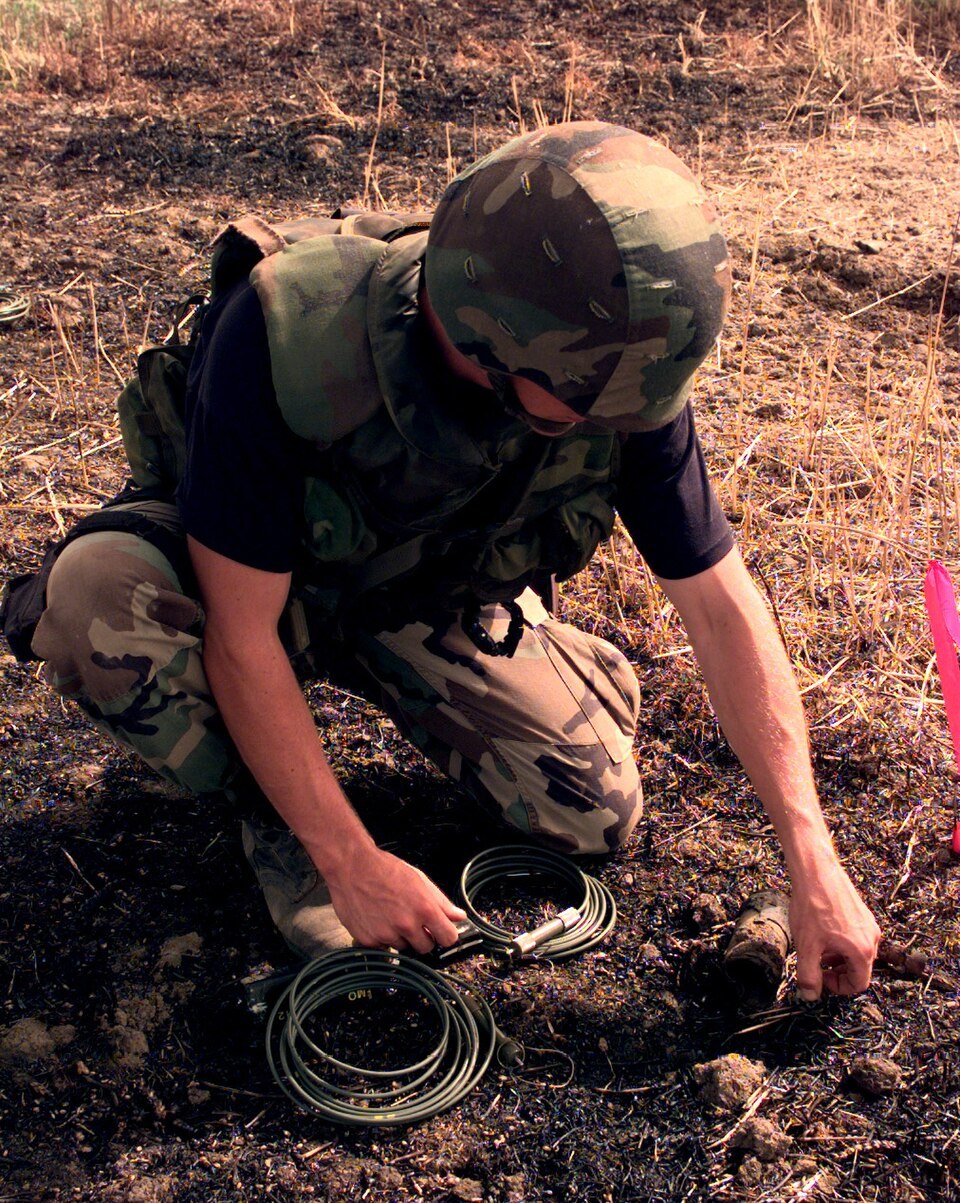
The core problem is not the moment of use but what follows it. A proportion of the submunitions – estimates vary by model, manufacturing quality and the ground on which they fell – do not explode on impact for any reason, whether a fuze fault or landing on soft ground that does not generate enough shock. These items remain on the ground or partly buried, live and capable of exploding, for years or even decades after the fighting ends, and are known as unexploded ordnance.
The danger falls disproportionately on civilians returning to their areas after the war, particularly children who may pick up a small coloured or metal object from the ground without knowing what it is. This has made cluster munitions a highly sensitive humanitarian and legal subject, alongside the debate about the accuracy of their original distribution in areas near civilians.
In response, a group of states adopted the Convention on Cluster Munitions in Oslo in 2008, which entered into force in 2010. It prohibits states parties from using, producing, stockpiling and transferring this type of weapon, and requires them to clear unexploded ordnance from their territory and assist its victims. However, major military powers including the United States, Russia and China have not joined the Convention, nor have most countries of the Middle East, which means the legal status of this weapon differs greatly depending on the state using it and whether it is a party to the Convention at all.
Examples from the Turkish and Arab defence industries
Turkey is not a state party to the Convention on Cluster Munitions, and its army historically held a stock of 155 mm DPICM cluster artillery shells within its artillery arsenal, some of which were produced locally by the Turkish company MKE alongside conventional ammunition. At the same time, the general trend in modern munitions manufacturing – in Turkey as in many other armies – is toward precision-guided munitions rather than unguided cluster munitions, because they achieve the required military effect with fewer rounds and lower risks of unexploded ordnance.
In Arab armies, cluster munitions are not a commonly cited item in announced modern arms deals, as most current procurement contracts in the region lean toward rocket artillery systems and precision-guided munitions as more modern alternatives, which reflects the same general global trend more than an individual regional policy.
Why does this concept matter?
The cluster munition is not a weapon found only in military archives; it appears constantly in reports on modern conflicts, in political debate over specific arms deals, and in human rights discussions about unexploded ordnance in post-war areas. Understanding how it works and its legal limits helps in reading such news more accurately, distinguishing lawful from unlawful use according to the obligations of the state concerned, and telling an accurate description of the weapon from a simplified or misleading one that confuses it with weapons completely different in nature.
For a closer understanding of this weapon’s components, see also our explainers on the proximity fuze that determines the moment munitions detonate, and on the tandem warhead, the glide bomb and JDAM as examples of other paths the munitions industry has taken toward precision instead of cluster dispersal. As for the carrier, many cluster rockets are fired from launchers similar to the HIMARS system, just as some self-propelled howitzers carry DPICM shells among their conventional ammunition.
For how the solid-propellant motor that drives the launcher-fired rockets carrying these munitions toward their target works, see the related file on the solid-propellant rocket motor.
Frequently asked questions
Sources