V-22 Osprey: How the Tiltrotor Works, Specifications and Operators
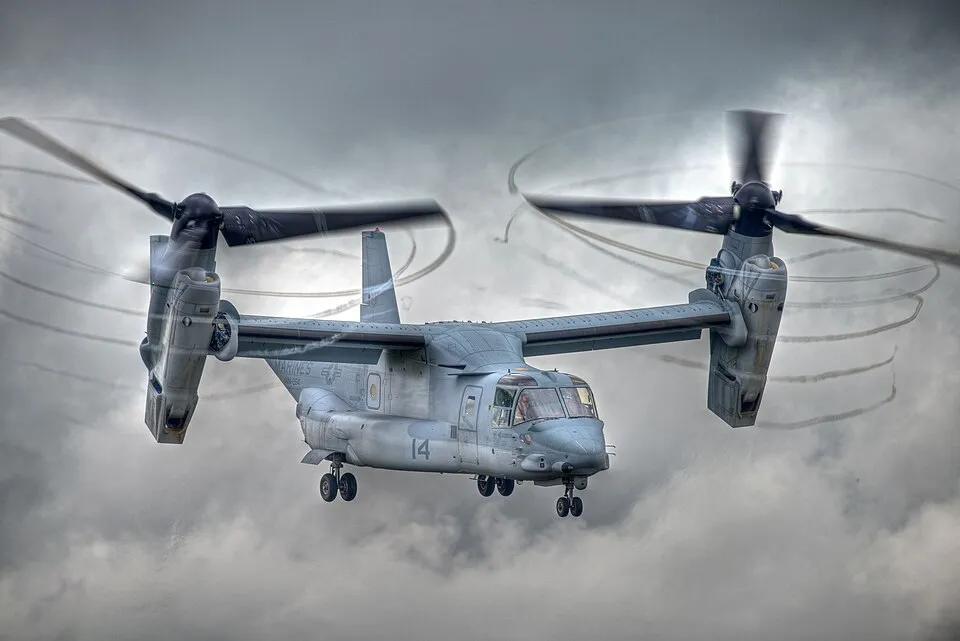
It takes off vertically like a helicopter, then tilts its engines forward to fly at the speed of a propeller aircraft. This is the “V-22 Osprey”, the first military tiltrotor aircraft to enter service on a large scale. It has appeared repeatedly in Gulf skies on US forces’ missions, and its name has also been linked to accidents that stirred controversy. This guide explains how the Osprey works, its official specifications, its variants and who operates it.
What is the V-22 Osprey?
The US Air Force describes the Osprey as an aircraft that combines the helicopter’s ability to take off vertically, hover and land vertically with the long range, fuel efficiency and speed of turboprop aircraft. It is built by a partnership of Bell and Boeing.
The idea is simple in theory and complex in engineering: at the tip of each wing is an engine and a huge rotor inside a “nacelle” that can be rotated. At take-off the two nacelles are vertical and the aircraft rises like a helicopter; after take-off they rotate gradually forward and the aircraft shifts into horizontal flight mode.
Osprey variants
- MV-22B: the US Marine Corps version, the most numerous, used to carry troops and equipment from amphibious ships to shore.
- CV-22B: the US Air Force special operations version, intended for the infiltration, exfiltration and resupply of special forces over long distances.
- CMV-22B: the US Navy version for carrying personnel and supplies to aircraft carriers.
Official specifications of the CV-22 Osprey
| Item | Value |
|---|---|
| Engines | Two Rolls-Royce AE1107C engines |
| Power | More than 6,200 horsepower per engine |
| Length | About 17.5 metres |
| Wingspan | About 25.5 metres |
| Rotor diameter | About 11.6 metres |
| Maximum weight | 60,500 pounds (about 27.4 tonnes) for self-deployment |
| Combat radius | 500 nautical miles (about 926 km) with an auxiliary tank |
| Payload | 24 seated personnel, or 32 on the floor, or 10,000 pounds (about 4.5 tonnes) of cargo |
| Armament | 12.7 mm machine gun on the rear ramp |
| Unit cost | 90 million dollars (January 2025) |
The Air Force says its programme includes 56 CV-22 aircraft by the end of 2025.
Why do armed forces need an aircraft like this?
A conventional helicopter is slow and limited in range, and a fixed-wing aircraft needs a runway. The Osprey, according to the US Air Force, performs missions that would normally require two different aircraft. It can carry a special forces team hundreds of kilometres at a much higher speed than a helicopter, then land in an area with no runway. This is why the Marines rely on it for deployment from amphibious ships, and special operations rely on it for night infiltration missions.
History and accidents
The two companies delivered the first two test aircraft of the CV-22 version to Edwards Air Force Base in September 2000, crew training began with the first two production aircraft in August 2006, Air Force Special Operations Command received the first operational aircraft in January 2007, and initial operational capability was reached in 2009.
However, the Osprey’s record has not been free of accidents. The development programme saw fatal accidents, and the crash of a CV-22 off Japan in November 2023 led to the temporary grounding of the US Osprey fleet before a gradual return to flight. The aircraft’s safety remains a subject of debate in Congress and the US media.
The Osprey in the Arab region
No Arab country operates the Osprey so far, and the only foreign operator is the Japan Ground Self-Defense Force. But the aircraft is strongly present in the region within US forces, whether aboard amphibious ships in the Gulf and the Red Sea or within special operations squadrons. The US Air Force published an official photograph of a CV-22 from the 8th Special Operations Squadron flying around Dubai in September 2021. Because the aircraft is expensive and complex to maintain, heavy helicopters such as the Chinook and transport aircraft such as the C-130J remain the more realistic choice for Arab armed forces.
Frequently asked questions about the Osprey
Is the Osprey an aircraft or a helicopter?
It is a tiltrotor aircraft that combines the two: it takes off and lands like a helicopter and flies horizontally like an aeroplane.
How many troops does the Osprey carry?
24 seated personnel or 32 on the floor, according to the US Air Force.
How much does the Osprey cost?
About 90 million dollars per aircraft of the CV-22 version, according to the 2025 fact sheet.
Do Arab countries own the Osprey?
No, and the only foreign operator at present is Japan.
Conclusion
The Osprey is a bold attempt to break the barrier between helicopter and aeroplane, and it succeeded in giving US forces a speed and range that helicopters did not provide. But it came at a high price and with a safety record that has been the subject of controversy, which explains why it remains an almost exclusively American weapon to this day.