Britain’s DragonFire laser weapon: £10 per shot and its entry-into-service date
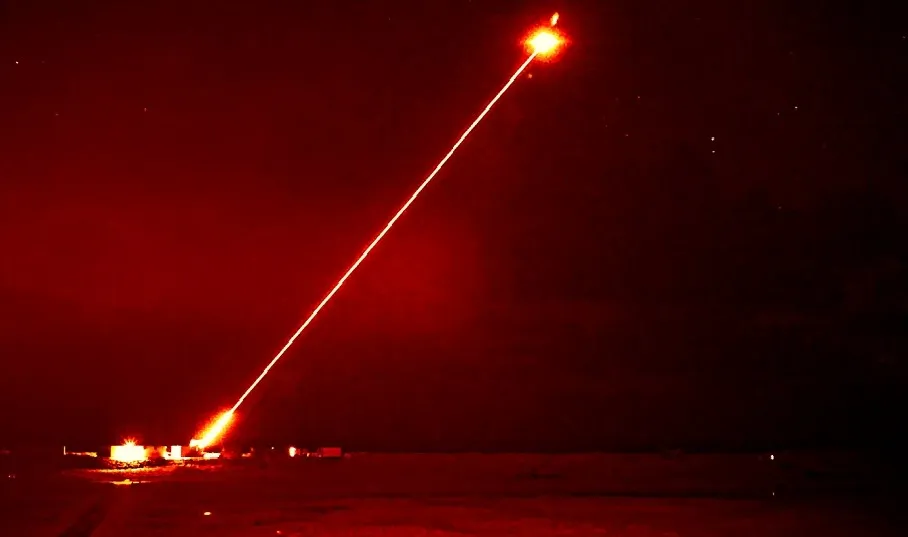
DragonFire is a high-energy laser weapon developed by the United Kingdom to intercept drones and aerial threats. The UK government says each shot costs only about £10 and that the system can hit a target the size of a pound coin from a kilometre away. On 20 November 2025 the Ministry of Defence awarded MBDA a £316 million contract to fit the system to a Type 45 destroyer by 2027.
Quick facts
| Type | High-energy laser weapon (directed energy) |
|---|---|
| Developers | Dstl, MBDA, Leonardo and QinetiQ |
| Cost per shot | About £10 |
| Stated accuracy | Hitting a pound coin from 1 km |
| Manufacturing contract | £316 million to MBDA (20 November 2025) |
| First platform | Type 45 destroyer in 2027 |
| Trials | Downing drones flying at 650 km/h |
Programme timeline
| Date | Milestone | Status |
|---|---|---|
| Before 2024 | First static high-power firing of a UK laser capability, and demonstrations of high-precision tracking of moving air and maritime targets | Trials |
| 19 January 2024 | First UK high-power firing of a laser weapon against aerial targets at the Ministry of Defence’s Hebrides range | Successful test |
| April 2024 | Announcement that entry into service would be accelerated to 2027 instead of 2032 under a new procurement model | Government decision |
| 20 November 2025 | £316 million contract for MBDA UK, and announcement that high-speed drones were downed in new trials | Manufacturing contract |
| 2027 (planned) | Fitting the system to a Royal Navy Type 45 destroyer | Not yet in service |
Note: as of publication, DragonFire is a system in the testing and contracting phase; its entry into operational service or use in actual combat has not been announced.
How does DragonFire work?
The UK Ministry of Defence describes DragonFire as a “laser directed energy weapon” (LDEW) that engages targets at the speed of light, focusing an intense beam of light on a single point of the target until it causes structural failure, or a more dramatic result if aimed at the warhead. According to the Royal Navy, the beam typically needs to be held on the same spot for about ten seconds. The government says firing it for ten seconds costs the equivalent in energy of running a standard household heater for an hour.
The system’s range is classified, but it is a “line-of-sight” weapon that can engage any visible target. In the November 2025 trials, the UK government announced a “UK first” in tracking, targeting and downing drones beyond the horizon, drones reaching speeds of up to 650 km/h.
Who makes what?
- Defence Science and Technology Laboratory (Dstl): led the programme on behalf of the Ministry of Defence.
- MBDA UK: the prime contractor and holder of the £316 million contract, in partnership with QinetiQ and Leonardo.
- Leonardo UK: developed the “beam director” that directs the laser energy towards the target, according to the company’s statement in the government release.
- QinetiQ: a development and testing partner, which says it will accelerate production of the system’s core technology.
Ministry of Defence statements indicate that the earlier development phase was the result of a joint investment of around £100 million between the ministry and industry, and that the new contract supports nearly 590 jobs, including 200 in Scotland, 185 in the south-west of England and 75 in the east of England.
What does “minimum deployable capability” mean?
For this programme the UK adopted a model based on rapidly delivering a “Minimum Deployable Capability” to the forces, followed by continued development and improvement after entry into service, rather than waiting for a complete system. According to the government, this approach is what allowed the in-service date to be brought forward by about five years from the original 2032 plan.
Why do lasers matter against drones?
Attacks with cheap drones in the region expose an unbalanced cost equation: an interceptor missile costing hundreds of thousands or millions of dollars to down a drone that costs no more than tens of thousands. Lasers offer a low cost-per-shot solution, with a theoretically unlimited “magazine” as long as power is available. However, they are affected by weather conditions such as dust and fog, and need to keep the beam on the target for seconds.
Laser versus interceptor missile: a quick comparison
| Criterion | DragonFire (laser) | Conventional interceptor missile |
|---|---|---|
| Cost of engagement | About £10 per shot | “Hundreds of thousands of pounds or more” per shot, according to the UK government |
| Magazine | Limited by the availability of power and cooling, not by the number of rounds | Limited by the number of missiles loaded |
| Engagement time | Needs to keep the beam on the target for about 10 seconds | Depends on the missile’s flight time |
| Limitations | Line of sight only; affected by dust and fog | Depends on the missile’s range and guidance type |
The UK Ministry of Defence describes the laser as a potential long-term, low-cost alternative for some tasks currently performed by missiles, such as downing attack drones; in other words, it complements missile-based air defence systems rather than fully replacing them, while also easing pressure on conventional munition stocks.
DragonFire versus Iron Beam
DragonFire shares the concept of the Israeli Iron Beam system, but it was designed first for naval use. The UK government describes DragonFire as the first high-energy laser weapon developed by a European country, as part of a plan to invest around £1 billion in directed-energy weapons. For comparison: Iron Beam, the counter-drone laser weapon, and What is an EMP weapon?.
Frequently asked questions
How much does a DragonFire shot cost?
About £10, according to the UK government.
When will DragonFire enter service?
It is scheduled to be fitted to the first Type 45 destroyer in 2027.
Who makes DragonFire?
A consortium led by MBDA with Leonardo and QinetiQ, overseen by the government laboratory Dstl.
What is DragonFire’s range?
The range is classified according to the UK Ministry of Defence, but it is a line-of-sight weapon capable of engaging any visible target.
Has DragonFire been used in combat?
No, no combat use has been announced so far; the system is in the testing and contracting phase and is scheduled to be fitted to a Type 45 destroyer in 2027.
Main image: test firing of the UK DragonFire laser system. Source: UK Ministry of Defence via Wikimedia Commons – OGL v3.
Sources
- GOV.UK – Boost for Armed Forces as new laser weapon takes down high-speed drones (20 Nov 2025)
- GOV.UK – New procurement rules help rapid fitting of military laser to Royal Navy ships
- GOV.UK / Dstl – Advanced future military laser achieves UK first (19 Jan 2024)
- Royal Navy – Laser downs drones in successful trial (19 Jan 2024)
- UK Parliament – Written answer (20 April 2026)