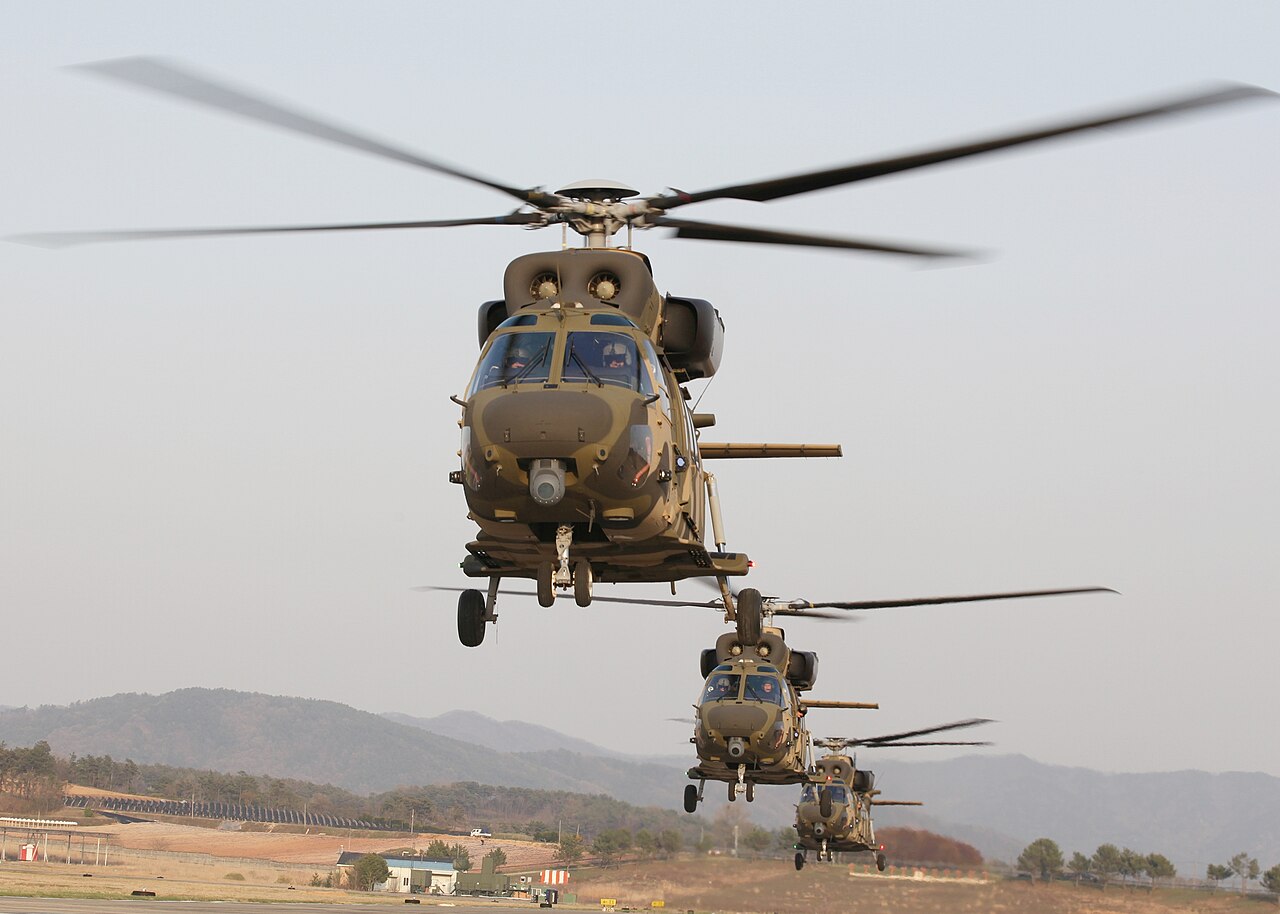
KUH-1 Surion helicopters for Iraq
 Iraq ←
 South Korea
Deal progress
Current status: Contract signed — latest milestone in 2024. Not every deal goes through every stage; a government sale approval, for example, applies only in some supplier countries.
Deal details
The deal covers KUH-1 Surion helicopters for Iraq, supplied by South Korea; KAI is listed as the manufacturer. It is classed under helicopters. The quantity has not been disclosed, and the value is put at about $94 million.
The two sides have signed a final contract. The most recent major milestone came in 2024, and completion of deliveries has not yet been announced.
Details: Contract signed in December 2024, with deliveries running to 2029.
What is the KUH-1 Surion helicopter?
The Surion is a multi-role transport helicopter developed by Korea Aerospace Industries (KAI) in partnership with Eurocopter, now Airbus Helicopters, with the Korean side accounting for 70% of the research and development work. It was brought in to replace the South Korean Army’s ageing UH-1H and 500MD helicopters, first flew on 10 March 2010 and entered service in 2012.
The helicopter moves troops and supplies and flies medical evacuation and search and rescue missions. It carries two pilots, two gunners and nine troops, or two pilots and 16 troops without the gunners. The gunners man machine guns at the side doors to cover the helicopter during troop insertions. It is the product of Korea’s first programme to develop a home-grown helicopter, and KAI later derived specialised versions from it.
Capabilities and performance
The Surion is powered by two General Electric T700 turboshaft engines, has a maximum take-off weight of 8709 kg and a maximum cruise speed of 259 km/h. Having two engines means it can keep flying if one fails, a key advantage over the mountainous terrain that covers most of the Korean peninsula. The engines are built under licence in South Korea as part of a policy to raise local content in the programme. The helicopter has a digital glass cockpit with multifunction displays and an autopilot.
The South Korean Army ordered 245 helicopters from 2012, and the family later grew to include the Marineon amphibious version for the Republic of Korea Marine Corps, along with medical evacuation, police and firefighting versions used by civil government agencies. Using one airframe for all these roles allows training, maintenance and spare parts to be standardised across operators, which was Seoul’s aim when it launched the programme.
Key specifications
| Role | Troop and supply transport, medical evacuation, search and rescue |
|---|---|
| Manufacturer | Korea Aerospace Industries (KAI) in partnership with Airbus Helicopters |
| First flight | 10 March 2010 |
| Entered service | 2012 |
| Engines | 2 × General Electric T700 |
| Capacity | 2 pilots and 16 troops |
| Maximum take-off weight | 8709 kg |
| Maximum cruise speed | 259 km/h |