BARKAN vs Global Combat UGVs: BARKAN, THeMIS and Uran-9 Compared

Last updated: September 22, 2026
As combat unmanned ground vehicles (UGVs) move from prototypes into real operational fleets worldwide, it’s worth placing Türkiye’s BARKAN, built by HAVELSAN, alongside its most-discussed global peers: Estonia’s THeMIS from Milrem Robotics, and Russia’s Uran-9. This comparison draws on specifications and operational track records available from open sources.
Technical Comparison
| Criterion | BARKAN | THeMIS | Uran-9 |
|---|---|---|---|
| Country of origin | Türkiye (HAVELSAN) | Estonia (Milrem Robotics) | Russia |
| Mobility | Wheeled | Tracked | Tracked |
| Approximate weight | ~1 ton | 1.6–2 tons depending on payload | ~10-12 tons |
| Top speed | Up to 25 km/h | ~20 km/h | ~35 km/h |
| Service status | Operational since 2023 | Fielded with multiple NATO militaries since roughly 2015 | Trial-deployed in Syria in 2018 |
| Primary role | Reconnaissance and fire support | Modular multi-role (logistics, casualty evacuation, weapon stations) | Direct armed combat |
Figures are approximate, based on manufacturer specifications and open-source reporting; they vary by variant and payload configuration.
BARKAN: Early Operational Maturity
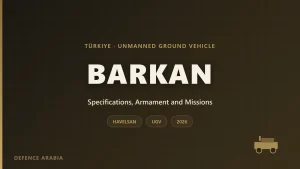
What sets BARKAN apart is that it reached real operational deployment as early as 2023 — moving past the prototype stage relatively quickly compared to most of its weight class. The third generation, BARKAN 3, announced in May 2026, adds AI-assisted autonomous navigation and swarm coordination between multiple vehicles, putting it on an advanced development track relative to its first generation. Read the full BARKAN guide →
THeMIS: The European Modular Standard
Developed by Estonia’s Milrem Robotics, THeMIS is among the most widely deployed unmanned ground vehicles in NATO militaries, adopted by several European states including France, the United Kingdom, and the Netherlands across various trial and operational programs. Its modular design allows different payloads to be mounted on the same chassis — from cargo transport and casualty evacuation to weapon turrets and reconnaissance sensors — giving it broader operational flexibility than most single-mission-designed platforms.
Uran-9: Documented Operational Challenges
Russia trial-deployed its armed Uran-9 UGV in Syria in 2018, but open-source reporting — including a 2019 analysis from the UK’s RUSI think tank — documented operational problems the vehicle encountered in the field, including limited remote-control range in complex urban terrain and mechanical issues with its track system during field testing. This episode is frequently cited in military literature as an example of the gap between laboratory performance and real-world field performance for heavier UGVs of this class.
How BARKAN Compares to Türkiye’s HANÇER
Within the Turkish family itself, BARKAN differs from Elektroland Defense’s HANÇER mainly in mobility: BARKAN is wheeled, lighter, and faster (up to 25 km/h), while HANÇER is tracked, slightly heavier (650 kg), and slower (15 km/h) but built for greater stability on rough terrain. A fuller breakdown is available in our complete guide to Turkish unmanned ground vehicles.
Why This Matters for Arab Militaries
When evaluating UGV procurement options, BARKAN stands out as a platform that has already reached operational maturity and real production, unlike some competing systems that remain in trial phases or have faced documented field challenges. That maturity — combined with Türkiye’s established industrial base and export experience built up through its drone program — makes Turkish UGV systems worth serious consideration in any modernization comparison.
FAQ
Sources
- Army Recognition — HAVELSAN’s BARKAN 3 Armed UGV (2026)
- Milrem Robotics — THeMIS Official Page
- RUSI — Analysis on Russian Ground Robotic Vehicles
- Defence Turkey — Türkiye’s New Breakthrough on the Field: Unmanned Ground Vehicles